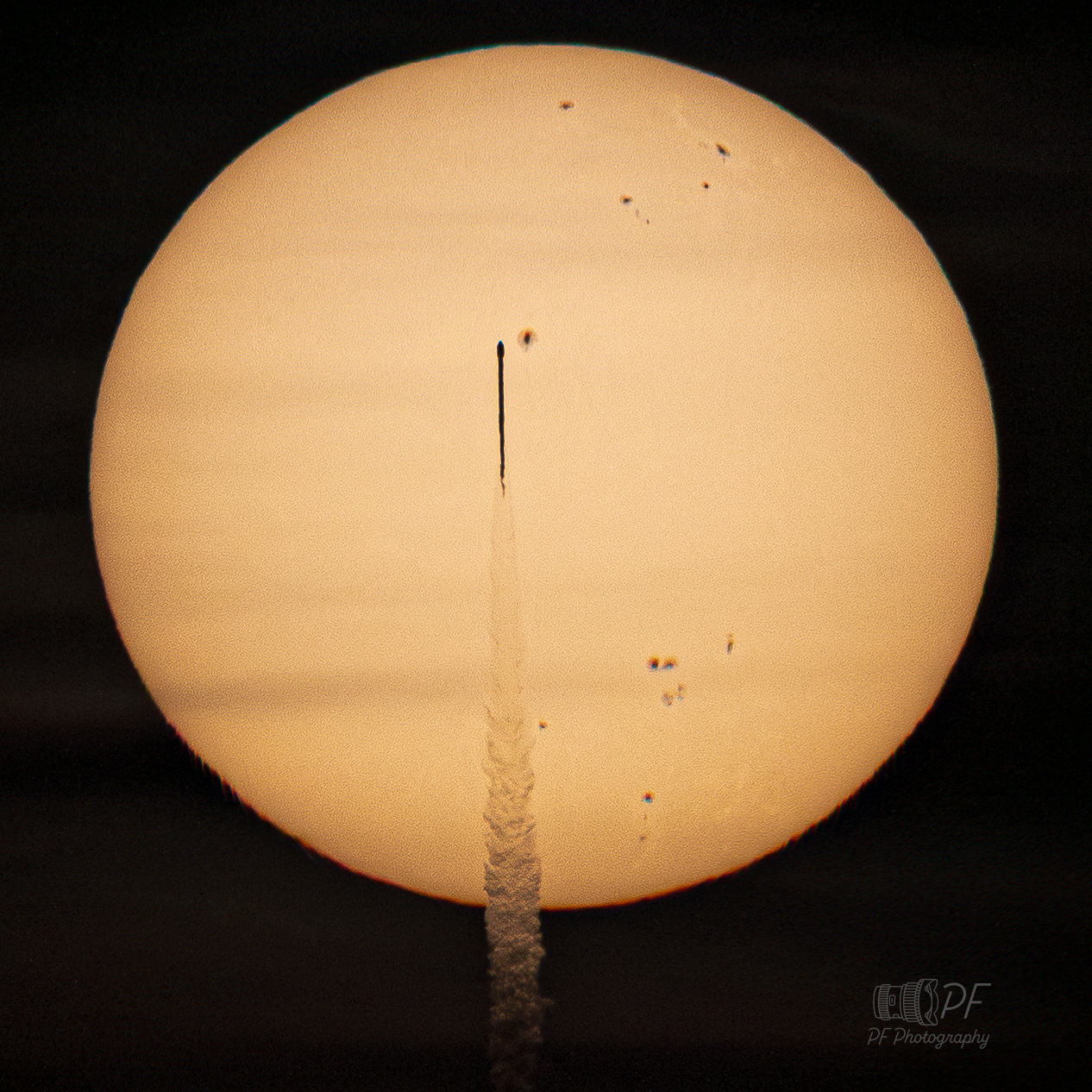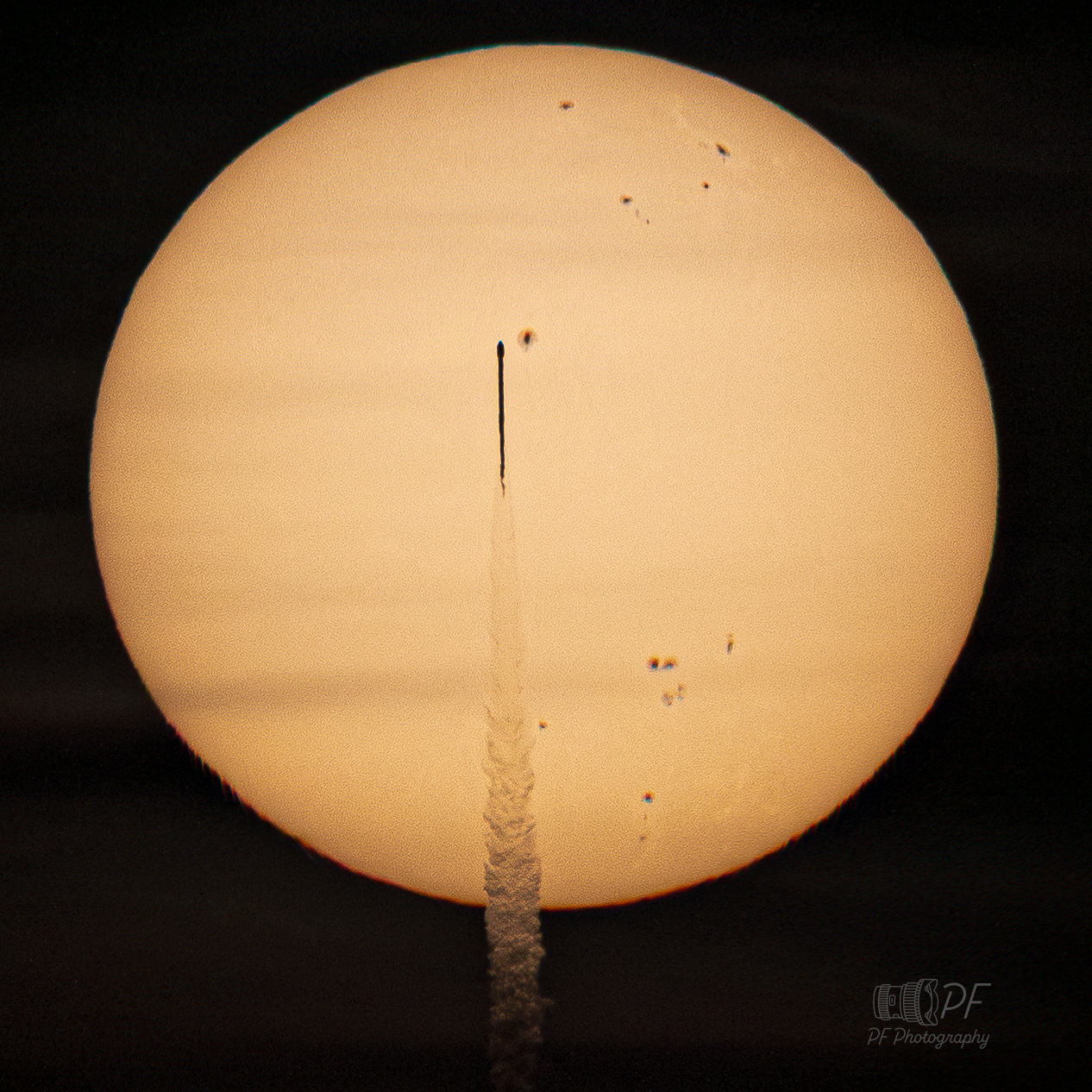
On the morning of September 24 a rocket crosses the bright solar disk in this long range telescopic snapshot captured from Orlando, Florida. That's about 50 miles west of its Kennedy Space Center launch site. This rocket carried three new space weather missions to space. Signals have now been successfully acquired from all three - NASA's Interstellar Mapping and Acceleration Probe, NASA’s Carruthers Geocorona Observatory, and the National Oceanic and Atmospheric Administration (NOAA) Space Weather Follow-On Lagrange 1 (SWFO-L1) - as they begin their journey to L1, an Earth-Sun lagrange point. L1 is about 1.5 million kilometers in the sunward direction from planet Earth. Appropriately, major space weather influencers, aka dark sunspots in active regions across the Sun, are posing with the transiting rocket. In fact, large active region AR4225 is just right of the rocket's nose.
En la mañana del 24 de septiembre, un cohete cruza el brillante disco solar en esta imagen capturada a distancia con un telescopio desde Orlando, Florida. Ese lugar se encuentra a unos 50 millas al oeste del sitio de lanzamiento del Centro Espacial Kennedy. Este cohete transportó tres nuevas misiones de clima espacial al espacio. Se han recibido con éxito señales de los tres - la NASA's Interstellar Mapping and Acceleration Probe, la NASA’s Carruthers Geocorona Observatory, y la National Oceanic and Atmospheric Administration (NOAA) Space Weather Follow-On Lagrange 1 (SWFO-L1) - mientras comienzan su viaje hacia L1, un punto lagrangeano entre la Tierra y el Sol. L1 se encuentra a unos 1.5 millones de kilómetros en la dirección hacia el Sol desde la Tierra. Apropiadamente, influenciadores importantes del clima espacial, es decir, manchas solares oscuras en regiones activas del Sol, aparecen junto con el cohete en tránsito. De hecho, la gran región activa AR4225 está justo a la derecha de la punta del cohete.