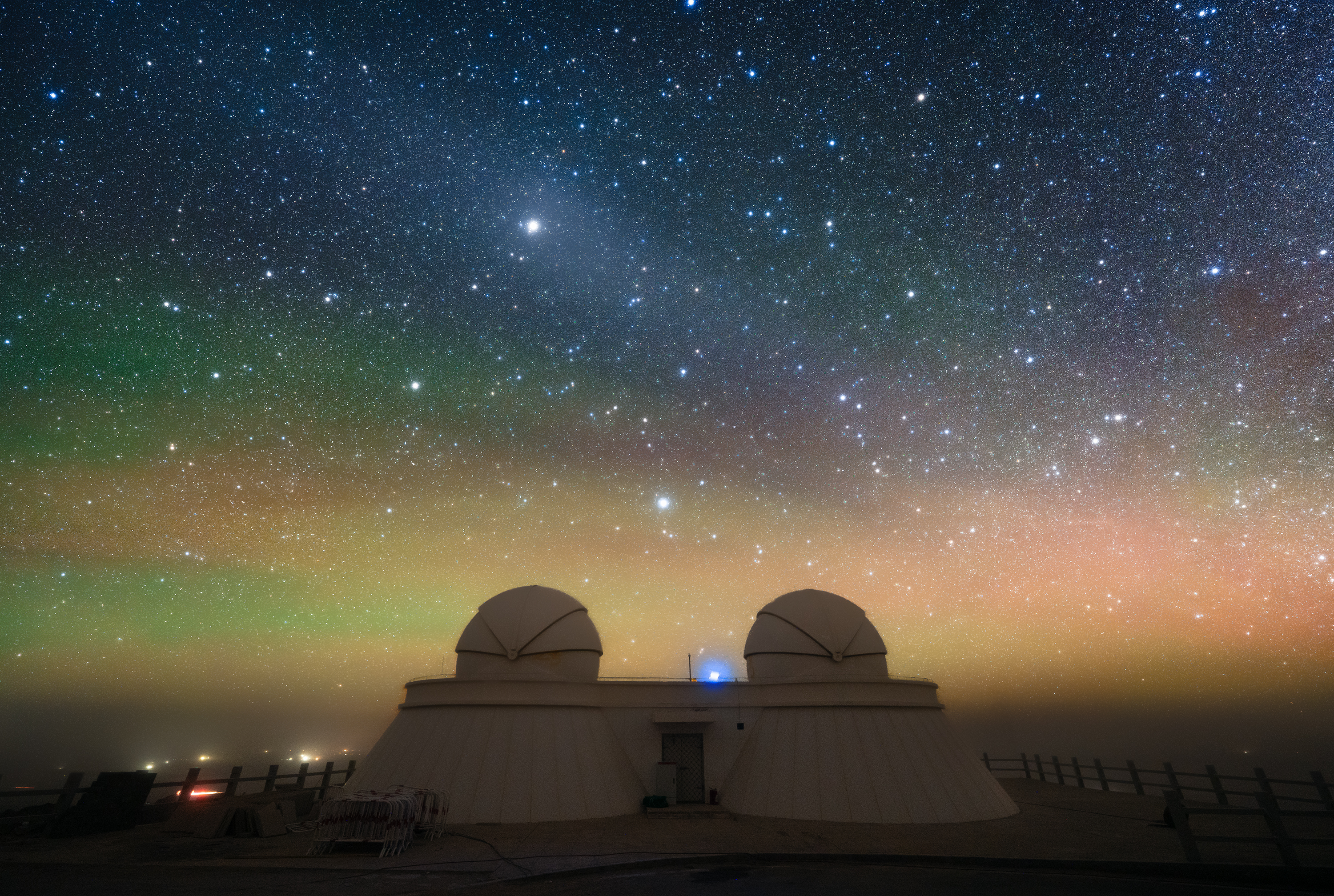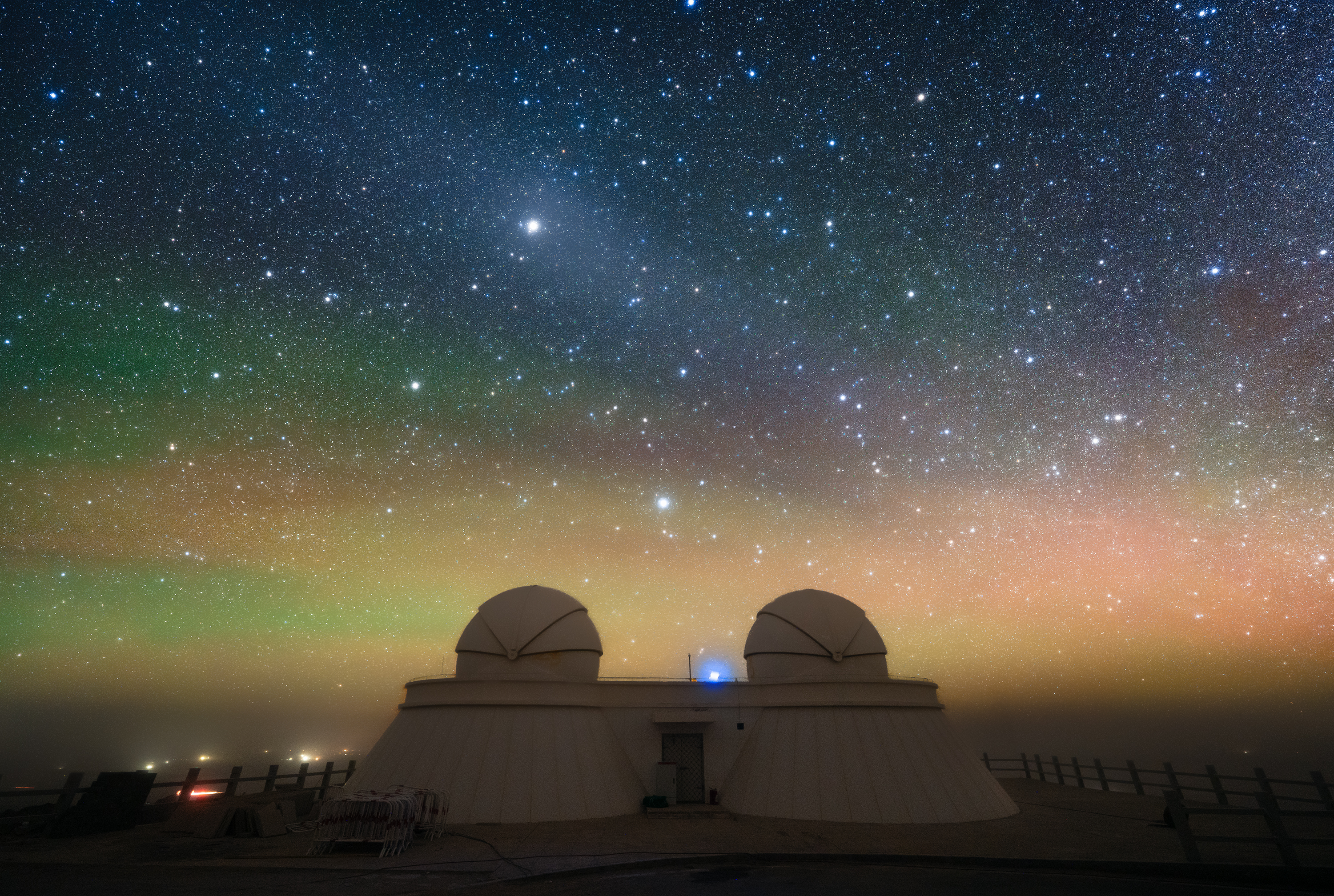
This year Saturn was at opposition on September 21, opposite the Sun in planet Earth's sky. At its closest to Earth, Saturn was also at its brightest of the year, rising as the Sun set and shining above the horizon all night long among the fainter stars of the constellation Pisces. In this snapshot from the Qinghai Lenghu Observatory, Tibetan Plateau, southwestern China, the outer planet is immersed in a faint, diffuse oval of light known as the gegenschein or counter glow. The diffuse gegenschein is produced by sunlight backscattered by interplanetary dust along the Solar System's ecliptic plane, opposite the Sun in planet Earth's sky. Like a giant eye, on this dark night Saturn and gegenschein seem to stare down on the observatory's telescope domes from their antisolar perspective. Strong atmospheric airglow forms a colorful background along the horizon.
Crédito: Qinghai Lenghu Observatory En este año, Saturno estuvo en oposición el 21 de septiembre, opuesto al Sol en el cielo terrestre. En su punto más cercano a la Tierra, Saturno también fue el más brillante del año, apareciendo cuando el Sol se ponía y brillando sobre el horizonte toda la noche entre las estrellas más tenues de la constelación de Piscis. En esta instantánea del Observatorio Qinghai Lenghu, en el Plateau de Tíbet, sudoeste de China, el planeta exterior está inmerso en una débil y difusa elipse de luz conocida como gegenschein o brillo contraste. El gegenschein difuso es producido por la luz solar retrodispersada por el polvo interplanetario a lo largo del plano de la eclíptica del Sistema Solar, opuesto al Sol en el cielo terrestre. Como un ojo gigante, en esta noche oscura, Saturno y el gegenschein parecen observar hacia abajo sobre los domos del telescopio del observatorio desde su perspectiva antisolar. Un fuerte resplandor atmosférico forma un fondo colorido a lo largo del horizonte.