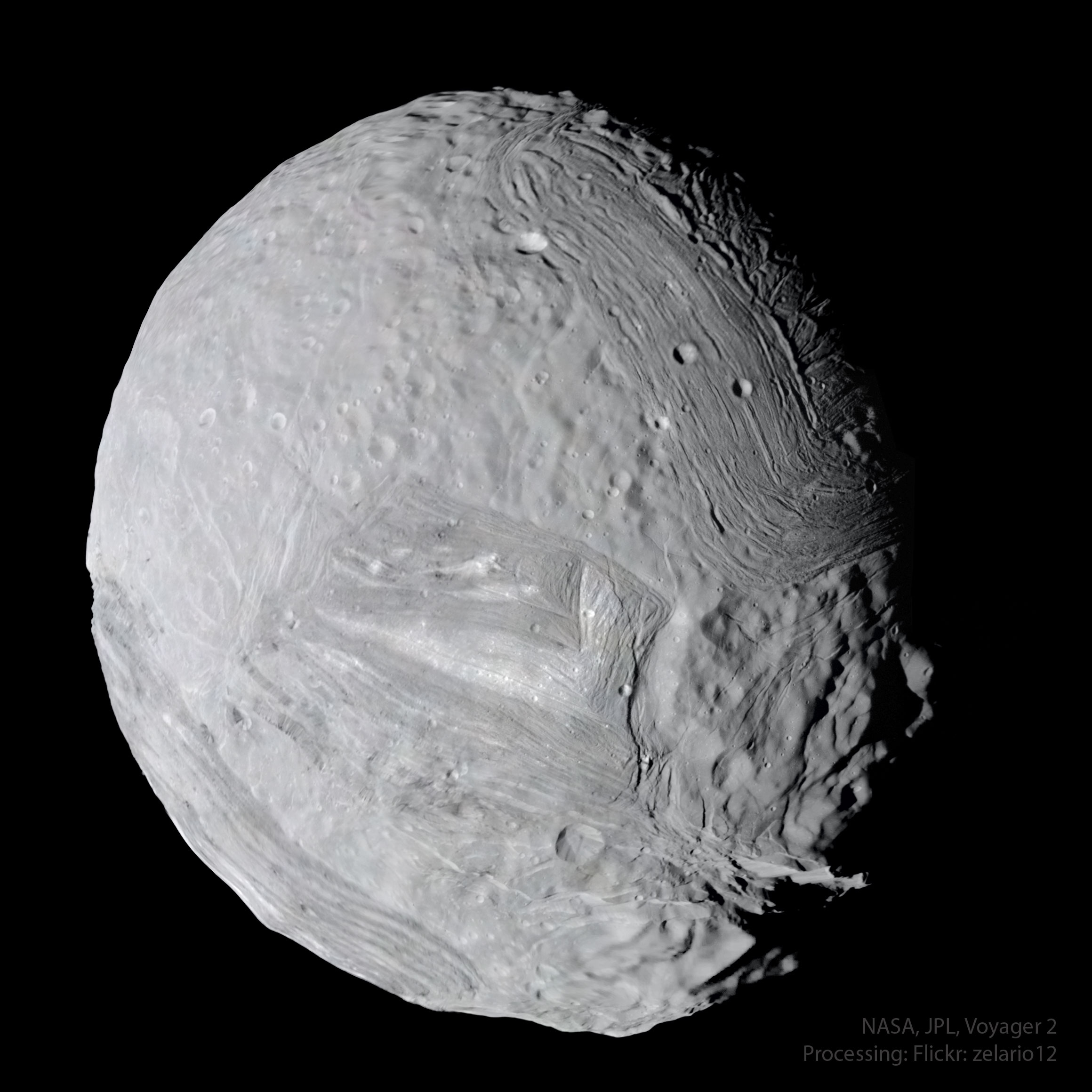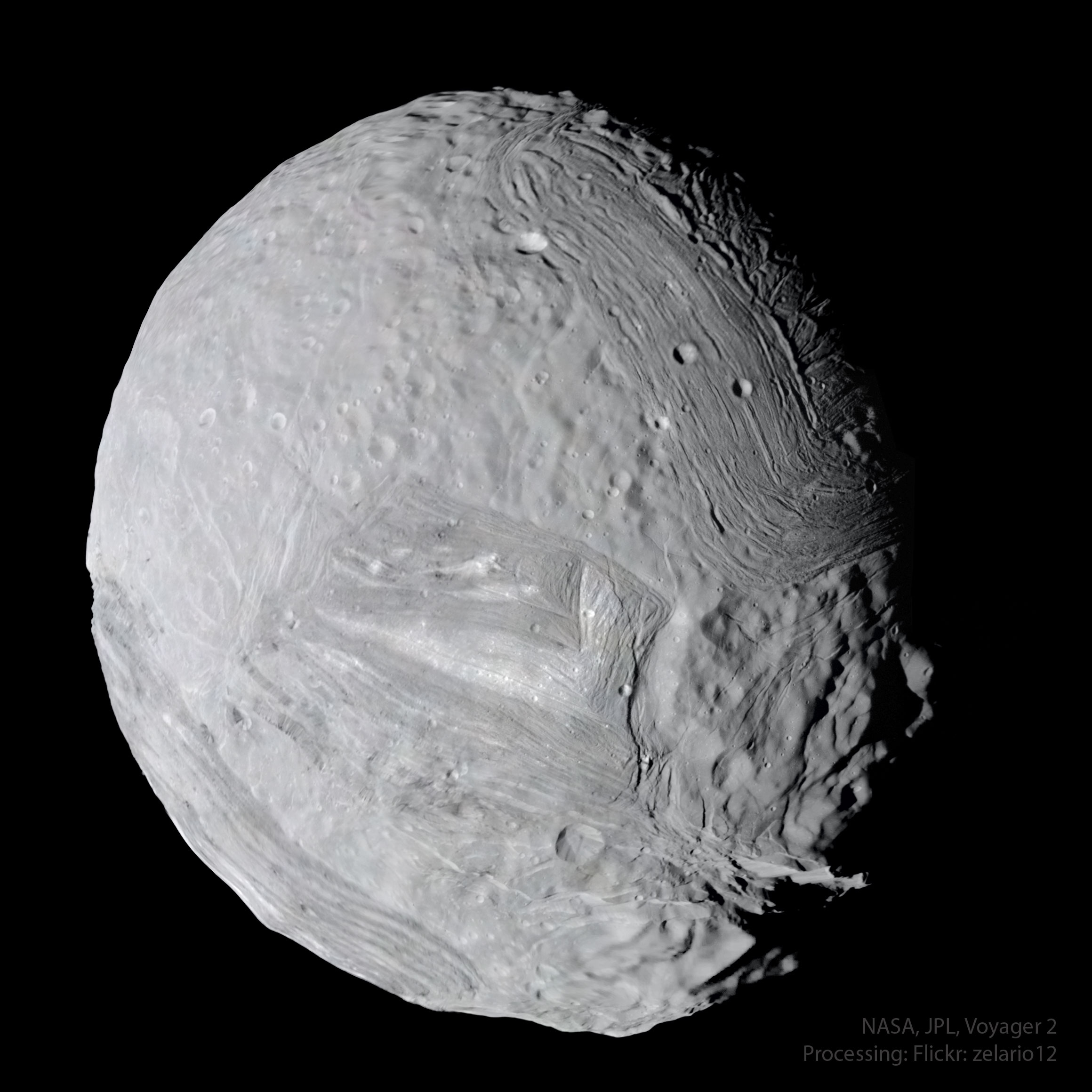
What is Miranda really like? Visually, old images from NASA's Voyager 2 have been recently combined and remastered to result in the featured image of Uranus's 500-kilometer-wide moon. In the late 1980s, Voyager 2 flew by Uranus, coming close to the cratered, fractured, and unusually grooved moon -- named after a character from Shakespeare’s The Tempest. Scientifically, planetary scientists are using old data and clear images to theorize anew about what shaped Miranda's severe surface features. A leading hypothesis is that Miranda, beneath its icy surface, may have once hosted an expansive liquid water ocean which may be slowly freezing. Thanks to the legacy of Voyager 2, Miranda has joined the ranks of Europa, Titan, and other icy moons in the search for water, and, possibly, microbial life, in our Solar System. Jigsaw Moon: Astronomy Puzzle of the Day
¿Cómo es Miranda en realidad? Visualmente, imágenes antiguas de la sonda Voyager 2 de la NASA han sido recientemente combinadas y reprocesadas para obtener la imagen destacada de esta luna de Urano, de 500 kilómetros de diámetro. A finales de la década de 1980, la Voyager 2 sobrevoló Urano, acercándose a esta luna craterizada, fracturada y con surcos inusuales, cuyo nombre proviene de un personaje de La Tempestad de Shakespeare. Desde el punto de vista científico, los planetólogos están utilizando datos antiguos e imágenes nítidas para formular nuevas teorías sobre qué dio forma a los pronunciados rasgos superficiales de Miranda. Una hipótesis destacada sugiere que Miranda, bajo su superficie helada, pudo haber albergado en el pasado un vasto océano de agua líquida que podría estar congelándose lentamente. Gracias al legado de la Voyager 2, Miranda se ha unido a Europa, Titán y otras lunas heladas en la búsqueda de agua y, posiblemente, de vida microbiana en nuestro Sistema Solar. Luna Rompecabezas: Astronomy Puzzle of the Day