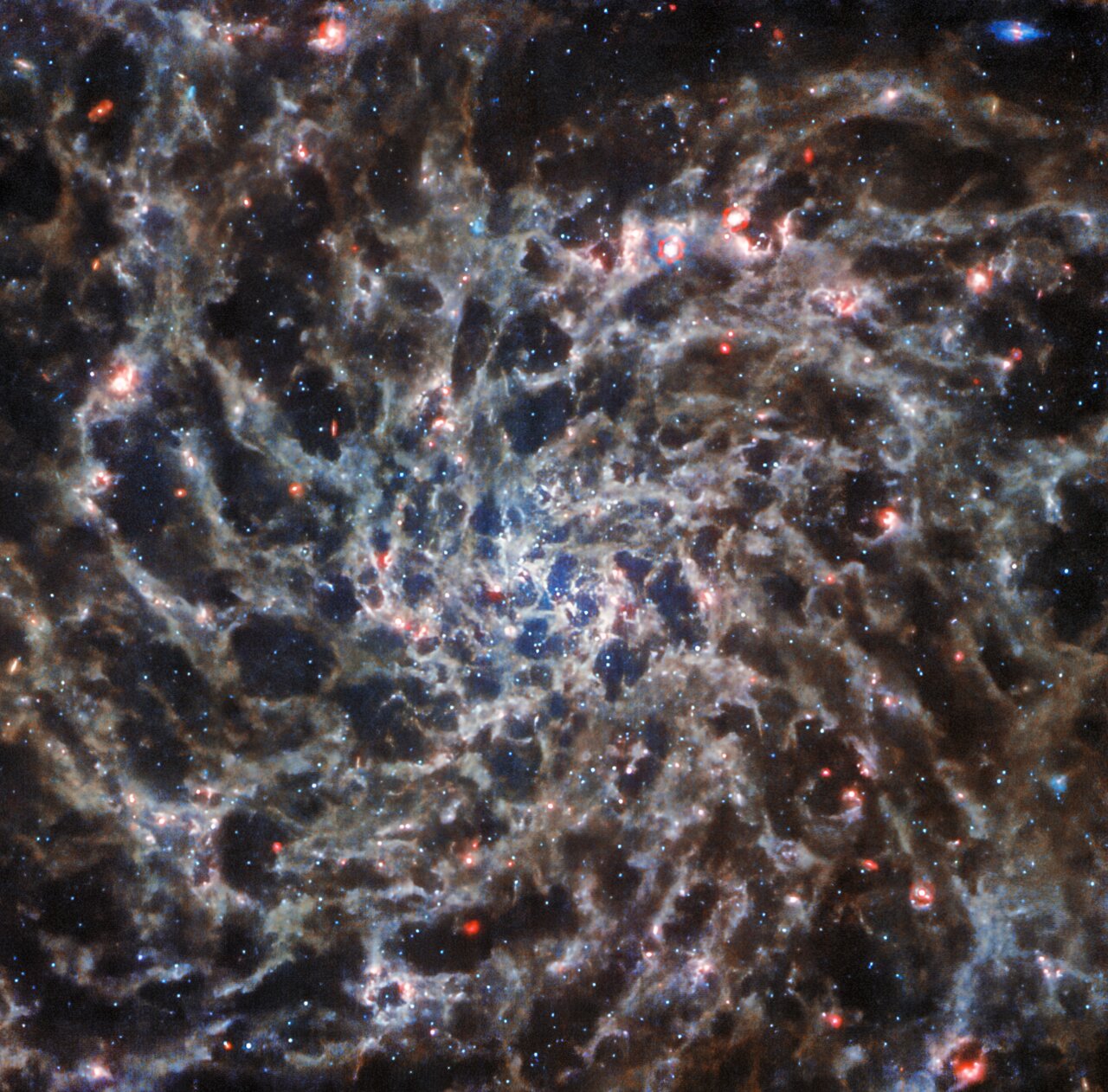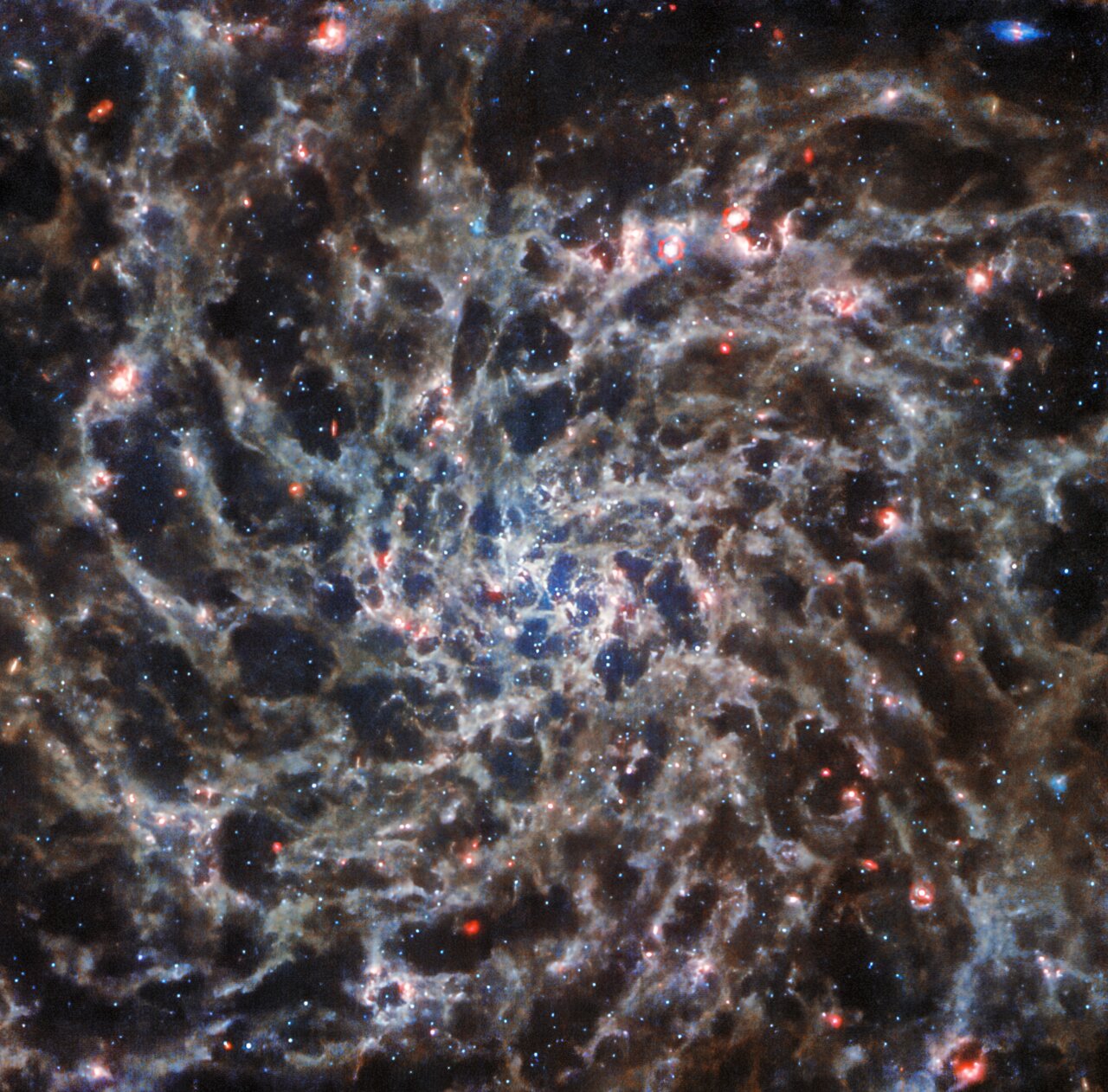
What does the universe look like through infrared goggles? Our eyes can only see visible light, but astronomers want to see more. Today’s APOD shows spiral galaxy IC 5332 as seen by two NASA telescopes: Webb in mid-infrared and Hubble in ultraviolet and visible light. To toggle between the two space-based views just slide your cursor over the image (or follow this link). The Hubble image highlights the spiral arms of the galaxy separated by dark regions, whereas the Webb image reveals a finer, more tangled structure. Interstellar dust scatters and absorbs light from the stars in the galaxy, causing the dark dust lanes in the Hubble image, and then emits heat in infrared light, so dust glows in this Webb image. The Mid-InfraRed Instrument on Webb needs to operate at a chilling temperature of -266ºC (or - 447ºF), otherwise it would detect infrared radiation from the telescope itself. Combining these observations, astronomers connect the “small scale” of gas and stars to the truly large scale of galactic structure and evolution.
¿Cómo se ve el universo con gafas de infrarrojos? Nuestros ojos solo pueden ver la luz visible, pero los astrónomos desean ver más allá. La imagen de hoy de APOD muestra la galaxia espiral IC 5332 tal como la observan dos telescopios de la NASA: Webb en el rango del infrarrojo medio y Hubble en luz ultravioleta y visible. Para alternar entre las dos vistas desde el espacio, simplemente mueva el cursor sobre la imagen (o siga este enlace). La imagen de Hubble resalta los brazos espirales de la galaxia separados por regiones oscuras, mientras que la imagen de Webb revela una estructura más fina y enredada. El polvo interestelar dispersa y absorbe la luz de las estrellas de la galaxia, causando las franjas oscuras de polvo en la imagen de Hubble, y luego emite calor en forma de luz infrarroja, por lo que el polvo brilla en esta imagen de Webb. El Instrumento de Infrarrojo Medio de Webb debe operar a una temperatura heladora de -266ºC (o -447ºF), de lo contrario detectaría radiación infrarroja proveniente del telescopio mismo. Al combinar estas observaciones, los astrónomos conectan la escala