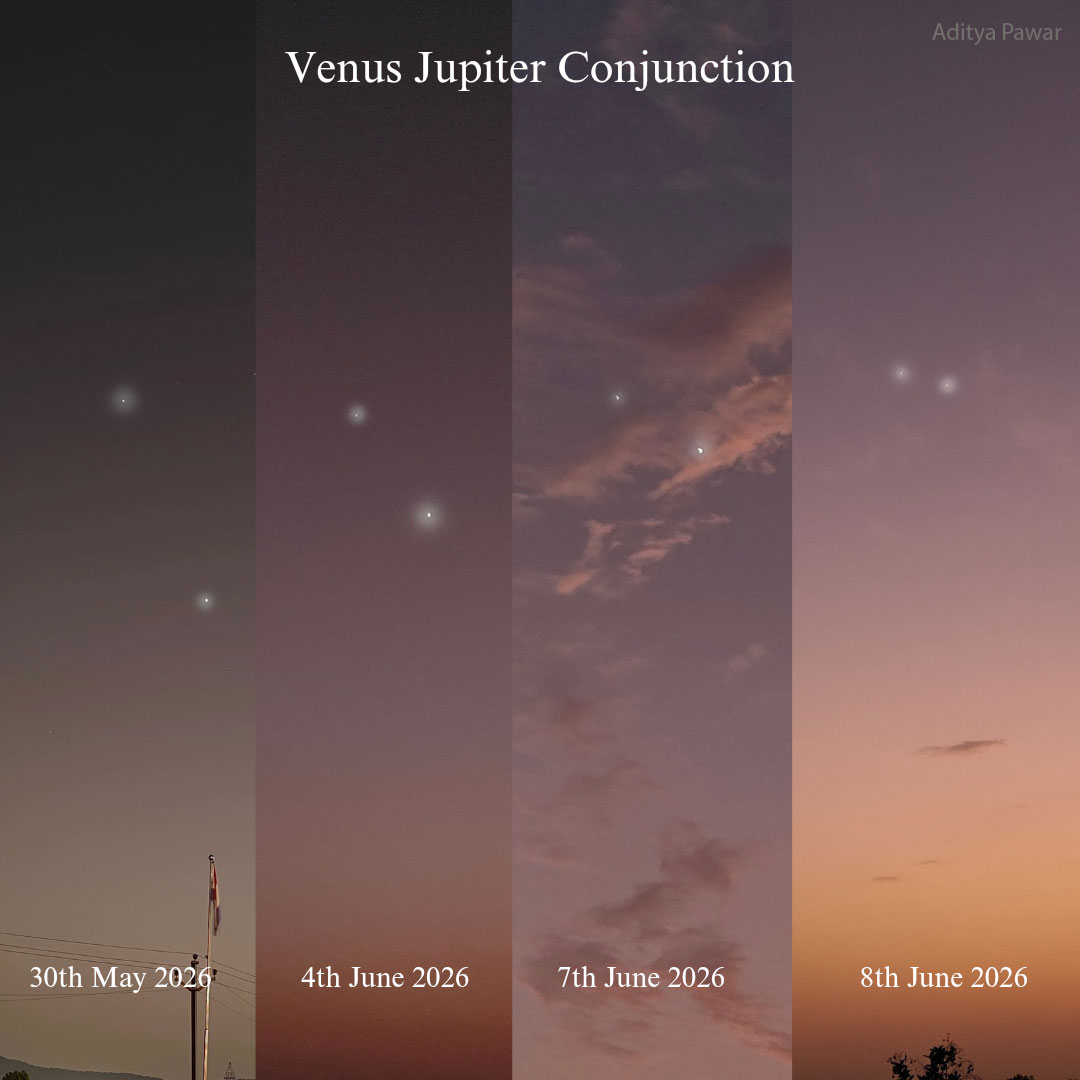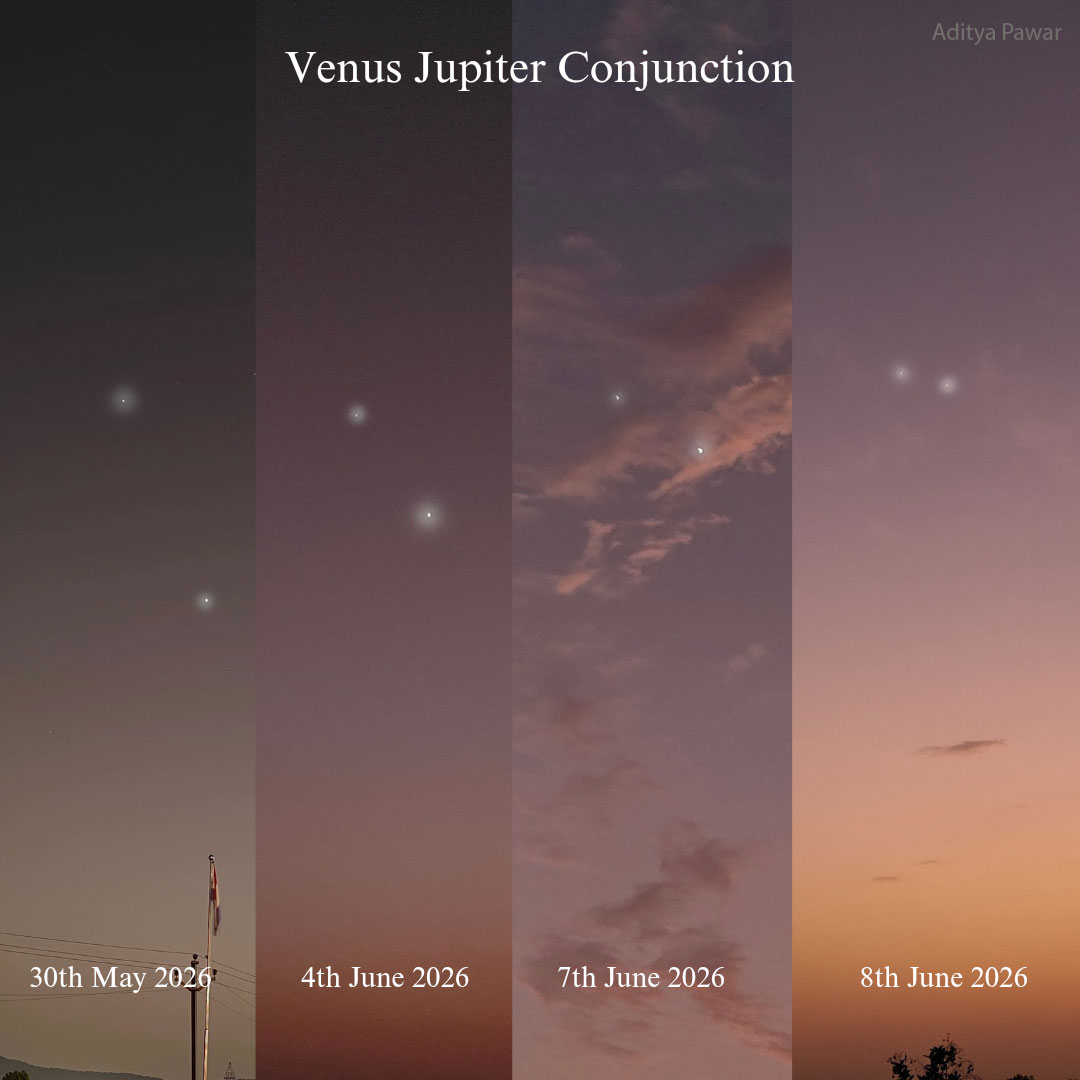
Venus and Jupiter may have caught your attention lately. The recent close conjunction of the two brightest planets in recent evening skies has been hard to miss. With Jupiter at the top, starting on May 30 and ending on June 8, their close approach was chronicled daily, left to right, in the featured panels from Maharashtra, India. Near the western horizon, the evening sky colors and exposures used for each panel depend on the local conditions near sunset. At their closest on June 9, the celestial pair appeared to be only about three times the width of a full moon apart. Of course, on that date, the two planets were physically separated by over 600 million kilometers in their orbits around the Sun. In the coming days, Jupiter will slowly settle into the sunset glare, but Venus will continue to move farther from the Sun in the western sky to excel in its current role as the brilliant evening star. Gallery: Venus - Jupiter Conjunction of 2026 June
Es posible que Venus y Júpiter hayan llamado su atención últimamente. La reciente conjunción entre los dos planetas más brillantes en el cielo vespertino ha sido difícil de pasar por alto. Con Júpiter en la parte superior, comenzando el 30 de mayo y finalizando el 8 de junio, su aproximación fue registrada diariamente, de izquierda a derecha, en los paneles destacados tomados desde Maharashtra, India. Cerca del horizonte occidental, los colores del cielo vespertino y las exposiciones utilizadas en cada panel dependen de las condiciones locales al atardecer. En su mayor acercamiento, el 9 de junio, la pareja celeste apareció separada por apenas unas tres veces el diámetro de la Luna llena. Por supuesto, en esa fecha, los dos planetas se encontraban físicamente separados por más de 600 millones de kilómetros en sus órbitas alrededor del Sol. En los próximos días, Júpiter se irá ocultando gradualmente en el resplandor del ocaso, mientras que Venus continuará alejándose del Sol en el cielo occidental, destacando en su papel actual como brillante estrella vespertina.