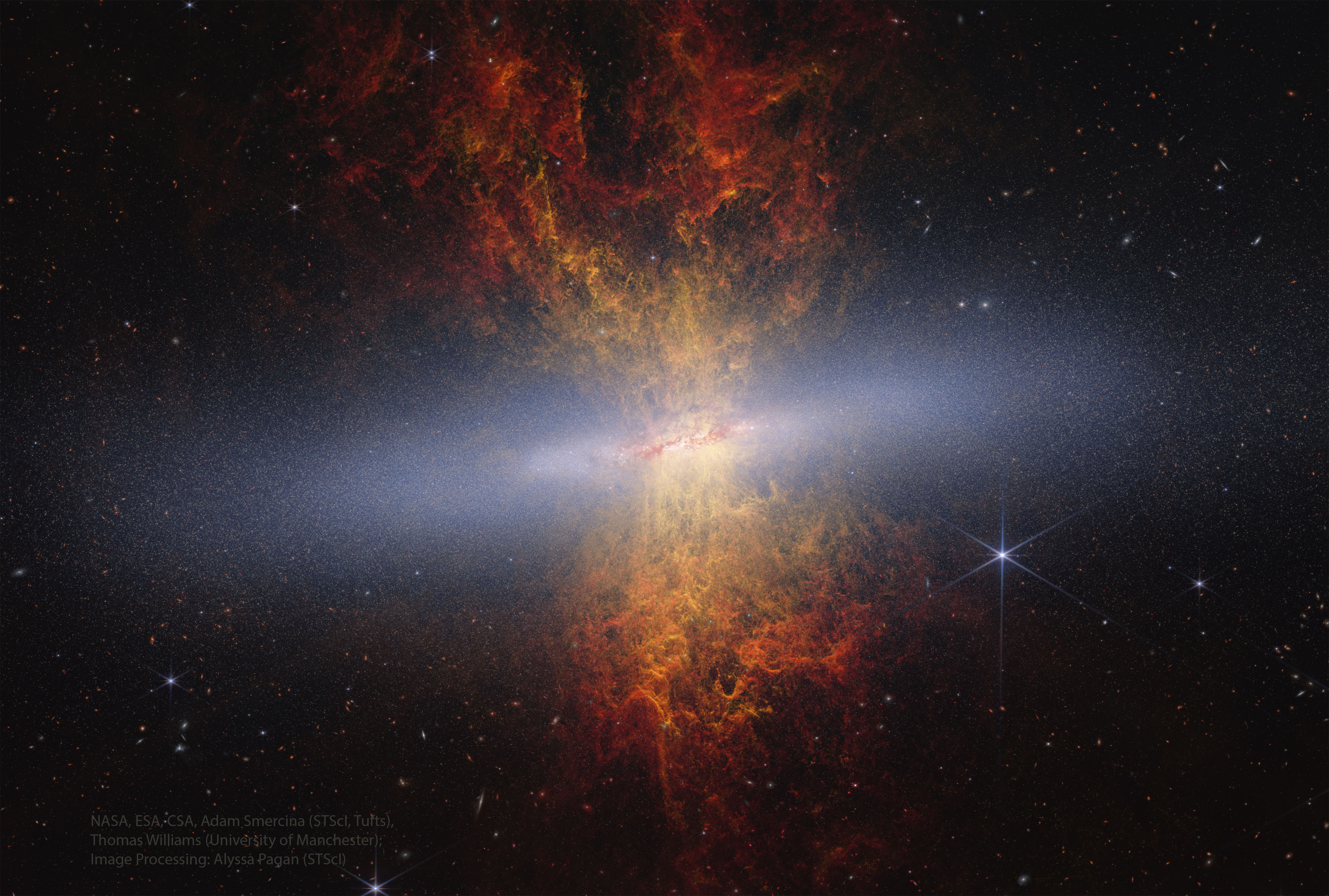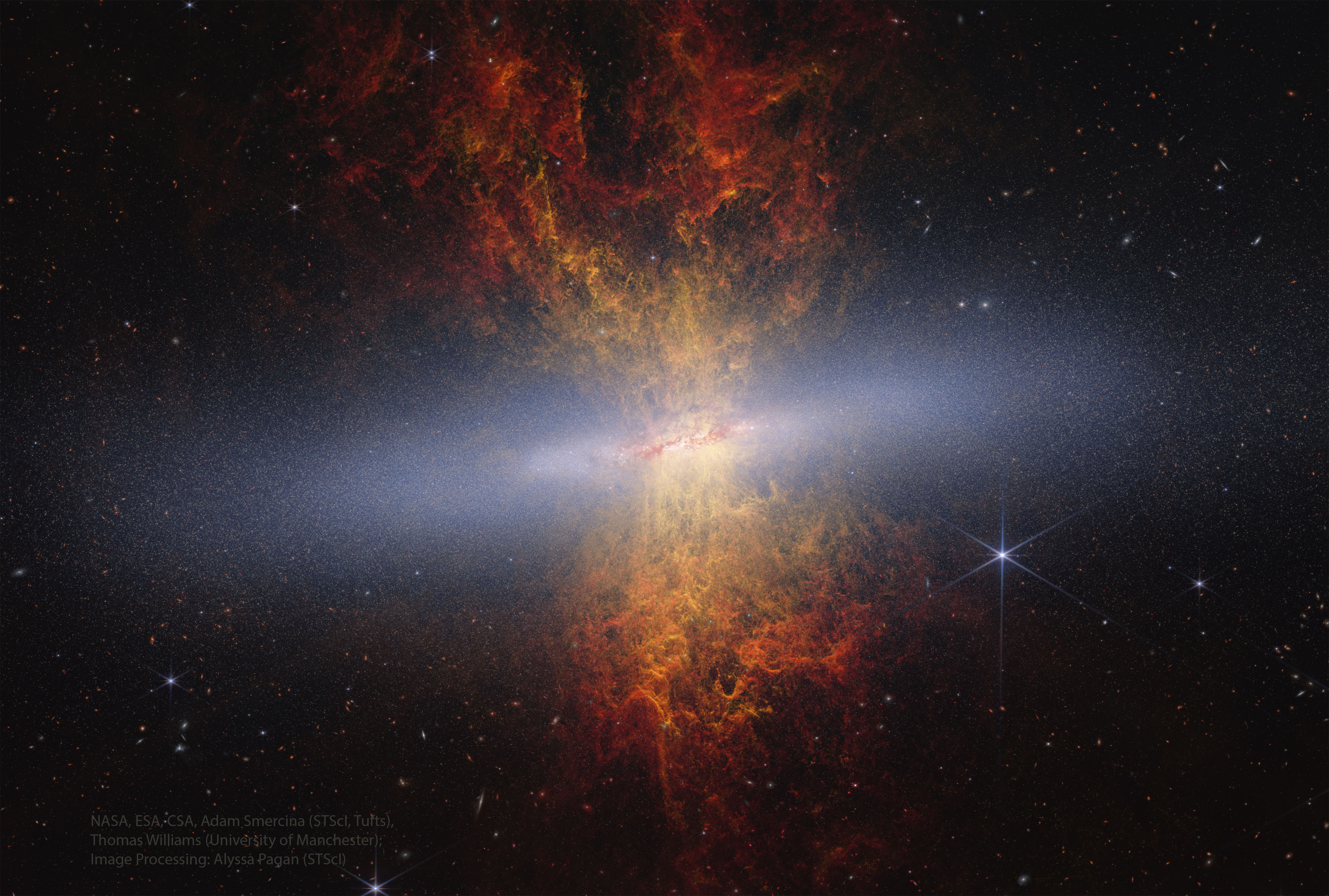
Why is the Cigar Galaxy billowing red smoke? M82, as this starburst galaxy is also known, was stirred up by a recent pass near large spiral galaxy M81. This doesn't fully explain the source of the red-glowing outwardly expanding gas and dust, however. Evidence indicates that this gas and dust is being driven out by the combined emerging particle winds of many stars, together creating a galactic superwind. The dust particles are thought to originate in M82's interstellar medium and are actually similar in size to particles in cigar smoke. The featured photographic mosaic combines images taken in visible light from the Hubble Space Telescope and images taken in infrared light from James Webb Space Telescope. It shows the light-colored central galaxy nearly edge on across the image center with tremendous orange and red colored filaments of gas and dust extending both up and down. The filaments extend for over 10,000 light years. The 12-million light-year distant Cigar Galaxy is the brightest galaxy in the sky in infrared light and can be seen in visible light with a small telescope towards the constellation of the Great Bear (Ursa Major).
¿Por qué la Galaxia Cigarro expulsa humo rojo en forma de penachos? M82, como también se conoce a esta galaxia de formación estelar intensa, fue perturbada por un paso reciente cerca de la gran galaxia espiral M81. Sin embargo, esto no explica completamente el origen del gas y el polvo que se expanden hacia el exterior con un resplandor rojizo. Las evidencias indican que este gas y polvo están siendo impulsados hacia afuera por los vientos de partículas combinados de numerosas estrellas, que juntas crean un superviento galáctico. Se cree que las partículas de polvo se originan en el medio interestelar de M82 y son, de hecho, similares en tamaño a las partículas del humo de cigarro. El mosaico fotográfico presentado combina imágenes tomadas en luz visible por el Telescopio Espacial Hubble e imágenes tomadas en luz infrarroja por el Telescopio Espacial James Webb. Muestra la galaxia central de color claro casi de canto a lo largo del centro de la imagen, con enormes filamentos de gas y polvo de color naranja y rojo que se extienden tanto hacia arriba como hacia abajo. Los filamentos se extienden por más de 10.000 años luz. La Galaxia Cigarro, situada a 12 millones de años luz de distancia, es la galaxia más brillante del cielo en luz infrarroja y puede observarse en luz visible con un pequeño telescopio en dirección a la constelación de la Osa Mayor (Ursa Major).