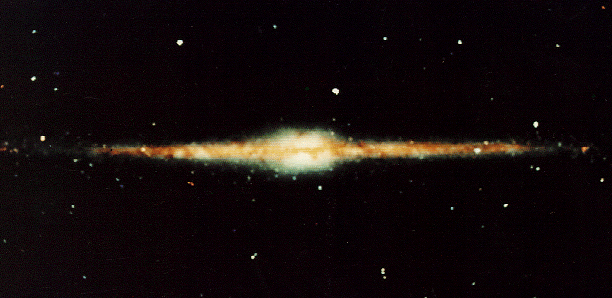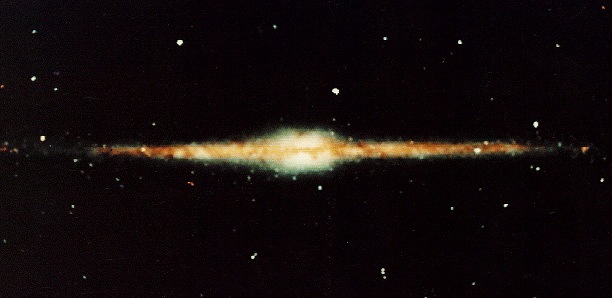
September 8, 1995 The Milky Way's Center Credit: NASA, COsmic Background Explorer (COBE) Project Explanation: NASA's COBE satellite scanned the heavens at infrared wavelengths in 1990 and produced this premier view of the central region of our own Milky Way Galaxy. The Milky Way is a typical spiral galaxy with a central bulge and extended disk of stars. However, gas and dust within the disk obscure visible wavelengths of light effectively preventing clear observations of the center. Since infrared wavelengths, are less affected by the obscuring material, the Diffuse InfraRed Background Experiment (DIRBE) on board COBE was able to detected infrared light from stars surrounding the galactic center and produce this image. Of course, the edge on perspective represents the view from the vicinity of our Sun, a star located in the disk about 30,000 light years out from the center. The DIRBE experiment used equipment cooled by a tub of liquid helium to detect the infrared light which, composed of wavelengths longer than red light, is invisible to the human eye.
8 de septiembre de 1995 El Centro de la Vía Láctea Crédito: NASA, Proyecto COsmic Background Explorer (COBE) Explicación: El satélite COBE de la NASA exploró los cielos en longitudes de onda infrarrojas en 1990 y produjo esta primera vista de la región central de nuestra propia galaxia, la Vía Láctea. La Vía Láctea es una galaxia espiral típica con un bulbo central y un disco extendido de estrellas. Sin embargo, el gas y el polvo dentro del disco oscurecen las longitudes de onda de luz visible, impidiendo efectivamente observaciones claras del centro. Dado que las longitudes de onda infrarrojas son menos afectadas por el material oscurecedor, el Experimento de Fondo Infrarrojo Difuso (DIRBE) a bordo de COBE pudo detectar luz infrarroja de las estrellas que rodean el centro galáctico y producir esta imagen. Por supuesto, la perspectiva de canto representa la vista desde las inmediaciones de nuestro Sol, una estrella ubicada en el disco a aproximadamente 30.000 años luz del centro. El experimento DIRBE utilizó equipo enfriado por una tina de helio líquido para detectar la luz infrarroja que, compuesta de longitudes de onda más largas que la luz roja, es invisible al ojo humano.