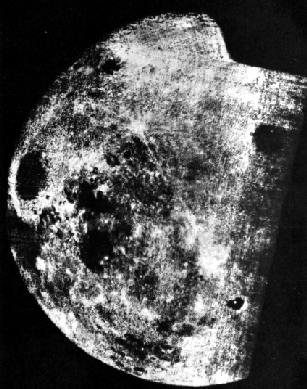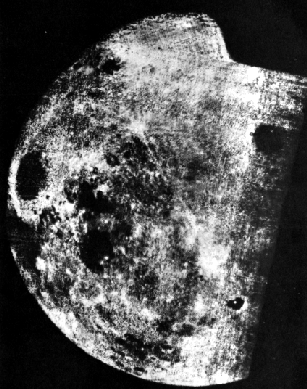
This historic picture was humanity's first glimpse of the far side of the Moon. It was taken by the Soviet spacecraft Luna 3 in October of 1959. Luna 3 followed closely on the heels of another Soviet probe, Luna 2, which had become the first spacecraft to impact the Moon on September 13th of that same year. Why does the Moon have a far side? Gravitational tidal forces within the Earth-Moon system have synchronized the Moon's period of rotation around its axis with its orbital period at about 28 days. So, as the Moon moves around its orbit its rotation exactly compensates, keeping the same face toward the Earth.
Esta histórica imagen fue el primer vistazo de la humanidad al lado lejano de la Luna. Fue tomada por la nave espacial soviética Luna 3 en octubre de 1959. La Luna 3 siguió de cerca a otra sonda soviética, la Luna 2, que se había convertido en la primera nave espacial en impactar la Luna el 13 de septiembre de ese mismo año. ¿Por qué tiene la Luna un lado lejano? Las fuerzas de marea gravitacionales dentro del sistema Tierra-Luna han sincronizado el período de rotación de la Luna alrededor de su eje con su período orbital de aproximadamente 28 días. Así, a medida que la Luna se mueve alrededor de su órbita, su rotación compensa exactamente, manteniendo la misma cara hacia la Tierra.