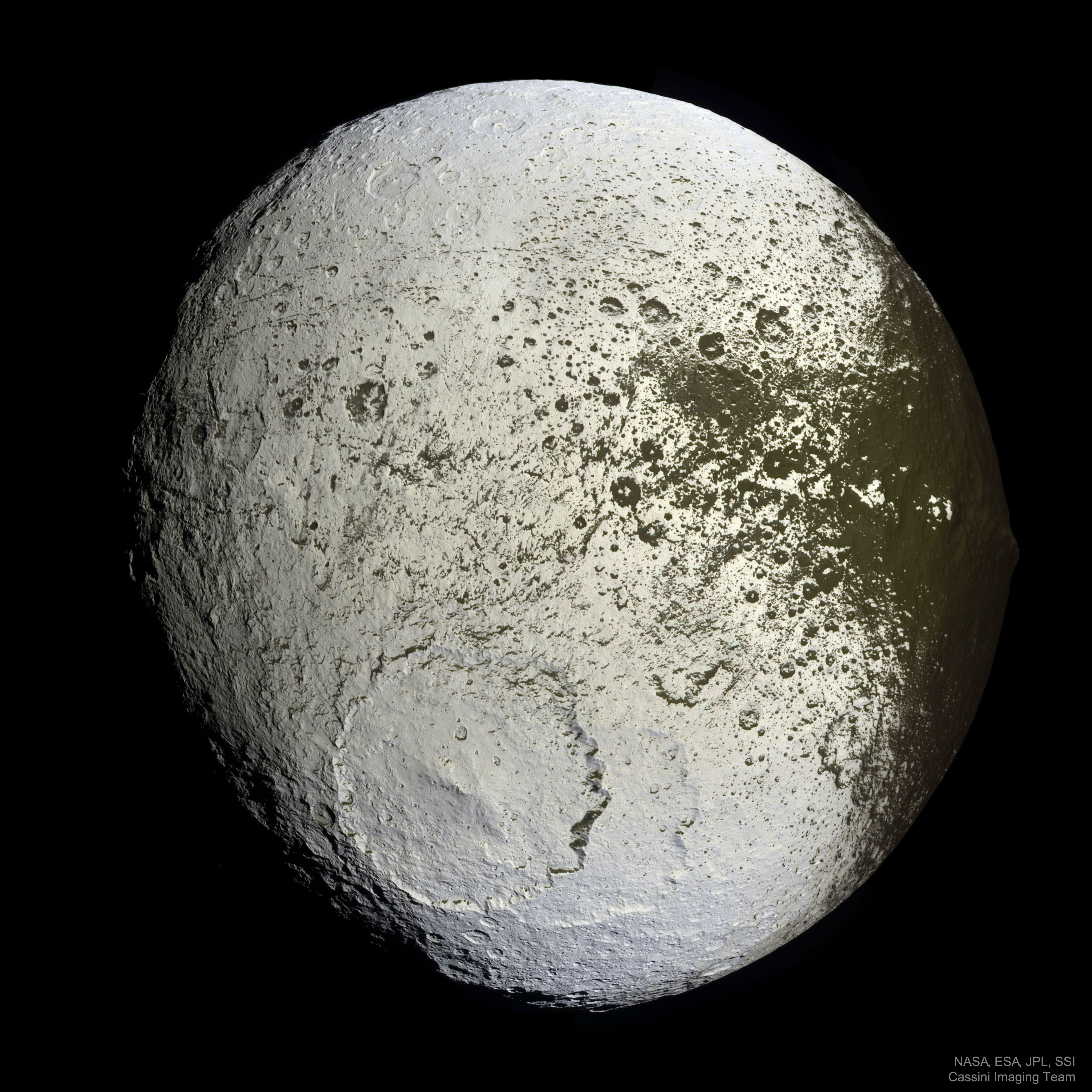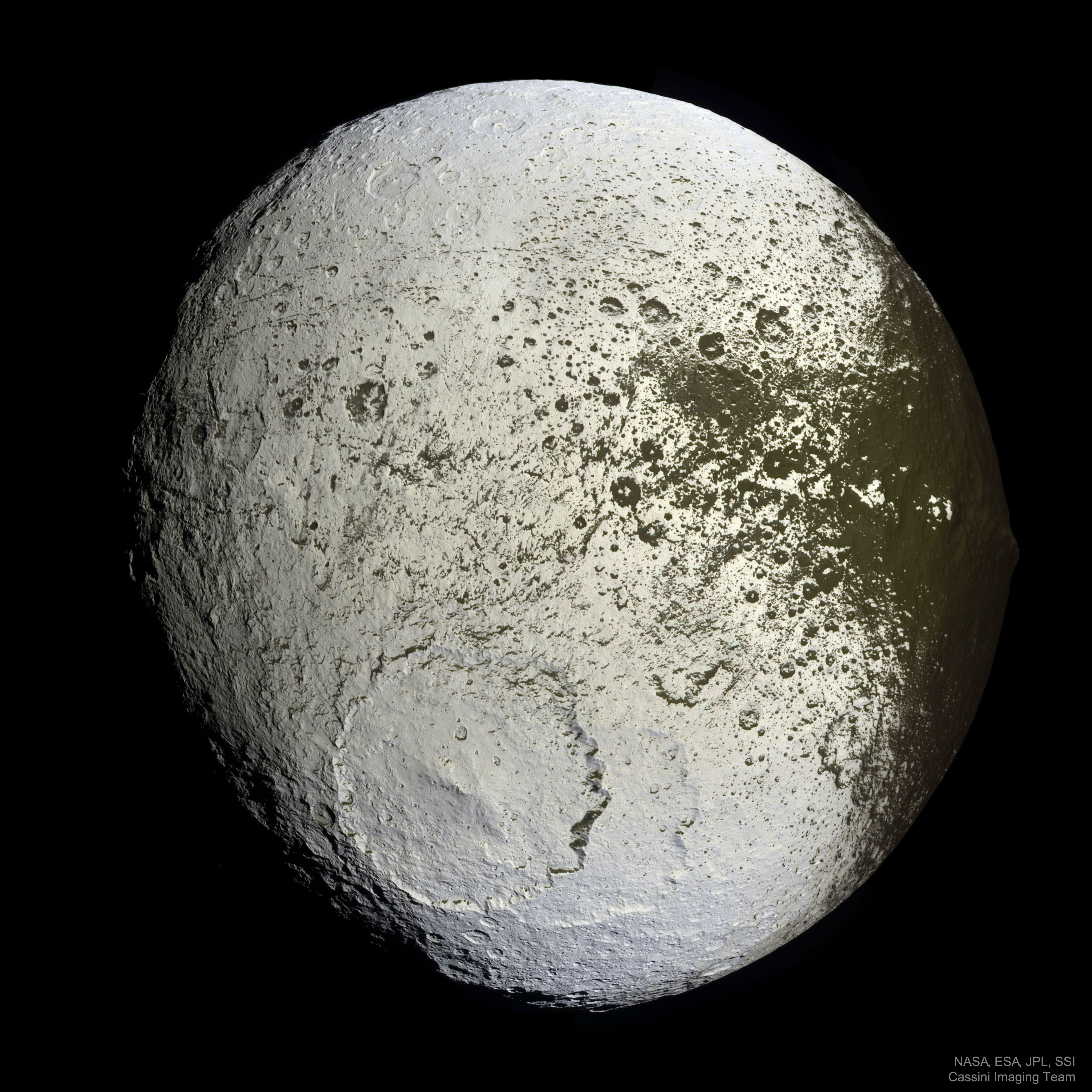
What has happened to Saturn's moon Iapetus? Vast sections of this strange world are dark as coal, while others are as bright as snow. To help better understand this unusually tinted moon, in 2007 NASA directed the robotic Cassini spacecraft then orbiting Saturn to swoop within 2,000 kilometers. Pictured here, from about 75,000 kilometers out, is the hemisphere of Iapetus that is always trailing. A large impact crater seen in the south spans 500 kilometers and appears superposed on an older crater of similar size. The dark material is seen increasingly coating the easternmost part of Iapetus, darkening craters and highlands alike. A leading hypothesis is that the dark material is mostly a form of carbon-rich soil leftover from when relatively warm but dirty ice sublimates. An initial coating of this dark material may have been effectively painted on by the accretion of meteor-liberated debris from other moons. Jigsaw Moon: Astronomy Puzzle of the Day
¿Qué le ha ocurrido a Iapeto, la luna de Saturno? Vastas regiones de este extraño mundo son tan oscuras como el carbón, mientras que otras son tan brillantes como la nieve. Para comprender mejor esta luna de tonalidad inusual, en 2007 la NASA dirigió la sonda robótica Cassini, que entonces orbitaba Saturno, para que se aproximara a menos de 2.000 kilómetros. Aquí se muestra, desde unos 75.000 kilómetros de distancia, el hemisferio de Iapeto que siempre se encuentra en la dirección de retroceso orbital. Un gran cráter de impacto visible en el sur abarca 500 kilómetros y parece estar superpuesto sobre un cráter más antiguo de tamaño similar. El material oscuro se observa cubriendo de manera creciente la parte más oriental de Iapeto, oscureciendo tanto los cráteres como las tierras altas. La hipótesis más aceptada es que dicho material oscuro es principalmente una forma de suelo rico en carbono, resto de cuando el hielo relativamente cálido pero impuro se sublimó. Un recubrimiento inicial de este material oscuro pudo haber sido efectivamente depositado mediante la acreción de partículas liberadas por meteoritos provenientes de otras lunas.