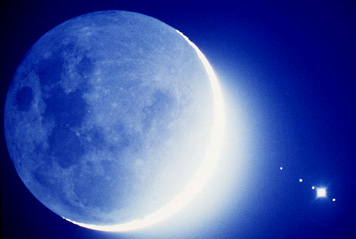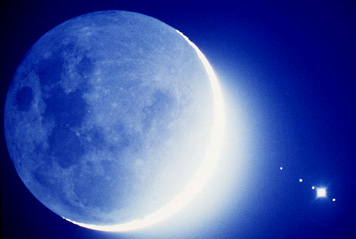
How often does a Full Moon occur twice in a single month? Exactly once in a Blue Moon. In fact, the modern usage of the term "Blue Moon" refers to the second Full Moon in a single month. Tonight's Blue Moon (Universal Time) will be the first since September 1993. A Blue Moon typically occurs every few years. The reason for the rarity of the Blue Moon is that the 29.53 days between full moons is just slightly shorter than the number of days in the average month. Don't, however, expect the moon to look blue tonight! The term "Blue Moon" is thought to derive from common language expressions used hundreds of years ago. It is possible for the Moon to appear tinged by a blue hue, sometimes caused by fine dirt circulating in the Earth's atmosphere, possibly from a volcanic explosion. The above picture is of our Moon taken was taken in a dark blue morning sky. The bright crescent is the only part directly exposed to sunlight - the rest of the Moon glows from sunlight reflected from the Earth. In this dramatic photo, however, the planet Jupiter is also visible along with its four largest moons.
¿Con qué frecuencia ocurre una Luna Llena dos veces en un mismo mes? Exactamente una vez en una Luna Azul. De hecho, el uso moderno del término "Luna Azul" hace referencia a la segunda Luna Llena que ocurre en un mismo mes. La Luna Azul de esta noche (en Tiempo Universal) será la primera desde septiembre de 1993. Una Luna Azul ocurre típicamente cada varios años. La razón de la rareza de la Luna Azul es que los 29,53 días entre lunas llenas son apenas un poco menos que el número de días del mes promedio. Sin embargo, ¡no espere que la Luna luzca azul esta noche! Se cree que el término "Luna Azul" deriva de expresiones del lenguaje cotidiano utilizadas hace cientos de años. Es posible que la Luna aparezca teñida con un matiz azulado, causado a veces por polvo fino en circulación en la atmósfera terrestre, posiblemente proveniente de una erupción volcánica. La imagen anterior muestra nuestra Luna fotografiada en un oscuro cielo matutino de color azul. El brillante creciente es la única parte expuesta directamente a la luz solar; el resto de la Luna resplandece gracias a la luz solar reflejada por la Tierra. En esta dramática fotografía, también es visible el planeta Júpiter junto con sus cuatro lunas más grandes.