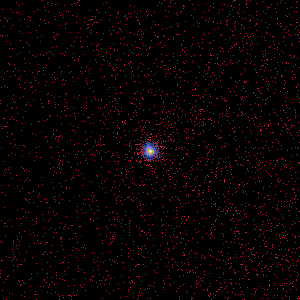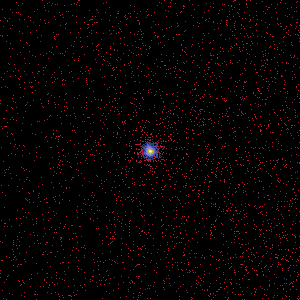
Sirius is the brightest star in the night sky. Intrinsically, Sirius is over 20 times brighter than our Sun and over twice as massive. As Sirius is 8.7 light years distant, it is not the closest star system -- the Alpha Centauri system holds this distinction. Sirius is called the Dog Star because of its prominence in the constellation of Canis Majoris (Big Dog). In 1862, Sirius was discovered to be a binary star system with a companion star, Sirius B, 10,000 times dimmer than the bright primary, Sirius A. Sirius B was the first white dwarf star discovered, a type of star first understood by Subrahmanyan Chandrasekhar in 1930. While studying Sirius in 1718, Edmond Halley discovered that stars move with respect to each other. The Sirius system is shown above captured in X-ray light.
Sirio es la estrella más brillante del cielo nocturno. Intrínsecamente, Sirio es más de 20 veces más brillante que nuestro Sol y más del doble de masivo. Dado que Sirio se encuentra a 8,7 años luz de distancia, no es el sistema estelar más cercano —distinción que corresponde al sistema Alfa Centauri—. Sirio recibe el nombre de Estrella del Can debido a su prominencia en la constelación de Canis Majoris (el Can Mayor). En 1862, se descubrió que Sirio es un sistema estelar binario con una estrella compañera, Sirio B, 10.000 veces más tenue que la brillante estrella primaria, Sirio A. Sirio B fue la primera enana blanca descubierta, un tipo de estrella cuya naturaleza fue comprendida por primera vez por Subrahmanyan Chandrasekhar en 1930. Mientras estudiaba a Sirio en 1718, Edmond Halley descubrió que las estrellas se mueven entre sí. El sistema de Sirio se muestra en la imagen captada en luz de rayos X.