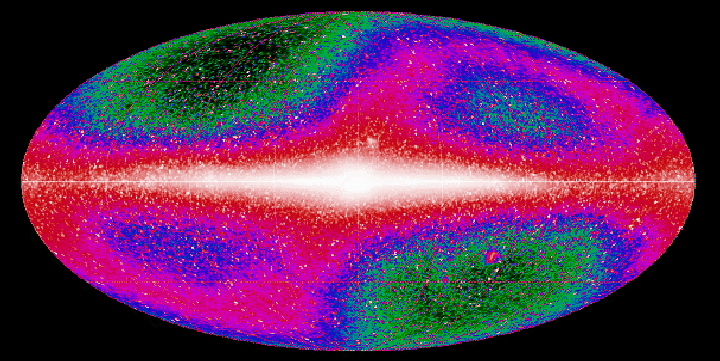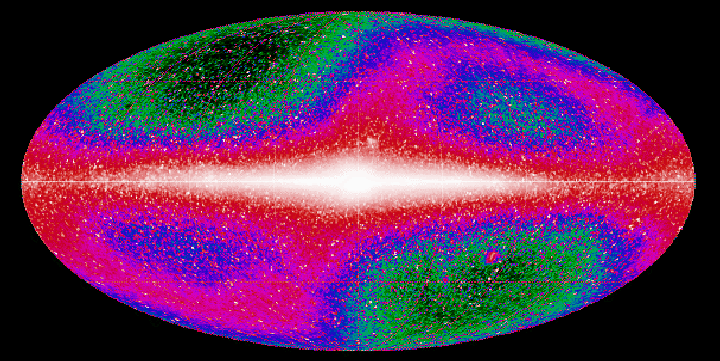
What if you could see infrared light? Because this light is less absorbed by dust than visible light, you could peer into the center of our Milky Way Galaxy. The stars there are normally hidden from direct view by the interstellar dust clouds which line the Galactic plane. Above is a false color image of the entire sky made by the DIRBE instrument onboard NASA's COBE Satellite using infrared light with a wavelength of 3.5 microns - about 7 times longer than the wavelength of visible light. The galactic plane runs horizontally along the middle of the image. At this wavelength, the cool stars in our galaxy shine brightly and can be seen to define the plane of the Milky Way and the central bulge. Interplanetary dust, which tends to lie along the plane of our own solar system, scatters sunlight and emits radiation at these wavelengths too. The faint glow it produces results in the "S" shape apparent in this infrared all-sky view.
¿Qué ocurriría si pudieras ver la luz infrarroja? Dado que este tipo de luz es absorbida por el polvo en menor medida que la luz visible, podrías penetrar con la mirada hasta el centro de nuestra galaxia, la Vía Láctea. Las estrellas que allí se encuentran permanecen normalmente ocultas a la observación directa por las nubes de polvo interestelar que se distribuyen a lo largo del plano galáctico. La imagen de arriba es una imagen en falso color de todo el cielo obtenida por el instrumento DIRBE a bordo del satélite COBE de la NASA, empleando luz infrarroja con una longitud de onda de 3,5 micrómetros, aproximadamente 7 veces mayor que la longitud de onda de la luz visible. El plano galáctico atraviesa horizontalmente el centro de la imagen. A esta longitud de onda, las estrellas frías de nuestra galaxia brillan intensamente y pueden verse definiendo el plano de la Vía Láctea y el abultamiento central. El polvo interplanetario, que tiende a distribuirse a lo largo del plano de nuestro propio sistema solar, dispersa la luz solar y también emite radiación en estas longitudes de onda. El tenue resplandor que produce genera la forma de «S» visible en esta panorámica infrarroja del cielo completo.