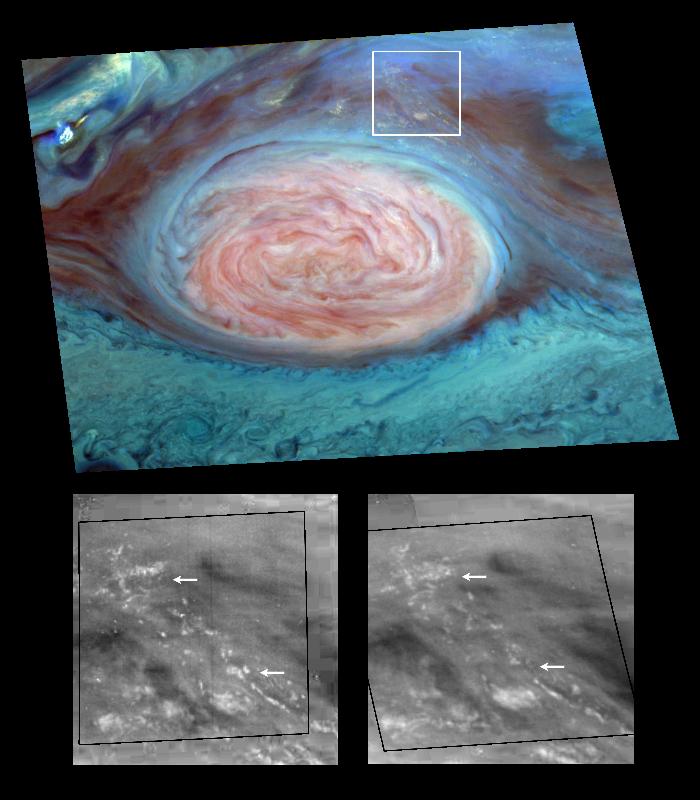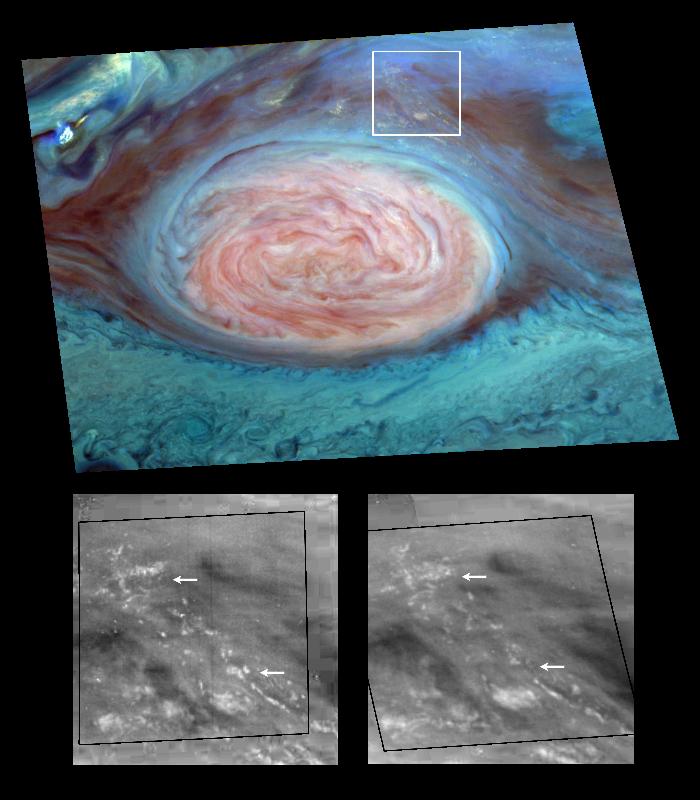
Storm clouds, similar to the familiar cumulonimbus thunderheads of Earth, appear to be present on Jupiter. The mosaic of images above shows the region near the raging edge of Jupiter's Great Red Spot, itself some 2 to 3 Earths wide, as observed by the Galileo spacecraft in June of this year. The false colors represent altitude. Low altitude clouds are blue, high, thick clouds are white and high, thin clouds are pink, with the box at the upper right containing the high cloud features likened to the storm clouds of Earth. Scientists speculate that these features are evidence for an abundance of water in at least some regions of Jupiter's atmosphere. On Earth, atmospheric water vapor plays an important role in driving winds - this could well be true on Jupiter, where winds reach up to 300 miles per hour.
Nubes de tormenta, similares a los conocidos cumulonimbos terrestres, parecen estar presentes en Júpiter. El mosaico de imágenes superior muestra la región cercana al turbulento borde de la Gran Mancha Roja de Júpiter —de entre 2 y 3 veces el diámetro terrestre—, tal como fue observada por la sonda Galileo en junio de este año. Los colores falsos representan altitud. Las nubes de baja altitud aparecen en azul; las nubes altas y densas, en blanco; y las nubes altas y delgadas, en rosa. El recuadro en la esquina superior derecha contiene las formaciones de nubes altas que se asemejan a las nubes de tormenta de la Tierra. Los científicos especulan que estas formaciones son evidencia de una abundancia de agua en al menos algunas regiones de la atmósfera de Júpiter. En la Tierra, el vapor de agua atmosférico desempeña un papel importante en la generación de vientos; esto bien podría ser cierto en Júpiter, donde los vientos alcanzan hasta 480 kilómetros por hora.