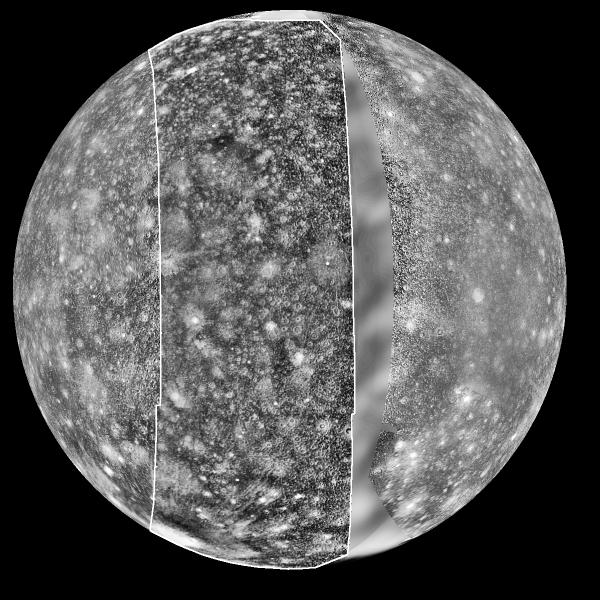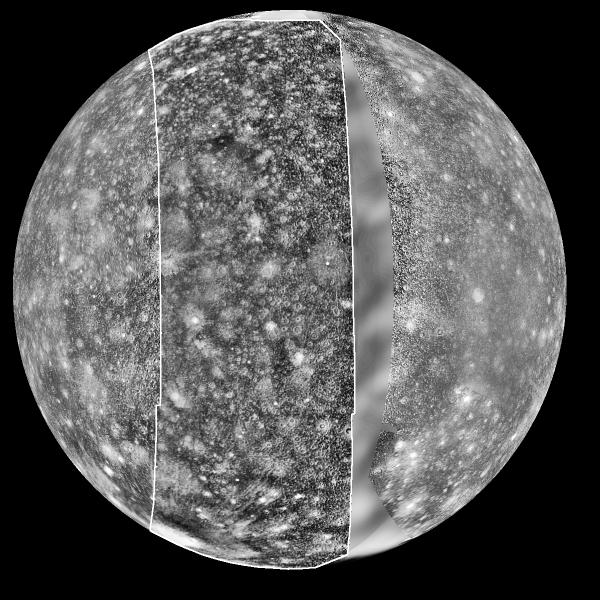
Callisto's surface shows its age. While probably formed at the same time as Io, the difference between the surfaces of these two moons of Jupiter could hardly be greater. Io's surface is young, shows practically no impact craters, and is continually being repaved by the lava exploding from its many large volcanoes. Callisto's surface is old, shows the highest density of impact craters in the Solar System, and harbors no volcanoes or even any large mountains. Callisto's surface is one large ice-field, laced with cracks and craters from billions of years of collisions with interplanetary debris. The high-resolution vertical band in the above mosaic was taken by the robot spacecraft Galileo currently orbiting Jupiter. The rest of the mosaic was compiled from pictures taken by the Voyager spacecraft which passed the Callisto in 1979.
La superficie de Calisto muestra su edad. Aunque probablemente se formaron al mismo tiempo que Ío, la diferencia entre las superficies de estas dos lunas de Júpiter no podría ser mayor. La superficie de Ío es joven, no presenta prácticamente ningún cráter de impacto y está siendo continuamente renovada por la lava que expulsan sus numerosos y grandes volcanes. La superficie de Calisto es antigua, presenta la mayor densidad de cráteres de impacto del Sistema Solar y no alberga volcanes ni siquiera grandes montañas. La superficie de Calisto es un extenso campo de hielo, entrecruzado de grietas y cráteres producto de miles de millones de años de colisiones con material interplanetario. La franja vertical de alta resolución en el mosaico anterior fue tomada por la nave espacial robótica Galileo, que orbita actualmente alrededor de Júpiter. El resto del mosaico fue elaborado a partir de imágenes tomadas por la nave espacial Voyager, que sobrevoló Calisto en 1979.