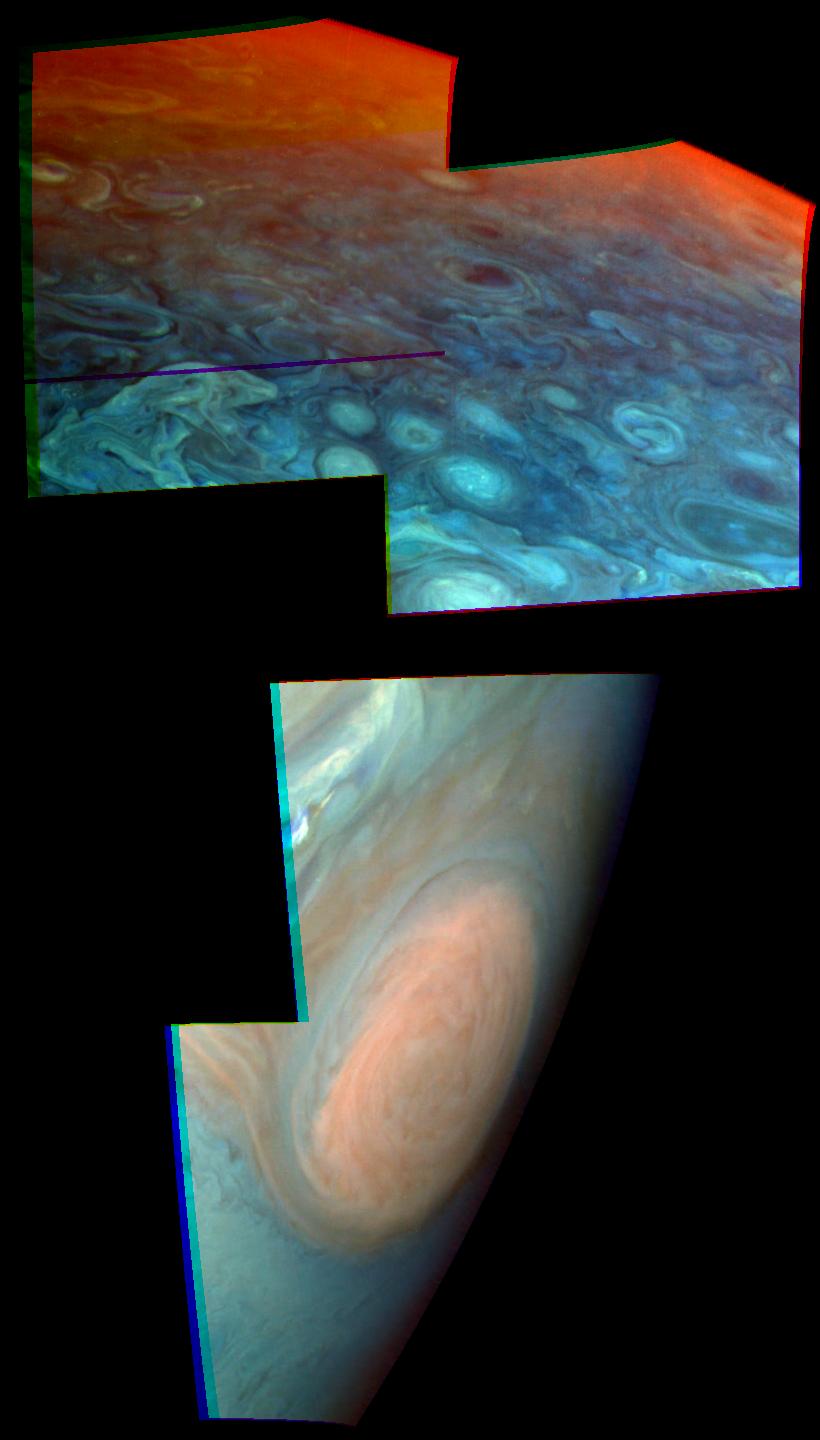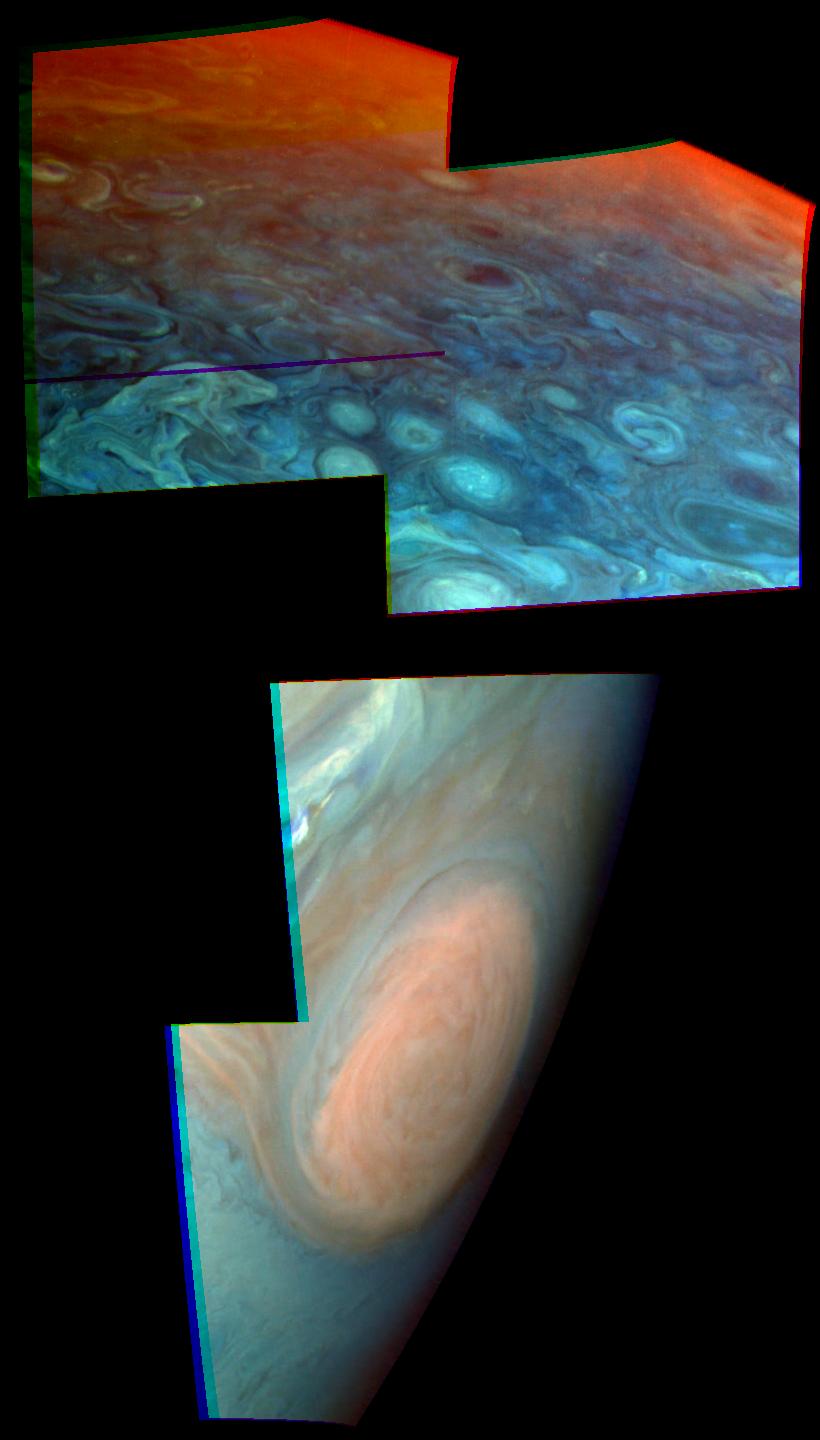
A dramatic mosaic of recent images from the Galileo spacecraft reveals details of swirling clouds and a thick stratospheric haze in the atmosphere of Jupiter, the Solar System's largest planet. This false color representation is keyed to altitude - red indicates cloud features near the top of the gas giant's extensive atmosphere while blue corresponds to features at depth. North is up in the mosaic, centered at about 50 degrees northern Jovian latitude, and the limb or edge of the planet arcs across the upper right. The line of sight looking toward the limb emphasizes the high altitude, red haze. What causes the red haze? It may well be created as energetic electrons and other charged particles swept up by Jupiter's magnetosphere are funneled along magnetic field lines and bombard the atmosphere near the polar regions. Charged magnetospheric particles can also create Aurora.
Un dramático mosaico de imágenes recientes de la sonda espacial Galileo revela detalles de nubes en espiral y una densa neblina estratosférica en la atmósfera de Júpiter, el planeta más grande del Sistema Solar. Esta representación en falso color está codificada por altitud: el rojo indica características de nubes cercanas a la cima de la extensa atmósfera del gigante gaseoso, mientras que el azul corresponde a características en mayor profundidad. El norte apunta hacia arriba en el mosaico, centrado en aproximadamente 50 grados de latitud joviana norte, y el limbo o borde del planeta se arquea a través de la parte superior derecha. La línea de visión hacia el limbo enfatiza la neblina rojiza de gran altitud. ¿Qué causa esta neblina roja? Es probable que sea generada cuando electrones energéticos y otras partículas cargadas, capturadas por la magnetosfera de Júpiter, son canalizadas a lo largo de las líneas del campo magnético y bombardean la atmósfera cerca de las regiones polares. Las partículas cargadas de la magnetosfera también pueden crear auroras.