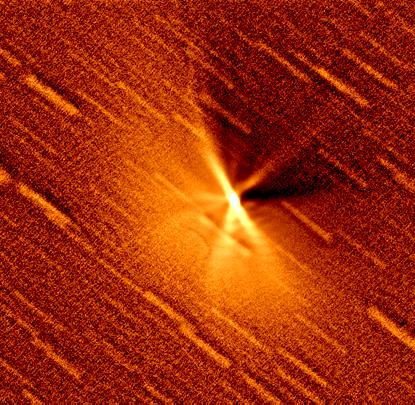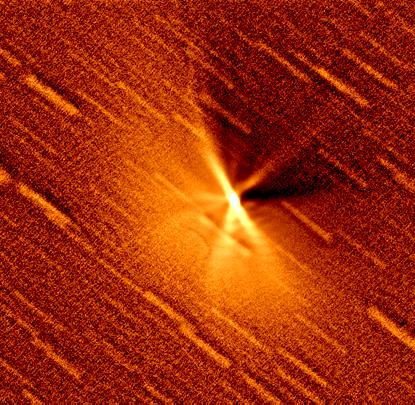
Comets become fountains of gas and dust as they get near the Sun. Solar heat vaporizes the outer layers of these spectacular orbiting icebergs, exposing caverns of pressurized gas that erupt into jets. The above digitally enhanced image of Comet Hale-Bopp was taken on January 29th and highlights several of these dust jets. Here, background stars appear as faint raised streaks. Comet Hale-Bopp is currently brighter than most stars, and is visible in the morning sky. Comet Hale-Bopp will continue to brighten and develop an extended tail until April.
Los cometas se convierten en fuentes de gas y polvo a medida que se acercan al Sol. El calor solar vaporiza las capas externas de estos espectaculares icebergs en órbita, exponiendo cavernas de gas presurizado que irrumpen en chorros. La imagen digitalmente mejorada del Cometa Hale-Bopp, tomada el 29 de enero, destaca varios de estos chorros de polvo. En ella, las estrellas de fondo aparecen como tenues franjas alargadas. El Cometa Hale-Bopp es actualmente más brillante que la mayoría de las estrellas y es visible en el cielo matutino. El Cometa Hale-Bopp continuará aumentando su brillo y desarrollando una extensa cola hasta abril.