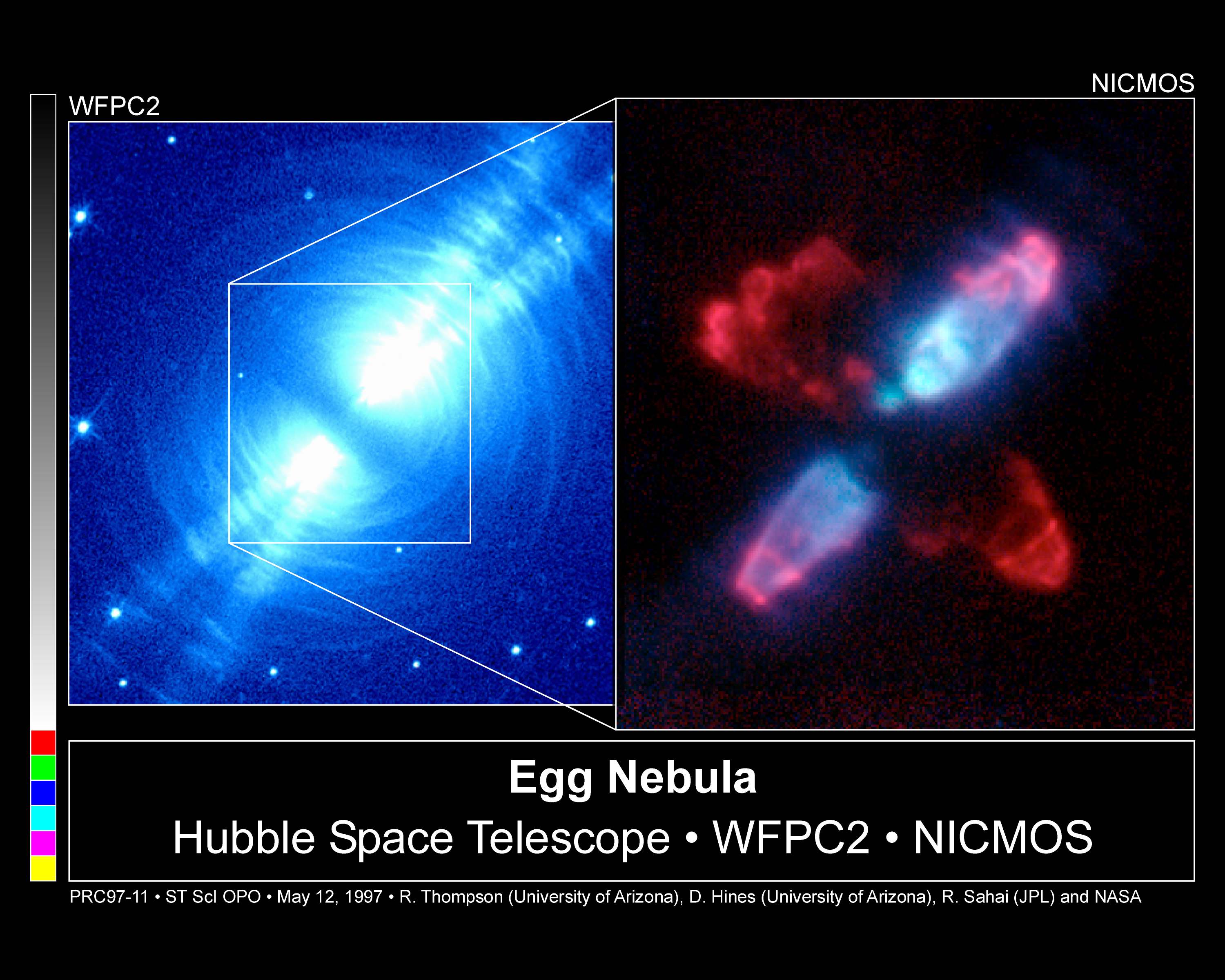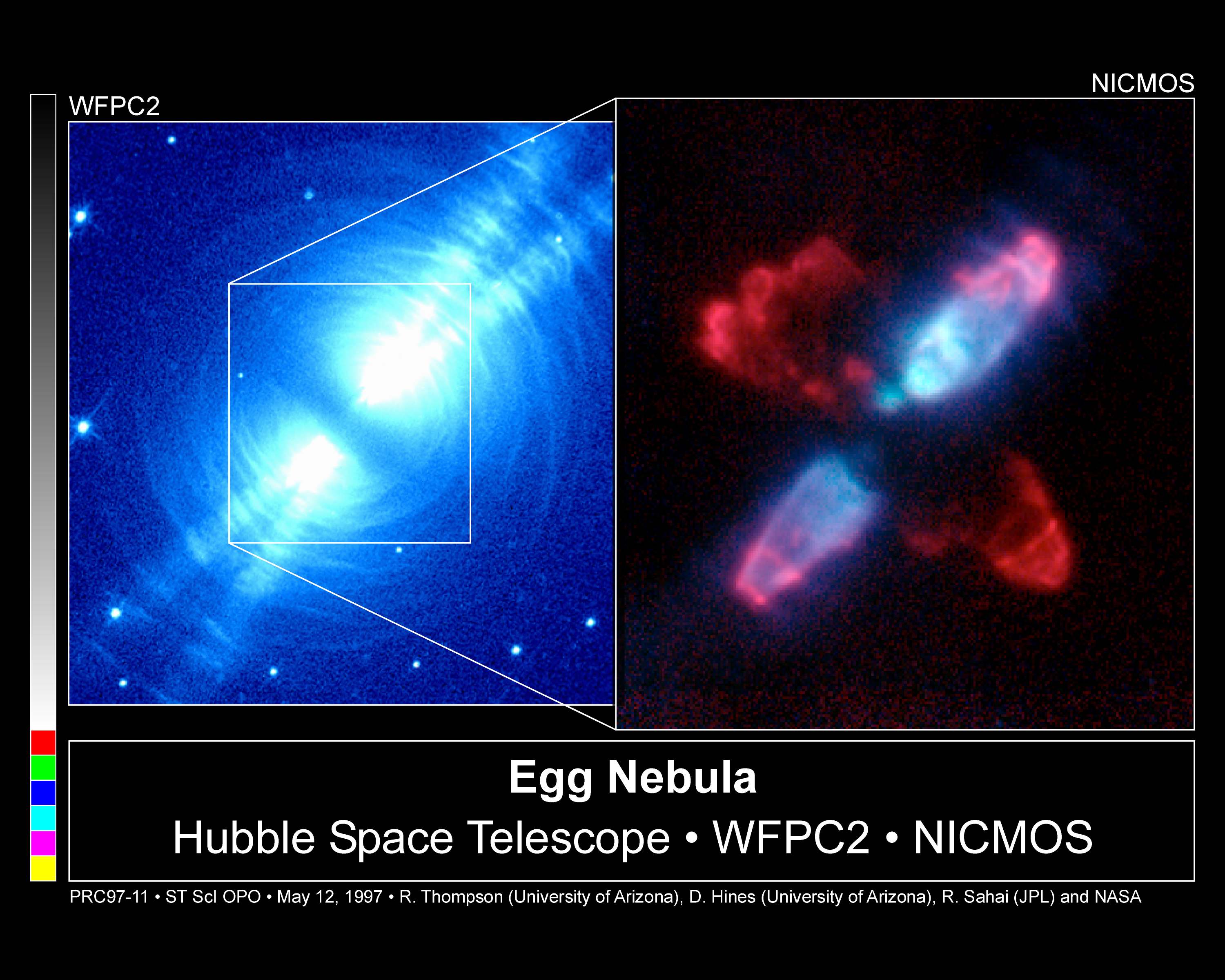
The Egg Nebula is taking a beating. Like a baby chick pecking its way out of an egg, the star in the center of the Egg Nebula is casting away shells of gas and dust as it slowly transforms itself into a white dwarf star. The above picture was taken by the newly installed Near Infrared Camera and Multi-Object Spectrometer (NICMOS) now on board the Hubble Space Telescope. A thick torus of dust now surrounds the star through which the shell gas is escaping. Newly expelled gas shells escape in beams as can be seen in the original HST image and in the recently released image shown above. This infrared image is coded in false color to highlight two different types of emission. The red light represents hot hydrogen gas heated by the collisions of expanding shells. The blue light represents light from the central star scattered by the dust in the nebula. It takes light about 3000 years to reach us from the Egg Nebula, which is hundreds of times the size of our Solar System.
La Nebulosa del Huevo está siendo sometida a un intenso proceso de transformación. Al igual que un polluelo que rompe su cascarón al eclosionar, la estrella en el centro de la Nebulosa del Huevo está expulsando capas de gas y polvo mientras se transforma lentamente en una enana blanca. La imagen anterior fue tomada por la recientemente instalada Cámara de Infrarrojo Cercano y Espectrómetro Multi-Objeto (NICMOS, por sus siglas en inglés), actualmente a bordo del Telescopio Espacial Hubble. Un grueso toro de polvo rodea actualmente la estrella, a través del cual escapa el gas de las capas expulsadas. Las capas de gas recién expelidas escapan en forma de chorros, como puede observarse en la imagen original del HST y en la imagen recientemente publicada que se muestra arriba. Esta imagen infrarroja está codificada en falso color para destacar dos tipos distintos de emisión. La luz roja representa gas de hidrógeno caliente, calentado por las colisiones de las capas en expansión. La luz azul representa la luz de la estrella central dispersada por el polvo en la nebulosa. La luz tarda aproximadamente 3000 años en llegar hasta nosotros desde la Nebulosa del Huevo, que tiene un tamaño cientos de veces mayor que el de nuestro Sistema Solar.