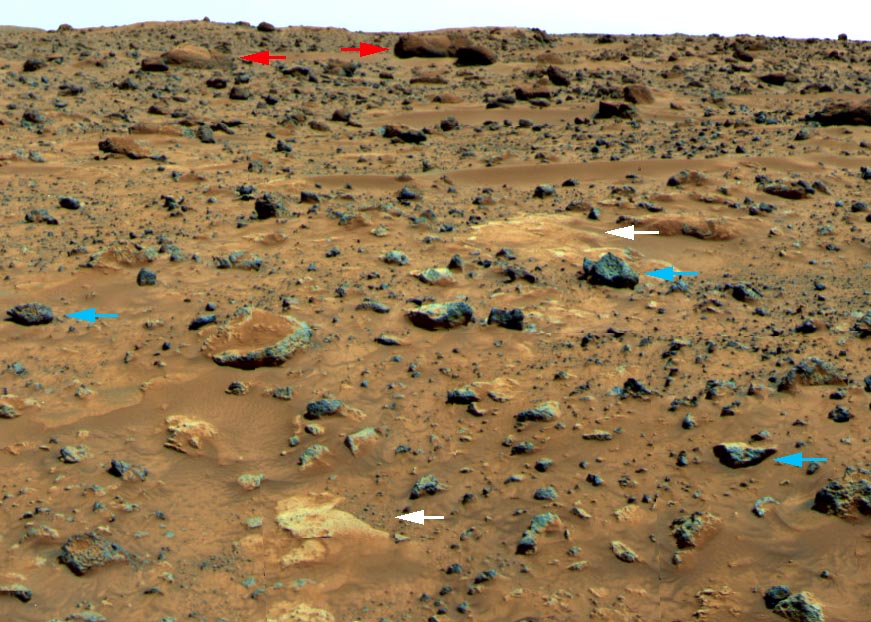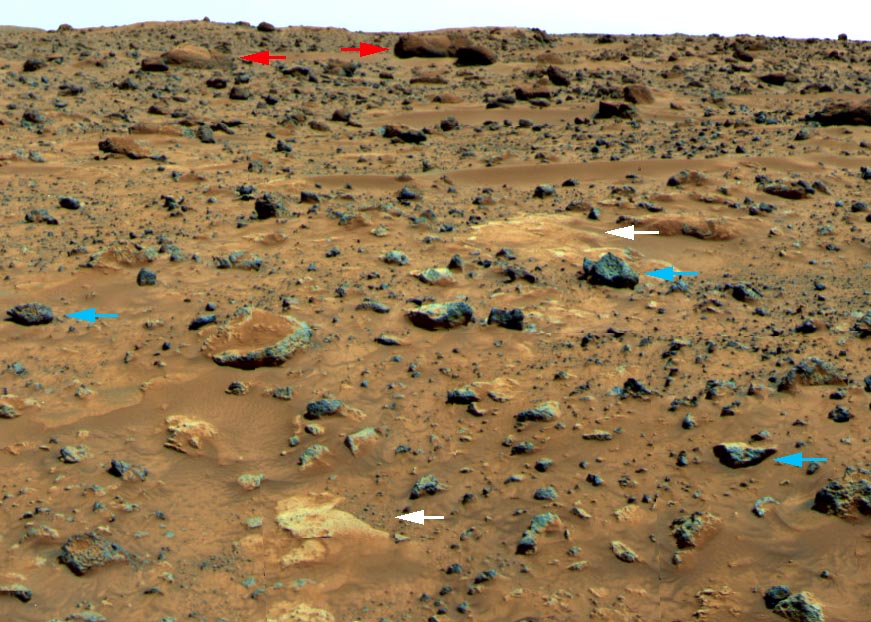
The rocks on Mars tell us stories about their past. To decipher these stories, a scientist must become a detective, searching for clues and fitting them with theories. The above photograph of the rocky Martian surface to the northeast of Pathfinder's landing site provides many such clues. For example, at least three types of rocks are evident, marked with red, white and blue arrows. The red arrows point to smooth rocks, which Pathfinder scientists hypothesize have been eroded by tumbling through ancient channels of water which evaporated long ago. The blue arrows indicate a different type of rock, ragged ones with sharp edges, hypothesized to have been ejected when nearby craters formed or volcanoes erupted. The white areas are more mysterious, and might be some sort of composite material. Sojourner was recently diverted to study these white areas to gather more clues so continued detective work can yield better insight into the Martian past.
Las rocas en Marte nos cuentan historias sobre su pasado. Para descifrar estas historias, un científico debe convertirse en detective, buscando pistas y ajustándolas con teorías. La fotografía de la rocosa superficie marciana al noreste del sitio de aterrizaje de Pathfinder ofrece numerosas pistas de este tipo. Por ejemplo, se distinguen al menos tres tipos de rocas, señaladas con flechas de color rojo, blanco y azul. Las flechas rojas apuntan a rocas lisas, que los científicos de Pathfinder hipotetizan que fueron erosionadas al rodar por antiguos canales de agua que se evaporó hace mucho tiempo. Las flechas azules indican un tipo diferente de roca: fragmentos irregulares con bordes afilados, que se hipotetiza fueron eyectados cuando se formaron cráteres cercanos o erupcionaron volcanes. Las áreas blancas son más misteriosas y podrían ser algún tipo de material compuesto. Sojourner fue desviado recientemente para estudiar estas áreas blancas y recopilar más pistas, de modo que el continuo trabajo de investigación pueda arrojar una mayor comprensión del pasado marciano.