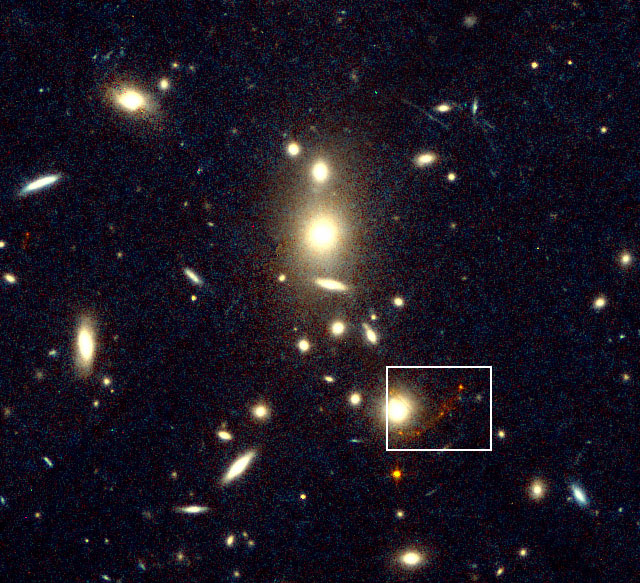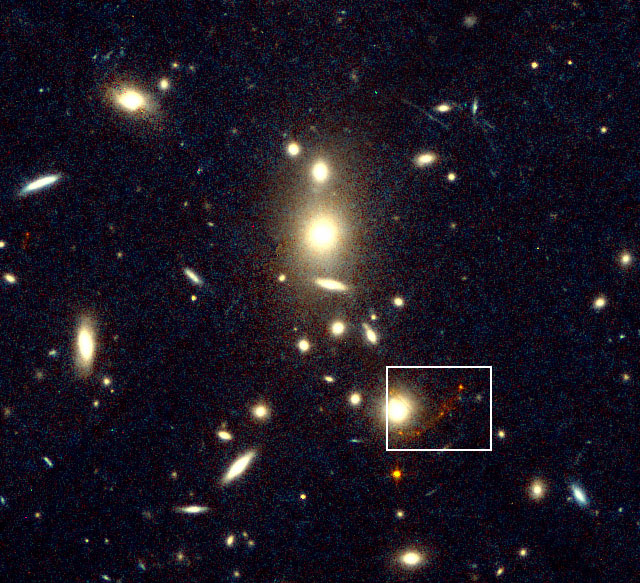
What if we could see back to the beginning of the universe? At one tenth the universe's present age, we might see galaxies forming. But what did galaxies look like when they were forming? These questions took a step toward being answered yesterday with the release of analysis of a Hubble Space Telescope (HST) photograph of the most distant object yet discovered. Pictured in the box above, this galaxy appears to us - billions of years later and across the universe - as a faint red smudge. In technical terms, this galaxy lies at the record redshift of z=4.92. Practically all of the yellow-white objects in the photograph are galaxies in a nearby cluster which together act as a lens in amplifying the light from the ancient galaxy. A follow-up picture by the ground-based Keck Telescope actually measured the distant redshift.
¿Qué veríamos si pudiéramos observar hasta el comienzo del universo? A una décima parte de la edad actual del universo, quizás podríamos ver galaxias en formación. ¿Pero cómo lucían las galaxias cuando se estaban formando? Estas preguntas dieron un paso hacia su respuesta ayer, con la publicación del análisis de una fotografía del Telescopio Espacial Hubble (HST) del objeto más distante jamás descubierto. Representada en el recuadro superior, esta galaxia nos aparece —miles de millones de años después y a lo largo del universo— como una tenue mancha rojiza. En términos técnicos, esta galaxia se encuentra en el corrimiento al rojo récord de z=4,92. Prácticamente todos los objetos amarillo-blancos de la fotografía son galaxias de un cúmulo cercano que actúan en conjunto como una lente, amplificando la luz proveniente de la antigua galaxia. Una imagen de seguimiento tomada por el Telescopio Keck, situado en tierra, confirmó el lejano corrimiento al rojo.