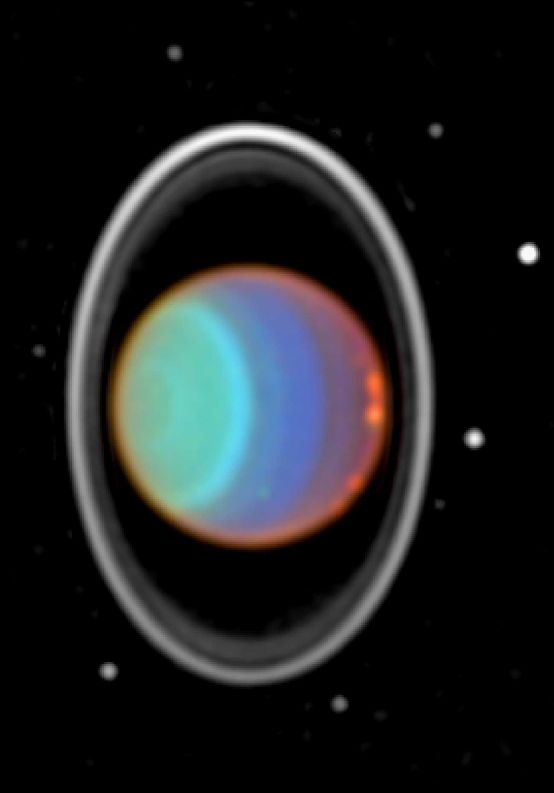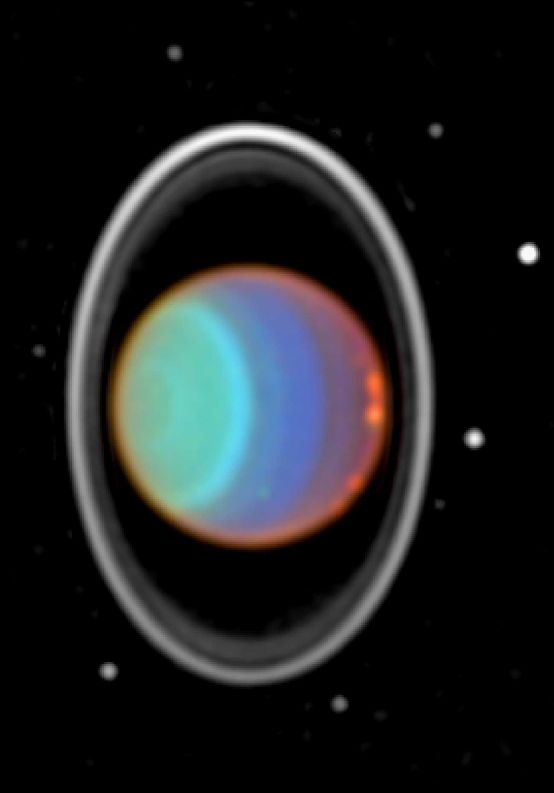
The giant planet Uranus is faint and featureless when viewed in visible light. But this pair of near-infrared mosaics from the Hubble Space Telescope's NICMOS camera reveals moons, rings, and clouds of this distant gas planet. The color coded images highlight different atmospheric layers - blue represents the deepest layers while the highest cloud features have a reddish tinge. Racing around the planet, high, bright clouds are seen to move substantially between the two pictures taken only ninety minutes apart. Ring systems are a common to the solar system's giant planets. Here the main Uranian ring seems to vary in width and is clearly brightest near the top. The eight specks beyond the ring system are small Uranian moons which also show counter-clockwise motion over ninety minutes as traced by the arrows on the right hand image.
El planeta gigante Urano es tenue y carece de rasgos visibles cuando se observa en luz visible. Sin embargo, este par de mosaicos en el infrarrojo cercano obtenidos con la cámara NICMOS del Telescopio Espacial Hubble revela las lunas, los anillos y las nubes de este distante planeta gaseoso. Las imágenes, codificadas en color, destacan diferentes capas atmosféricas: el azul representa las capas más profundas, mientras que las características de nube más elevadas presentan una tonalidad rojiza. Moviéndose velozmente alrededor del planeta, se puede observar que las nubes altas y brillantes se desplazan de manera considerable entre las dos imágenes, tomadas con apenas noventa minutos de diferencia. Los sistemas de anillos son comunes en los planetas gigantes del sistema solar. En este caso, el anillo principal de Urano parece variar en anchura y es claramente más brillante cerca de la parte superior. Los ocho puntos situados más allá del sistema de anillos son pequeñas lunas de Urano, que también muestran un movimiento en sentido antihorario a lo largo de los noventa minutos, tal como indican las flechas en la imagen de la derecha.