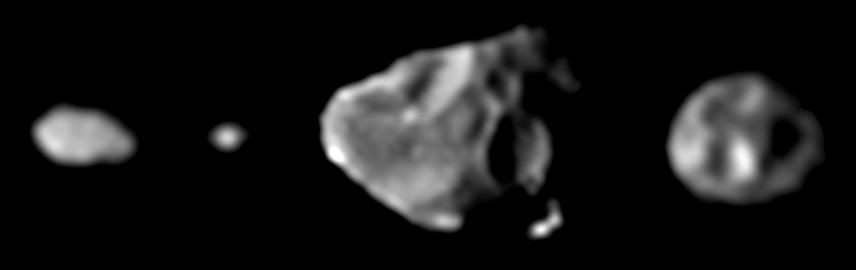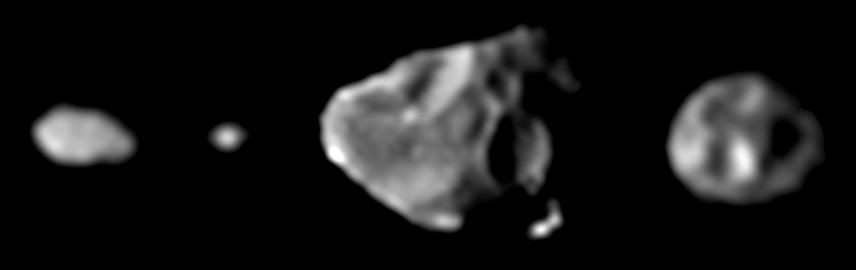
The potato-shaped inner moons of Jupiter are lined-up in this mosaic "family portrait" of these tiny Jovian satellites. The individual images were recorded over the last year by NASA's Galileo spacecraft and are scaled to the moons' relative sizes. Left to right in increasing order of distance from Jupiter are Metis (longest dimension 37 miles), Adrastea (12 miles), Amalthea (154 miles), and Thebe (72 miles). All these moons orbit in the zone between Io and Jupiter's rings, are bombarded by high-energy ions within the Jovian magnetosphere, and are probably locked in synchronous rotation by Jupiter's strong gravity. Why are they shaped like potatoes? Like the asteroids and the diminutive moons of Mars, their own gravity is not strong enough to mold them into spheres.
Las lunas interiores de Júpiter, de forma irregular similar a una patata, aparecen alineadas en este mosaico que constituye un "retrato familiar" de estos diminutos satélites jovianos. Las imágenes individuales fueron registradas durante el último año por la sonda Galileo de la NASA y están escaladas según los tamaños relativos de las lunas. De izquierda a derecha, en orden creciente de distancia a Júpiter, se encuentran Metis (dimensión máxima de 37 millas), Adrastea (12 millas), Amaltea (154 millas) y Tebe (72 millas). Todas estas lunas orbitan en la zona comprendida entre Io y los anillos de Júpiter, son bombardeadas por iones de alta energía dentro de la magnetosfera joviana y probablemente están bloqueadas en rotación sincrónica por la intensa gravedad de Júpiter. ¿Por qué tienen forma de patata? Al igual que los asteroides y las pequeñas lunas de Marte, su propia gravedad no es suficientemente intensa para moldearlas en esferas.