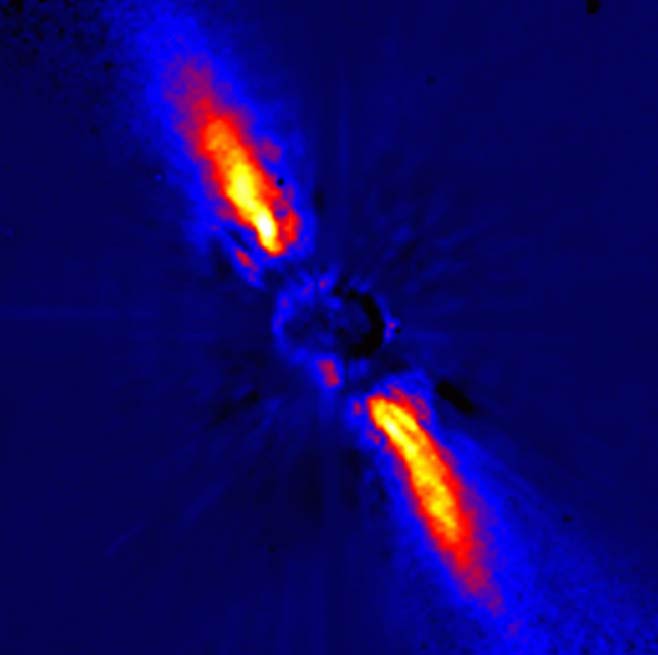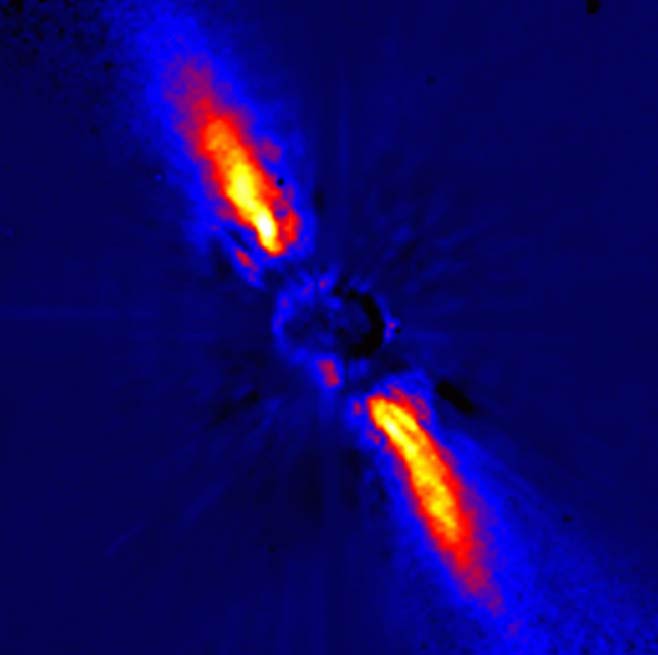
In the early 1980s, Beta Pictoris became one of the most important stars in the sky. Satellite and ground-based telescopic observations revealed the presence of a surrounding outer disk of material and an inner "clear" zone about the size of our solar system - strong evidence for the formation of planets. Beta Pictoris is 50 light years away and any orbiting planets are too small and faint to image at that distance. But evidence continues to mount that this star indeed has comet-like bodies in the disk and a Jupiter-sized planet orbiting within the central zone. Shown here in false color, this recent, highly detailed picture was obtained at the European Southern Observatory by blocking the overwhelming direct starlight and imaging the near-infrared light from the disk. The disk's warped bright inner region is indirect evidence for an orbiting planet.
A principios de la década de 1980, Beta Pictoris se convirtió en una de las estrellas más importantes del cielo. Observaciones telescópicas realizadas desde satélites y desde tierra revelaron la presencia de un disco externo de material circundante y una zona interior "despejada" de un tamaño aproximado al de nuestro sistema solar, lo que constituye una sólida evidencia de la formación de planetas. Beta Pictoris se encuentra a 50 años luz de distancia, y cualquier planeta en órbita es demasiado pequeño y tenue para ser captado en imágenes a esa distancia. Sin embargo, las evidencias continúan acumulándose de que esta estrella posee efectivamente cuerpos similares a cometas en el disco, así como un planeta del tamaño de Júpiter orbitando dentro de la zona central. Mostrada aquí en falso color, esta reciente imagen de gran detalle fue obtenida en el Observatorio Europeo Austral bloqueando la abrumadora luz directa de la estrella y capturando la luz infrarroja cercana proveniente del disco. La región interior brillante y deformada del disco constituye una evidencia indirecta de la existencia de un planeta en órbita.