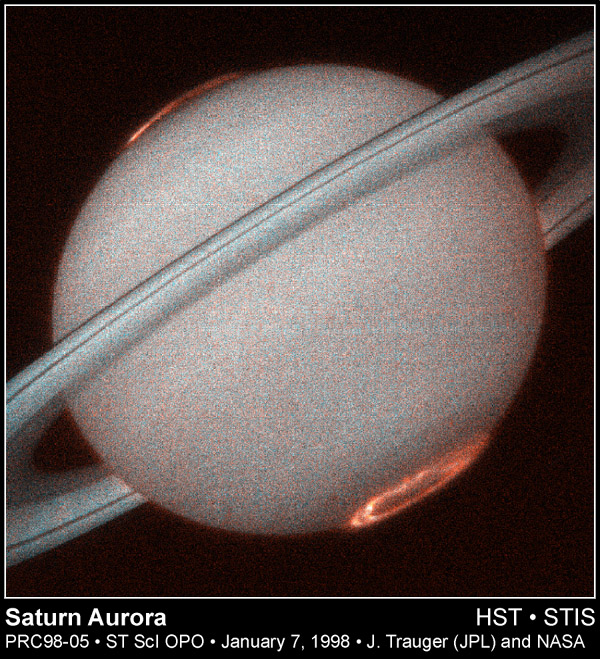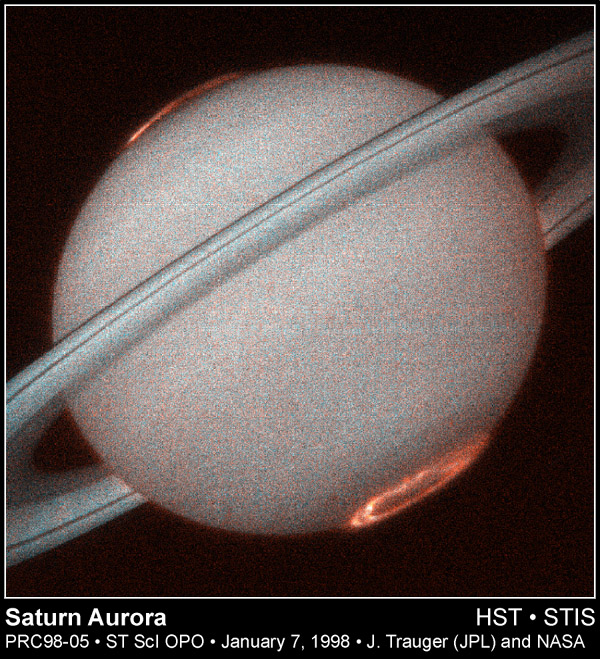
Girdling the second largest planet in the Solar System, Saturn's Rings are one of the most spectacular sights for earthbound telescopes. This recently released image, from the orbiting Hubble Space Telescope's STIS instrument, offers a striking view of another kind of ring around Saturn - pole encircling rings of ultraviolet aurora. Towering more than 1,000 miles above the cloud tops, these Saturnian auroral displays are analogous to Earth's. Energetic charged particles in the Solar Wind are funneled by the planet's magnetic field into polar regions where they interact with atmospheric gases. Following the ebb and flow of Saturn's aurora, researchers can remotely explore the planet's atmosphere and magnetic field. In this false color image, the dramatic red aurora identify emission from atomic hydrogen, while the more concentrated white areas are due to hydrogen molecules. In 2004, NASA plans to begin making close-up studies of the Saturnian system with the Cassini Spacecraft.
Ciñendo al segundo planeta más grande del Sistema Solar, los Anillos de Saturno son uno de los espectáculos más notables para los telescopios terrestres. Esta imagen recientemente publicada, obtenida por el instrumento STIS del Telescopio Espacial Hubble en órbita, ofrece una vista impresionante de otro tipo de anillo alrededor de Saturno: anillos de aurora ultravioleta que rodean sus polos. Elevándose más de 1,600 kilómetros por encima de las cimas de las nubes, estas auroras saturnianas son análogas a las de la Tierra. Las partículas cargadas de alta energía provenientes del Viento Solar son canalizadas por el campo magnético del planeta hacia las regiones polares, donde interactúan con los gases atmosféricos. Al seguir el flujo y reflujo de la aurora de Saturno, los investigadores pueden explorar remotamente la atmósfera y el campo magnético del planeta. En esta imagen de color artificial, las dramáticas auroras rojas identifican la emisión de hidrógeno atómico, mientras que las áreas blancas más concentradas corresponden a moléculas de hidrógeno. En 2004, la NASA planeaba iniciar estudios de cerca del sistema saturníaco con la nave espacial Cassini.