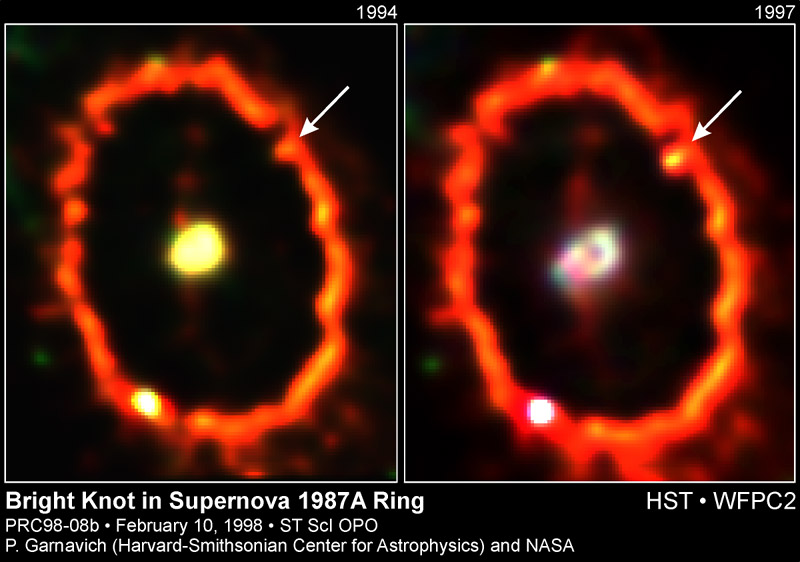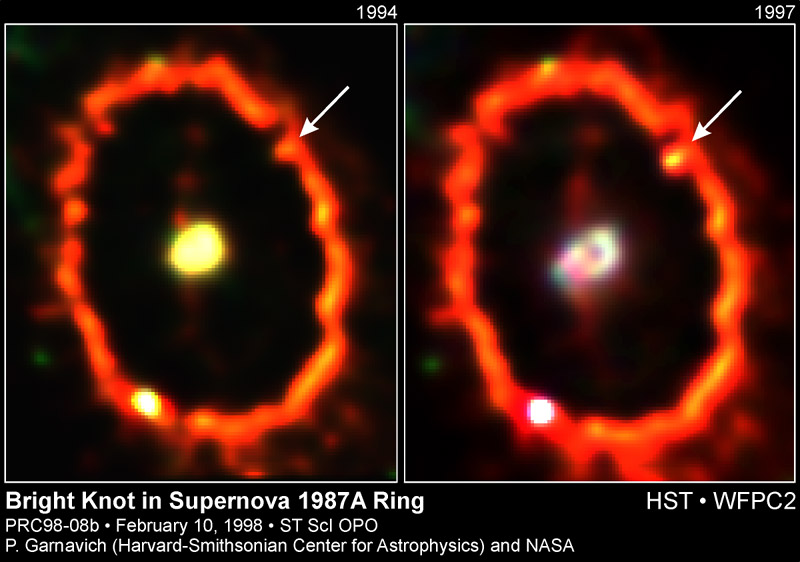
even years ago the brightest supernova of modern times was recorded. Now the expanding debris from this tremendous stellar explosion is seen to be crashing into previously expelled material. The onset of this collision is shown by the arrow in the above picture as the yellow spot on the interior of the ring. Although the collision is occurring at speeds near 60 million km/hour, it will appear to take years due to the vast distances involved. As the supernova blast wave moves out, it shock-heats any gas it encounters, causing it to glow. Astronomers are thus hopeful that the blast wave will illuminate the interesting past of SN 1987a, and perhaps provide more clues about the origins of the mysterious rings.
Hace varios años se registró la supernova más brillante de los tiempos modernos. Ahora se observa que los restos en expansión de esta tremenda explosión estelar colisionan con material expulsado anteriormente. El inicio de esta colisión se indica con la flecha en la imagen superior, visible como el punto amarillo en el interior del anillo. Aunque la colisión ocurre a velocidades cercanas a los 60 millones de km/hora, parecerá prolongarse durante años debido a las vastas distancias involucradas. A medida que la onda de choque de la supernova avanza hacia el exterior, calienta por choque el gas que encuentra a su paso, provocando que este brille. Los astrónomos albergan así la esperanza de que la onda de choque ilumine el interesante pasado de SN 1987a, y quizás proporcione más pistas sobre el origen de los misteriosos anillos.