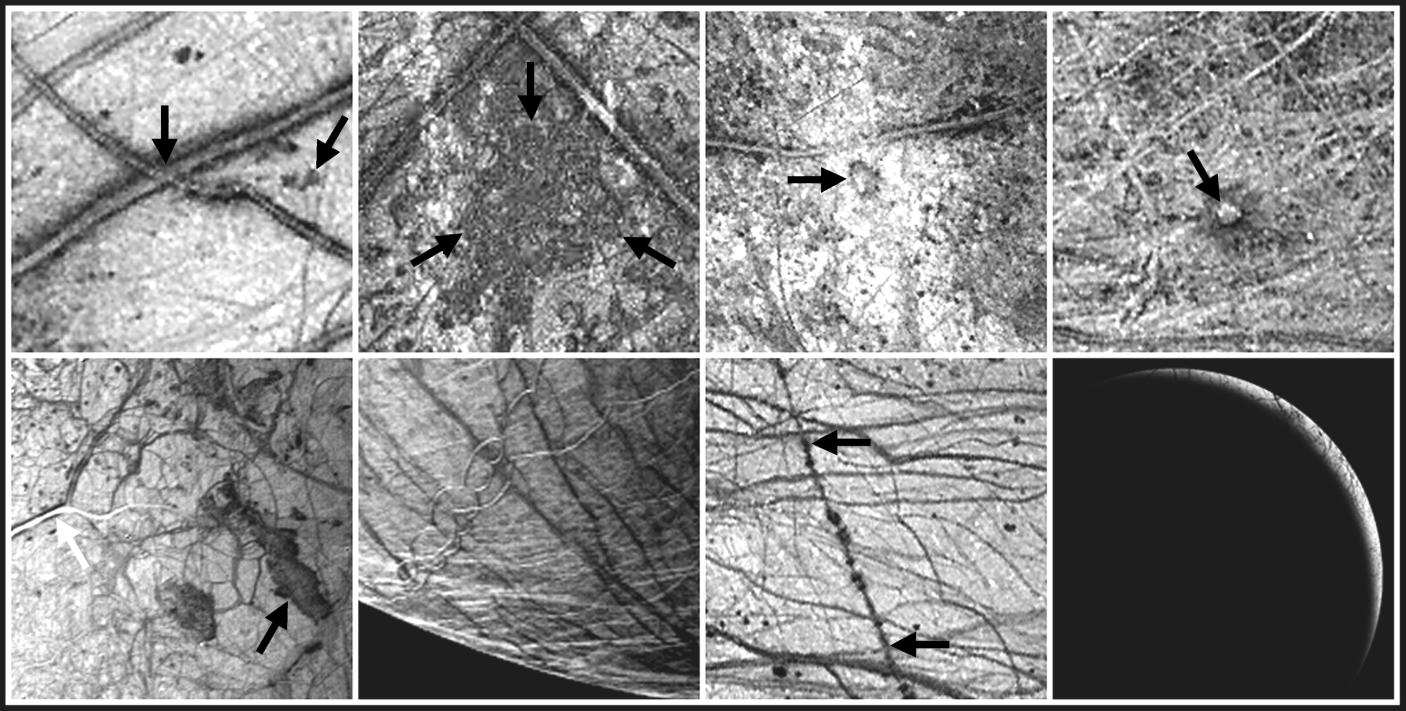
uropa's icy crust has many unusual features. Pictured above is part of Europa's southern hemisphere photographed by the Galileo spacecraft currently orbiting Jupiter. Europa is one of the largest moons of Jupiter, and is thought to have oceans of water underneath its ice-covered surface. Among many cracks and ridges appear dark cusp-shaped features running from the lower left toward the upper right. The origin of these features is not known for sure, but their shape is thought to indicate that large portions of Europa's crust move together, similar to tectonic motion of our Earth's crust.
La corteza helada de Europa presenta numerosas características inusuales. La imagen superior muestra una parte del hemisferio sur de Europa, fotografiada por la nave espacial Galileo, que actualmente orbita Júpiter. Europa es una de las lunas más grandes de Júpiter y se cree que posee océanos de agua líquida bajo su superficie cubierta de hielo. Entre numerosas grietas y crestas aparecen estructuras oscuras en forma de cúspide que se extienden desde el extremo inferior izquierdo hacia el superior derecho. El origen de estas estructuras no se conoce con certeza, pero su forma sugiere que grandes porciones de la corteza de Europa se desplazan conjuntamente, de manera similar al movimiento tectónico de la corteza terrestre.