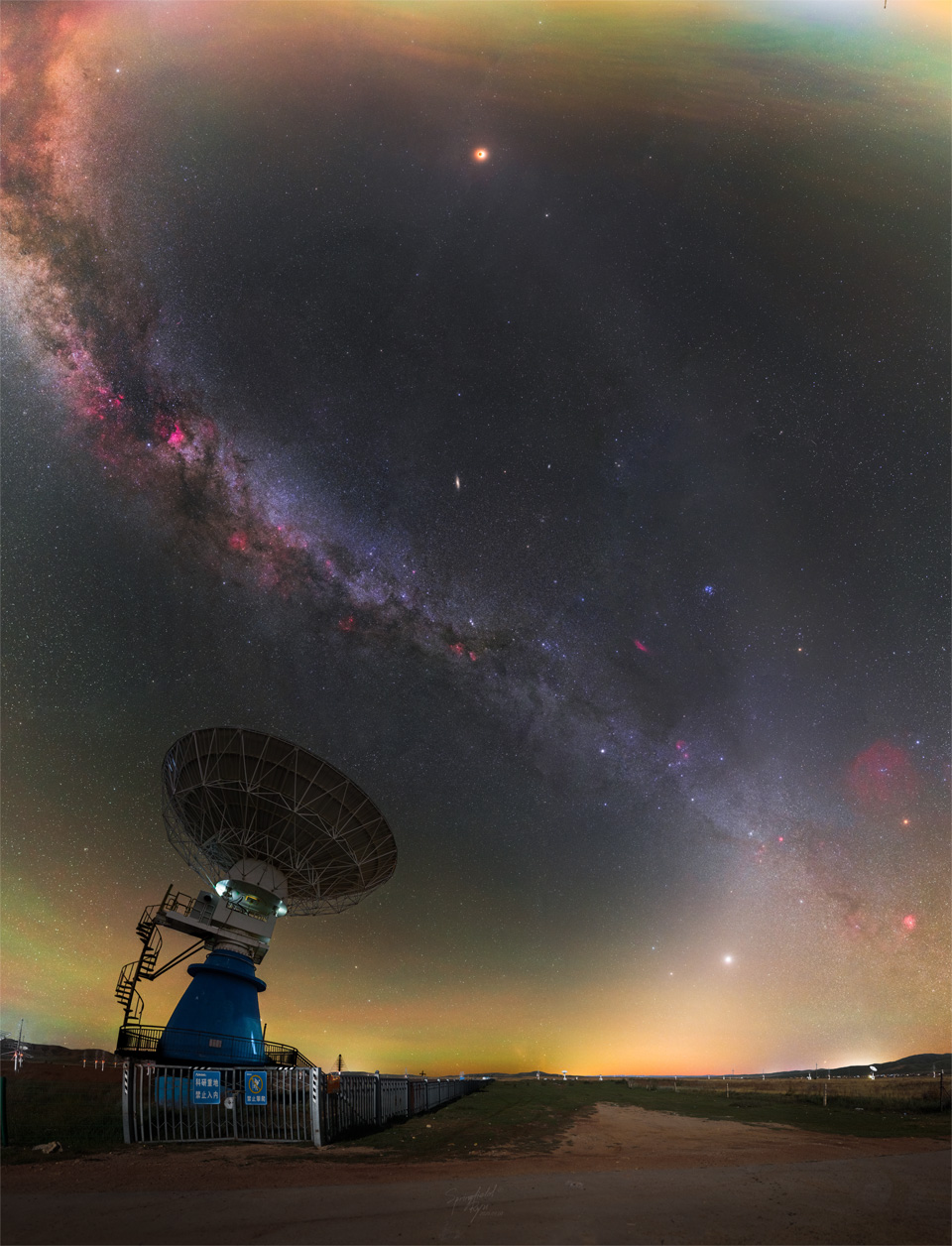
Since the early days of radio and television we have been freely broadcasting signals into space. For some time now, we have been listening too. Ohio State University's radio telescope, affectionately known as "The Big Ear" , was one of the first and largest listeners. Designed by John Kraus, OSU's Big Ear (about the size of three football fields) consisted of an immense metal ground plane with two fence-like reflectors (one fixed and one tiltable) and relied on the Earth's rotation to help scan the sky. This photo, taken by former Big Ear student volunteer Rick Scott, looks out across the ground plane toward the fixed reflector with the "receiver horns" in the foreground. This May, the final pieces of the Big Ear were torn down, but its explorations of the radio universe will be long remembered. Starting in 1965, the Big Ear was used in an ambitious premier survey of the radio sky, ultimately finding over 20,000 celestial radio sources. Changing its focus in the 1970s, it became the first telescope to continuously listen for signals from extraterrestrial civilizations. For an exciting moment during August 1977 a very strong and unanticipated signal, dubbed the Wow! Signal, was detected by the Big Ear. But alas, heard only once, the cause of the signal could not be determined.
Desde los primeros días de la radio y la televisión, hemos estado emitiendo señales libremente hacia el espacio. Desde hace algún tiempo, también hemos estado escuchando. El radiotelescopio de la Universidad Estatal de Ohio, conocido cariñosamente como "El Gran Oído" (Big Ear), fue uno de los primeros y más grandes receptores. Diseñado por John Kraus, el Big Ear de la OSU (aproximadamente del tamaño de tres campos de fútbol americano) consistía en un inmenso plano de tierra metálico con dos reflectores en forma de valla (uno fijo y otro inclinable) y dependía de la rotación de la Tierra para ayudar a escanear el cielo. Esta fotografía, tomada por el exvoluntario estudiantil del Big Ear Rick Scott, muestra una vista a través del plano de tierra hacia el reflector fijo, con las "bocinas receptoras" en primer plano. Este mes de mayo, las últimas piezas del Big Ear fueron demolidas, pero sus exploraciones del universo radiofónico serán recordadas por mucho tiempo. A partir de 1965, el Big Ear se utilizó en un ambicioso estudio preliminar del cielo radiofónico, encontrando en última instancia más de 20.000 fuentes de radio celestes. Al cambiar su enfoque en la década de 1970, se convirtió en el primer telescopio en escuchar de forma continua señales provenientes de civilizaciones extraterrestres. Durante un emocionante momento en agosto de 1977, el Big Ear detectó una señal muy intensa e inesperada, denominada la Señal ¡Guau! (Wow! Signal). Sin embargo, al haber sido detectada una sola vez, no fue posible determinar el origen de dicha señal.