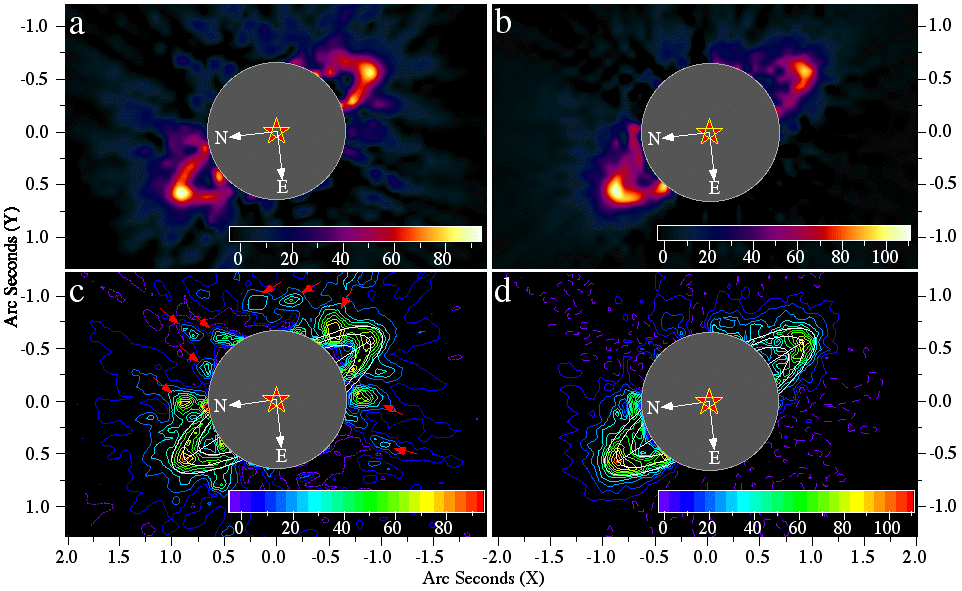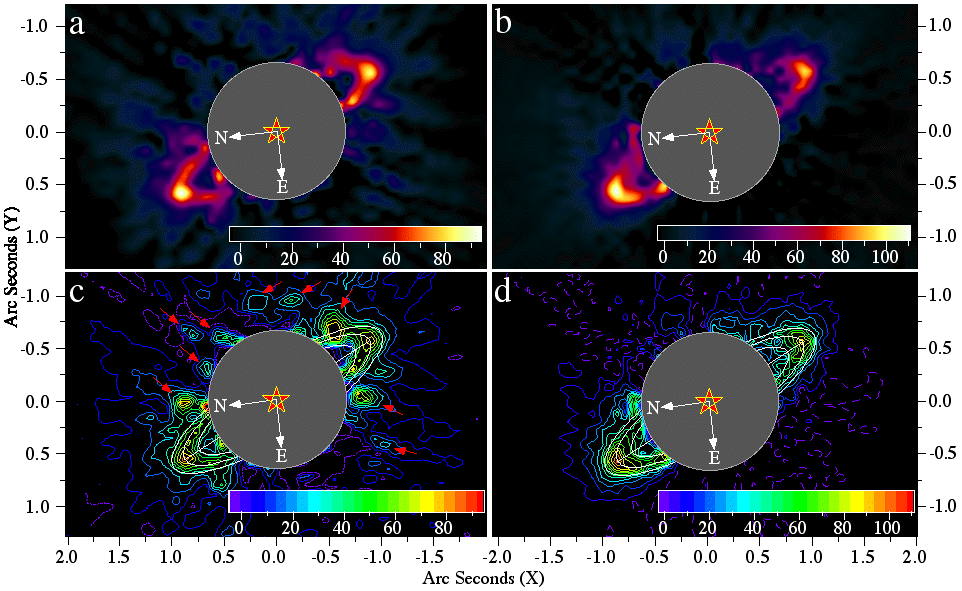
These are not false-color renderings of the latest observations of Saturn's magnificent rings. Instead, the panels show a strikingly similar system on a much larger scale - a ring around the young, Vega-like star, HR 4796A, located about 200 light-years from Earth. Probably composed of dusty debris ground from colliding planetesimals, this ring is confined to a zone less than 17 AU wide (1 AU equals the Earth-Sun distance) and girdles the star at a radius of about 70 AU, roughly twice the orbital radius of Neptune. In analogy with the relationship of Saturn's rings and moons, this circumstellar ring could be held in place by forces due to planets - shepherding planetary bodies or the gravitational influence of larger planets orbiting closer to the parent star. In any event, because the ring would not survive long without something to keep it there, astronomers consider its presence strong evidence for unseen planetary bodies around HR 4796A. The top panels show the false-color images at two infrared wavelengths from the Hubble Space Telescope's NICMOS instrument, and the bottom panels trace the corresponding image contours. At the center of each, the overwhelming light of HR 4796A has been masked to reveal the fainter circumstellar ring.
Estas no son representaciones en falso color de las últimas observaciones de los magníficos anillos de Saturno. En cambio, los paneles muestran un sistema sorprendentemente similar a una escala mucho mayor: un anillo alrededor de la estrella joven similar a Vega, HR 4796A, ubicada a unos 200 años luz de la Tierra. Probablemente compuesto de escombros polvorientos procedentes de la colisión de planetesimales, este anillo está confinado en una zona de menos de 17 UA de ancho (1 UA equivale a la distancia Tierra-Sol) y rodea la estrella a un radio de aproximadamente 70 UA, aproximadamente el doble del radio orbital de Neptuno. En analogía con la relación entre los anillos de Saturno y sus lunas, este anillo circumestelar podría mantenerse en su lugar por las fuerzas ejercidas por planetas: cuerpos planetarios pastores o la influencia gravitacional de planetas más grandes que orbitan más cerca de la estrella principal. En cualquier caso, dado que el anillo no sobreviviría mucho tiempo sin algo que lo mantenga en su lugar, los astrónomos consideran su presencia como una sólida evidencia de cuerpos planetarios no observados alrededor de HR 4796A. Los paneles superiores muestran las imágenes en falso color a dos longitudes de onda infrarrojas obtenidas con el instrumento NICMOS del Telescopio Espacial Hubble, y los paneles inferiores trazan los contornos de imagen correspondientes. En el centro de cada uno, la abrumadora luz de HR 4796A ha sido enmascarada para revelar el más tenue anillo circumestelar.