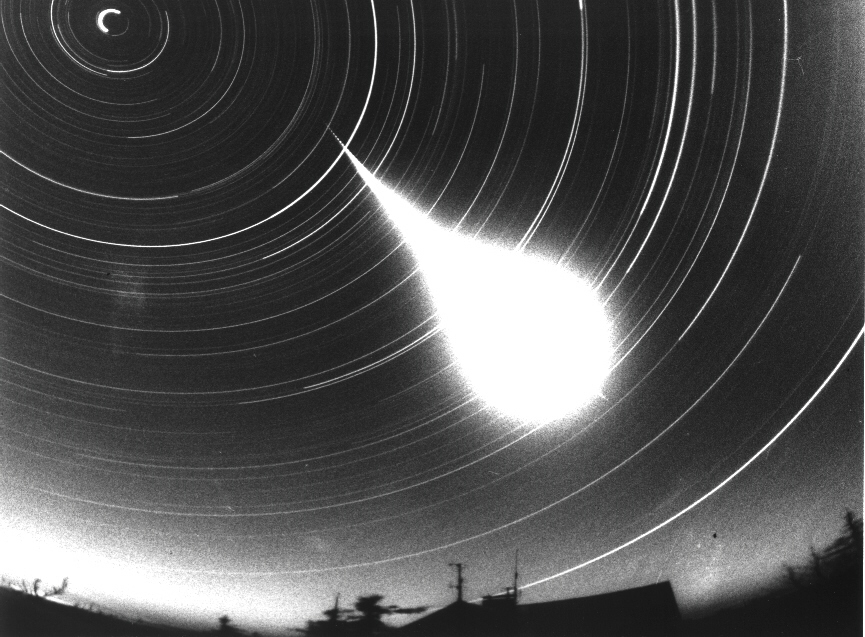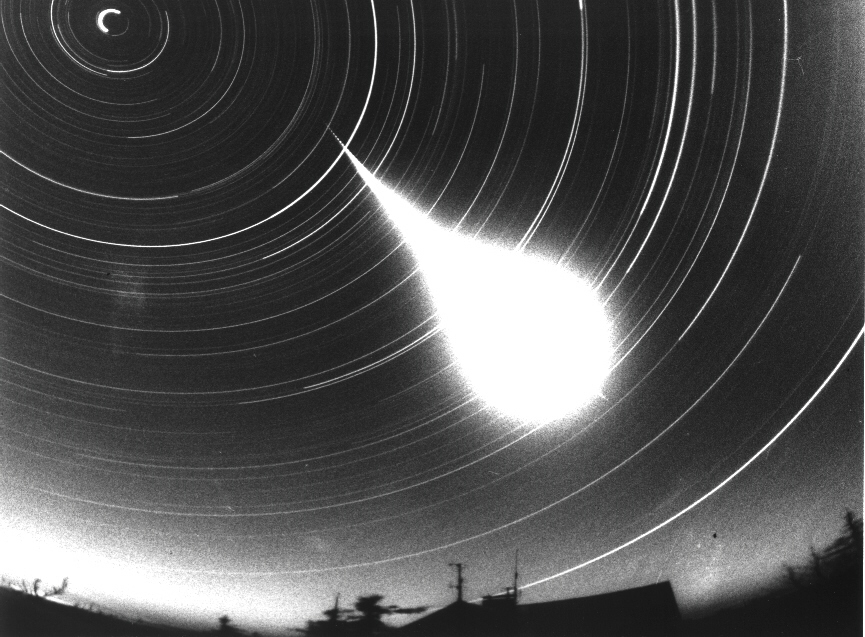
This exceptionally bright fireball meteor trail was photographed with a fish-eye camera at a Czech Republic station of the European Fireball Network on January 21, 1999. Of the star trails visible in this night-long exposure, the bright short arc in the upper left is due to Polaris, the north star. The breaks seen near the beginning of the fireball trail itself were produced by a shutter rotating 15 times a second. In all, three stations recorded the dazzling streak and their combined tracking information has revealed details of the meteor's brief atmospheric flight and previous interplanetary voyage. For example, the luminous trail is measured to begin at an altitude of 81.9 kilometers and covered 71.1 kilometers in 6.7 seconds. The projected prior orbit for the meteoroid corresponds to one typical for Apollo class asteroids which can cross Earth's orbit. In forty years of operations the European Network has multistation recordings of less than 10 or so fireballs as bright as this one. It is thought likely that a small (a few hundred grams) meteorite survived this fiery fall to Earth and landed near the Czech-Poland border.
Este excepcional rastro de meteoro tipo bola de fuego fue fotografiado con una cámara ojo de pez en una estación de la República Checa perteneciente a la Red Europea de Bolas de Fuego el 21 de enero de 1999. Entre los rastros estelares visibles en esta exposición de toda la noche, el arco corto y brillante en la esquina superior izquierda corresponde a Polaris, la estrella polar. Las interrupciones observadas cerca del inicio del rastro de la bola de fuego fueron producidas por un obturador que rotaba 15 veces por segundo. En total, tres estaciones registraron el deslumbrante trazo y la información combinada de su seguimiento ha revelado detalles sobre el breve vuelo atmosférico del meteoro y su viaje interplanetario previo. Por ejemplo, se midió que el rastro luminoso comenzó a una altitud de 81,9 kilómetros y recorrió 71,1 kilómetros en 6,7 segundos. La órbita previa proyectada para el meteoroide corresponde a una típica de los asteroides de clase Apolo, que pueden cruzar la órbita de la Tierra. En cuarenta años de operaciones, la Red Europea ha registrado con múltiples estaciones menos de 10 bolas de fuego tan brillantes como esta. Se considera probable que un pequeño meteorito (de unos pocos cientos de gramos) haya sobrevivido esta ardiente caída hacia la Tierra y haya aterrizado cerca de la frontera entre la República Checa y Polonia.