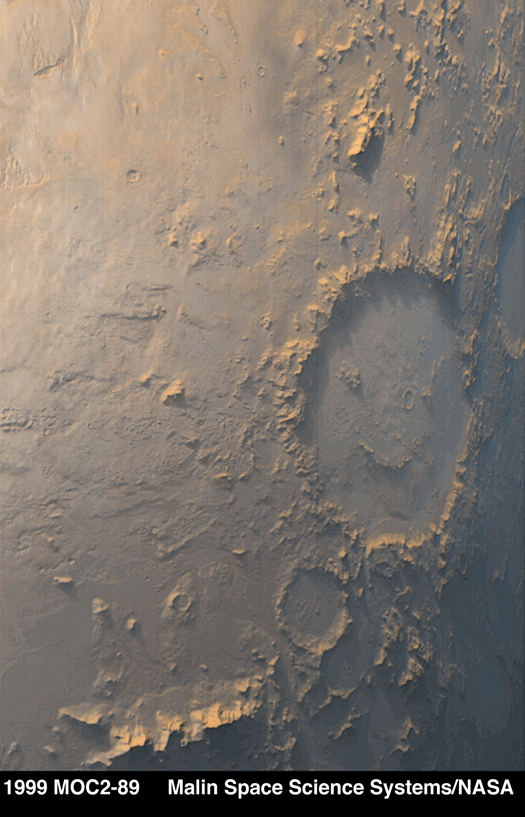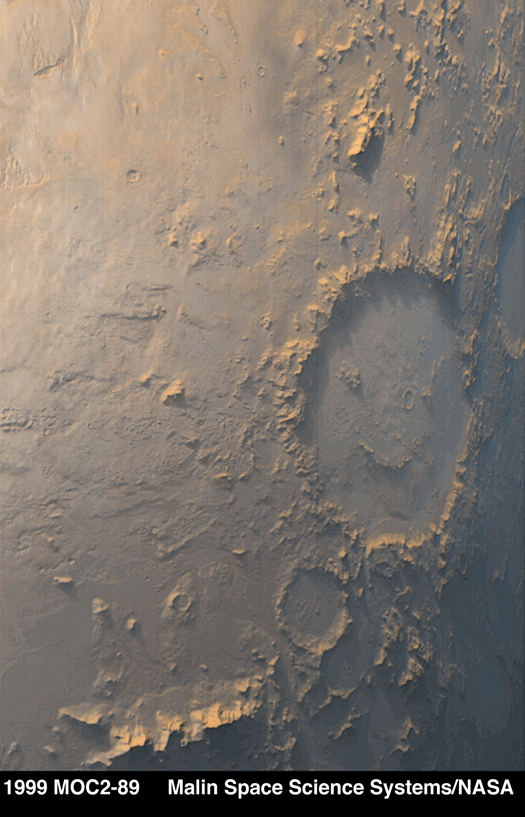
ven Mars can put on a happy face. The Martian crater Galle has internal markings reminiscent of a smiley face symbol. Such markings were originally discovered in the late 1970s in pictures taken by the Viking Orbiter. A large meteor impacted the Martian surface to form the crater. Conventional wisdom holds that the markings inside the crater are placed by chance by natural processes. The Mars Global Surveyor (MGS) spacecraft currently orbiting Mars took the above picture. MGS recently started the global surveying phase of its mission.
Incluso Marte puede mostrar una cara feliz. El cráter marciano Galle posee formaciones internas que recuerdan al símbolo de una cara sonriente. Dichas formaciones fueron descubiertas originalmente a finales de la década de 1970 en imágenes captadas por el Viking Orbiter. Un gran meteorito impactó la superficie marciana para dar origen a este cráter. La interpretación convencional sostiene que las formaciones en el interior del cráter han sido dispuestas por azar mediante procesos naturales. La nave espacial Mars Global Surveyor (MGS), actualmente en órbita alrededor de Marte, tomó la imagen que se muestra arriba. El MGS comenzó recientemente la fase de reconocimiento global de su misión.