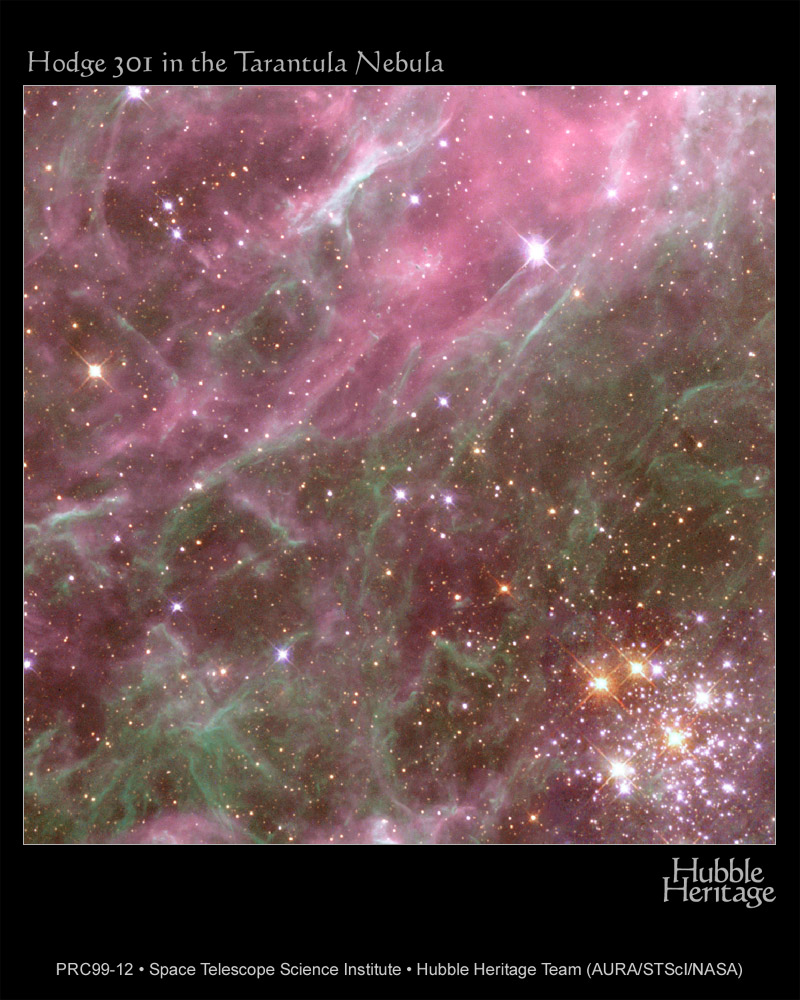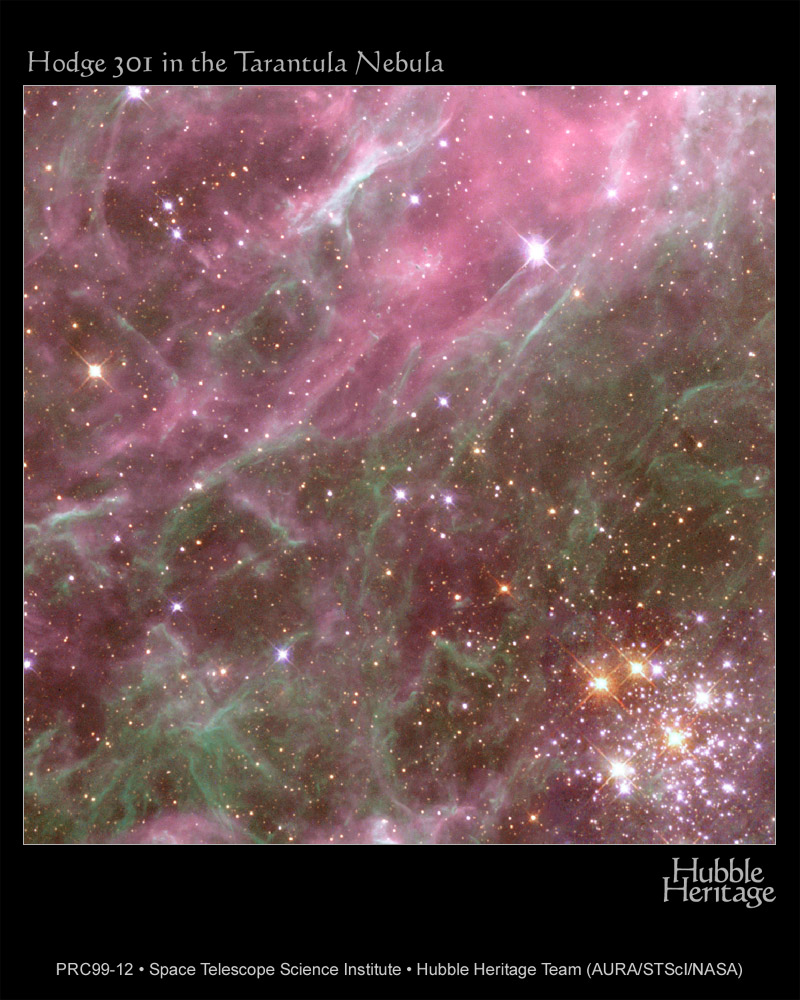
The star cluster at lower right, cataloged as Hodge 301, is a denizen of the Tarantula Nebula. An evocative nebula in the southern sky, the sprawling cosmic Tarantula is an energetic star forming region some 168,000 light-years distant in our neighboring galaxy the Large Magellanic Cloud. The stars within Hodge 301 formed together tens of millions of years ago and as the massive ones quickly exhaust their nuclear fuel they explode. In fact, the red giant stars of Hodge 301 are rapidly approaching this violent final phase of stellar evolution - known as a supernova. These supernova blasts send material and shock waves back into the nebular gas to create the Tarantula's glowing filaments also visible in this Hubble Space Telescope Heritage image. But these spectacular stellar death explosions signal star birth as well, as the blast waves condense gas and dust to ultimately form the next generation of stars inside the Tarantula Nebula.
El cúmulo estelar en la parte inferior derecha, catalogado como Hodge 301, es un habitante de la Nebulosa Tarántula. Esta evocadora nebulosa en el cielo austral es una energética región de formación estelar situada a unos 168.000 años-luz de distancia, en nuestra galaxia vecina, la Gran Nube de Magallanes. Las estrellas que conforman Hodge 301 se formaron juntas hace decenas de millones de años y, a medida que las más masivas agotan rápidamente su combustible nuclear, explotan. De hecho, las estrellas gigantes rojas de Hodge 301 se aproximan velozmente a esta violenta fase final de la evolución estelar, conocida como supernova. Estas explosiones de supernova envían material y ondas de choque hacia el gas nebular, creando los luminosos filamentos de la Tarántula que también son visibles en esta imagen del Telescopio Espacial Hubble, obtenida por el programa Heritage. Sin embargo, estas espectaculares explosiones de muerte estelar también anuncian el nacimiento de nuevas estrellas, ya que las ondas expansivas condensan gas y polvo para dar origen a la siguiente generación de estrellas en el interior de la Nebulosa Tarántula.