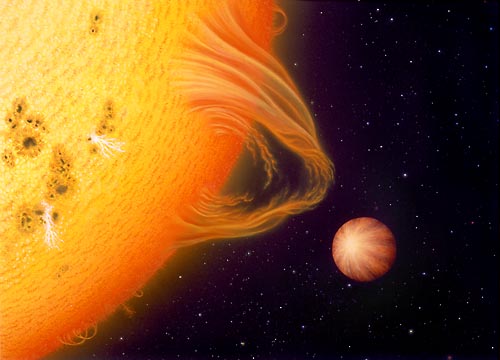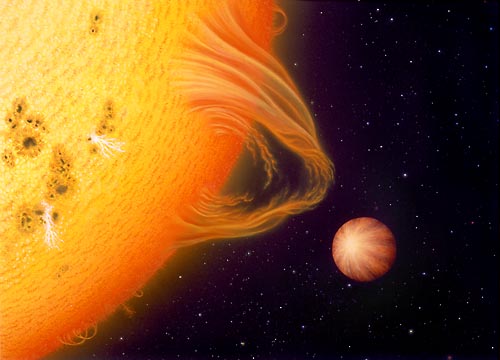
Yesterday, astronomers announced the discovery of the first system of planets around a normal star other than our Sun. Previously, only single planet star systems had been found. Subtle changes in the wobble of Upsilon Andromedae, a Sun-like star in the constellation of Andromeda, allowed astronomers led by R. Paul Butler (AAO) and Geoffrey W. Marcy (SFSU /UCB) to make the breakthrough. This star system is quite different from our own Solar System, however. All three detected planets have masses near or above Jupiter. The discovery implies that multiple-planet systems are quite common, increasing speculation that life-bearing planets similar to Earth may one day be found. The drawing above is an artist's depiction of the Upsilon Andromedae system and its innermost planet. This planet orbits unexpectedly close to its parent star.
Ayer, los astrónomos anunciaron el descubrimiento del primer sistema de planetas alrededor de una estrella normal distinta a nuestro Sol. Hasta entonces, solo se habían encontrado sistemas estelares con un único planeta. Sutiles variaciones en el bamboleo de Upsilon Andromedae, una estrella similar al Sol ubicada en la constelación de Andrómeda, permitieron a los astrónomos liderados por R. Paul Butler (AAO) y Geoffrey W. Marcy (SFSU/UCB) lograr este avance. Sin embargo, este sistema estelar es bastante diferente al nuestro. Los tres planetas detectados tienen masas cercanas o superiores a la de Júpiter. El descubrimiento implica que los sistemas multiplanetarios son bastante comunes, lo que aumenta la especulación de que algún día podrían encontrarse planetas con vida similar a la Tierra. El dibujo que aparece arriba es la representación artística del sistema Upsilon Andromedae y su planeta más interior, el cual orbita inesperadamente cerca de su estrella progenitora.