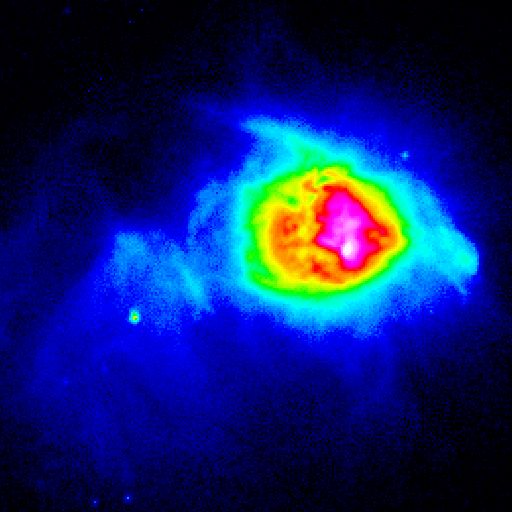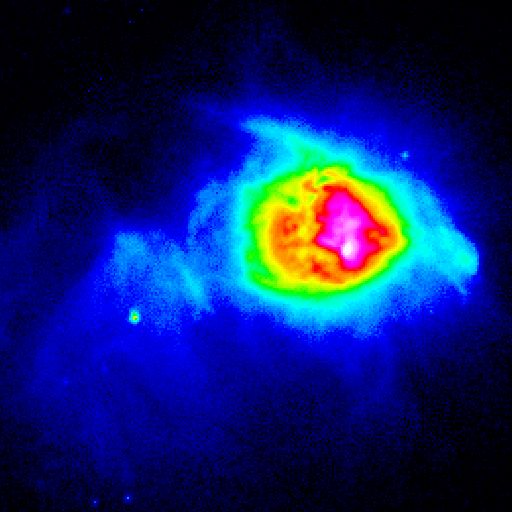
The bright blob of hydrogen gas cataloged as N88A is seen at the right. It measures a mere 3 light years across. Emerging from the cool, dusty interstellar medium in a nearby irregular galaxy known as the Small Magellanic Cloud, N88A hides hot young stars at its core. The false-color Hubble Space Telescope image was recorded in the characteristic "H-alpha" light emitted by hydrogen atoms as they are ionized by the young star's energetic ultraviolet light and then recombine. Other regions of ionized hydrogen (H II regions) which surround new born stars can be over a thousand light-years across but astronomers now recognize that these small ionized hydrogen blobs contain some of the most massive stars known.
La brillante nube de gas hidrógeno catalogada como N88A se observa a la derecha. Mide apenas 3 años luz de diámetro. Emergiendo del medio interestelar frío y polvoriento de una galaxia irregular cercana conocida como la Pequeña Nube de Magallanes, N88A oculta en su núcleo estrellas jóvenes y calientes. La imagen del Telescopio Espacial Hubble en falso color fue registrada en la característica luz "H-alfa" emitida por los átomos de hidrógeno al ser ionizados por la energética luz ultravioleta de las estrellas jóvenes y luego recombinarse. Otras regiones de hidrógeno ionizado (regiones H II) que rodean a estrellas recién nacidas pueden superar los mil años luz de extensión, pero los astrónomos reconocen actualmente que estas pequeñas nubes de hidrógeno ionizado contienen algunas de las estrellas más masivas conocidas.