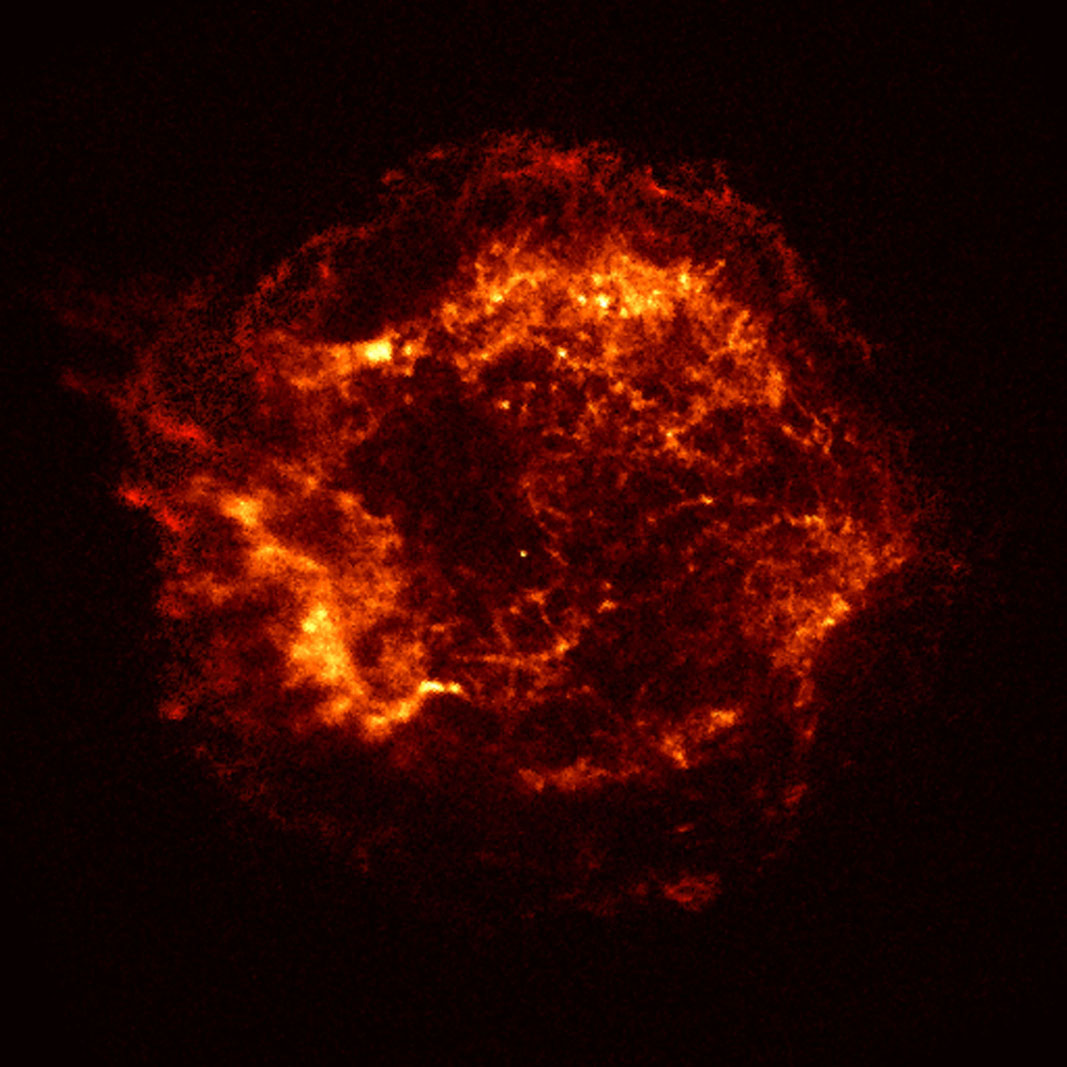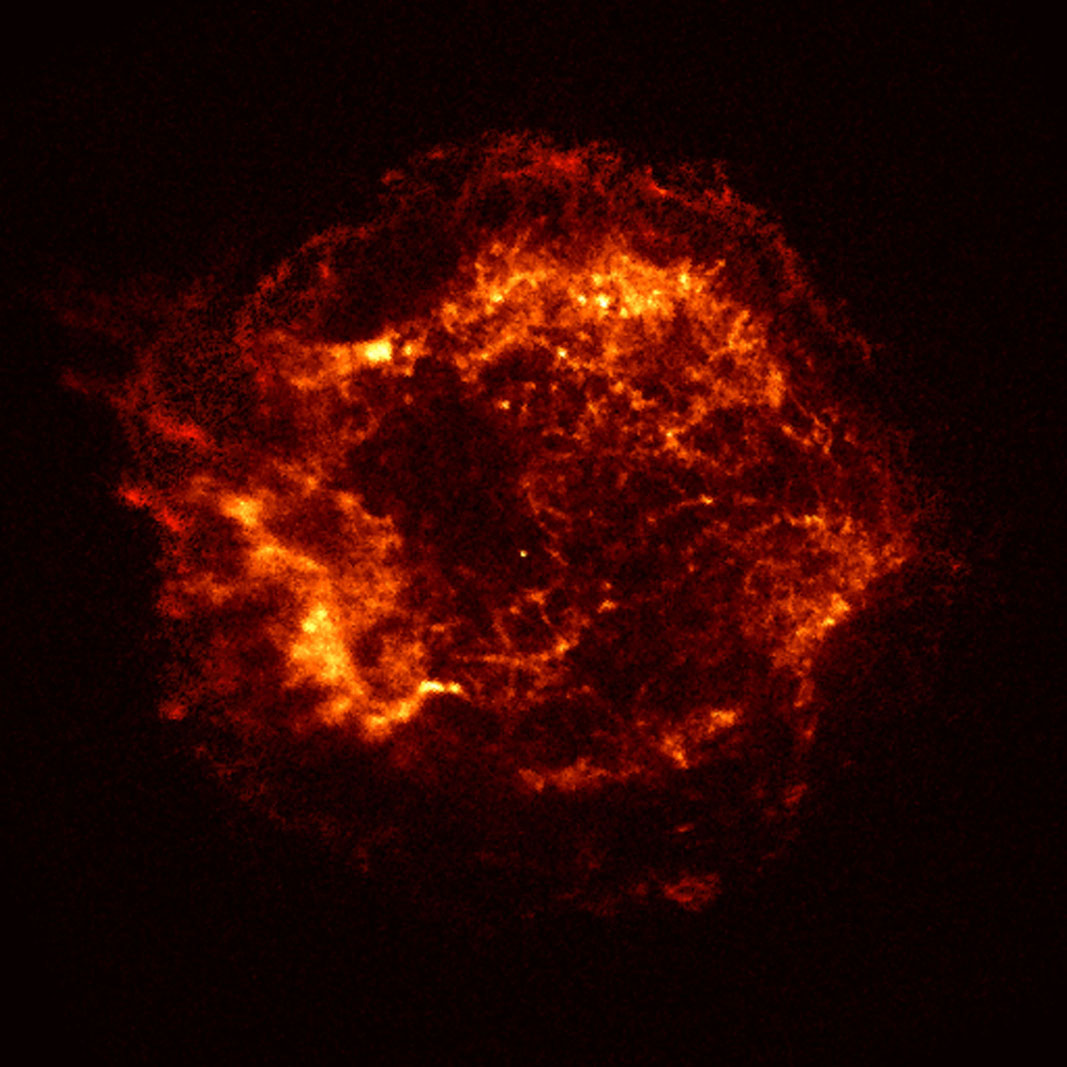
Cosmic wreckage from the detonation of a massive star is the subject of this official first image from NASA's Chandra X-ray Observatory. The supernova remnant, known as Cassiopeia A, was produced when a star exploded around 300 years ago in this northern sky constellation. It is revealed here in unprecedented detail in the light of X-rays - photons with thousands of times the energy of visible light. Shock waves expanding at 10 million miles-per-hour are seen to have heated this 10 light-year diameter bubble of stellar debris to X-ray emitting temperatures of 50 million kelvins. The tantalizing bright speck near the bubble's center could well be the dense, hot remnant of the stellar core collapsed to form a newborn neutron star. With this and other first light images, the Chandra Observatory is still undergoing check out operations in preparation for its much anticipated exploration of the X-ray sky. Chandra was launched aboard the space shuttle Columbia in July.
Los restos cósmicos de la detonación de una estrella masiva son el objeto de esta primera imagen oficial del Observatorio de Rayos X Chandra de la NASA. El remanente de supernova, conocido como Cassiopeia A, fue producido cuando una estrella explotó hace aproximadamente 300 años en esta constelación del cielo boreal. Se revela aquí con un nivel de detalle sin precedentes en la luz de rayos X —fotones con miles de veces la energía de la luz visible—. Se observa que las ondas de choque que se expanden a 10 millones de millas por hora han calentado esta burbuja de escombros estelares de 10 años luz de diámetro hasta temperaturas de emisión de rayos X de 50 millones de kelvins. El tentador punto brillante cerca del centro de la burbuja bien podría ser el denso y caliente remanente del núcleo estelar que colapsó para formar una estrella de neutrones recién nacida. Con esta y otras imágenes de primera luz, el Observatorio Chandra aún se encuentra en operaciones de verificación en preparación para su muy esperada exploración del cielo en rayos X. Chandra fue lanzado a bordo del transbordador espacial Columbia en julio.