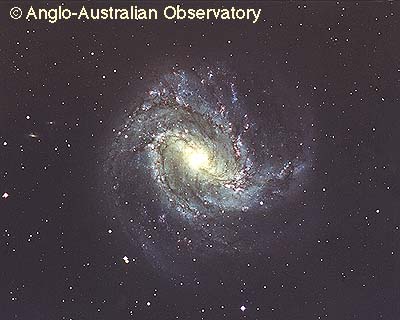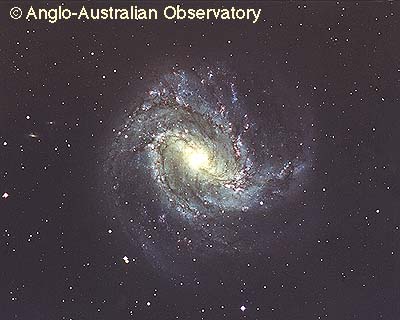
M83 is a bright spiral galaxy that can be found with a small telescope in the constellation of Hydra. It takes light about 15 million years to reach us from M83. M83 is quite a typical spiral - much like our own Milky Way Galaxy. Spiral galaxies contains many billions of stars, the youngest of which inhabit the spiral arms and glow strongly in blue light. Dark dust lanes are mixed in with the stars and help define M83's marked spiral structure. The space between the spiral arms is also filled with stars - but stars that are typically more dim and red. The stars and gas in spiral arms seem to be responding to much more mass than is visible here, implying that galaxies are predominantly composed of some sort of dark matter. Finding the nature of this dark matter remains one of the great challenges of modern science.
M83 es una brillante galaxia espiral que puede observarse con un pequeño telescopio en la constelación de Hydra. La luz tarda aproximadamente 15 millones de años en llegar a nosotros desde M83. M83 es una galaxia espiral bastante típica, muy similar a nuestra propia Vía Láctea. Las galaxias espirales contienen miles de millones de estrellas; las más jóvenes habitan los brazos espirales y brillan intensamente en luz azul. Oscuros carriles de polvo se mezclan con las estrellas y contribuyen a definir la marcada estructura espiral de M83. El espacio entre los brazos espirales también está lleno de estrellas, aunque generalmente más tenues y de tonalidad rojiza. Las estrellas y el gas en los brazos espirales parecen responder a una masa mucho mayor que la visible, lo que implica que las galaxias están compuestas predominantemente por algún tipo de materia oscura. Determinar la naturaleza de esta materia oscura sigue siendo uno de los grandes desafíos de la ciencia moderna.