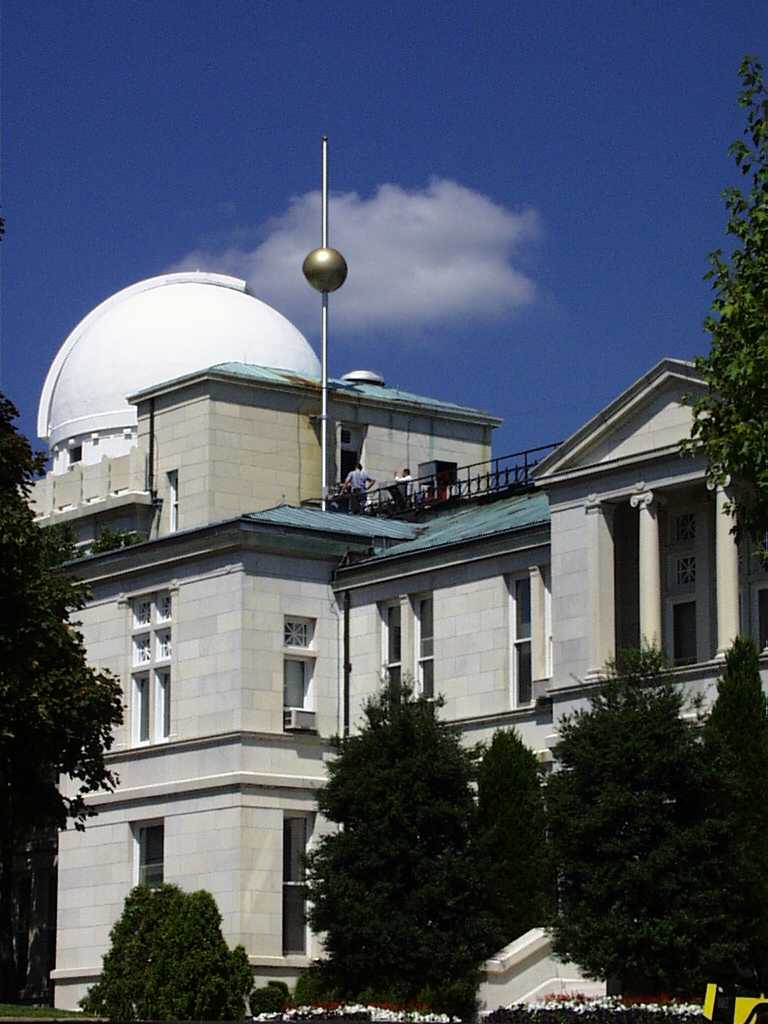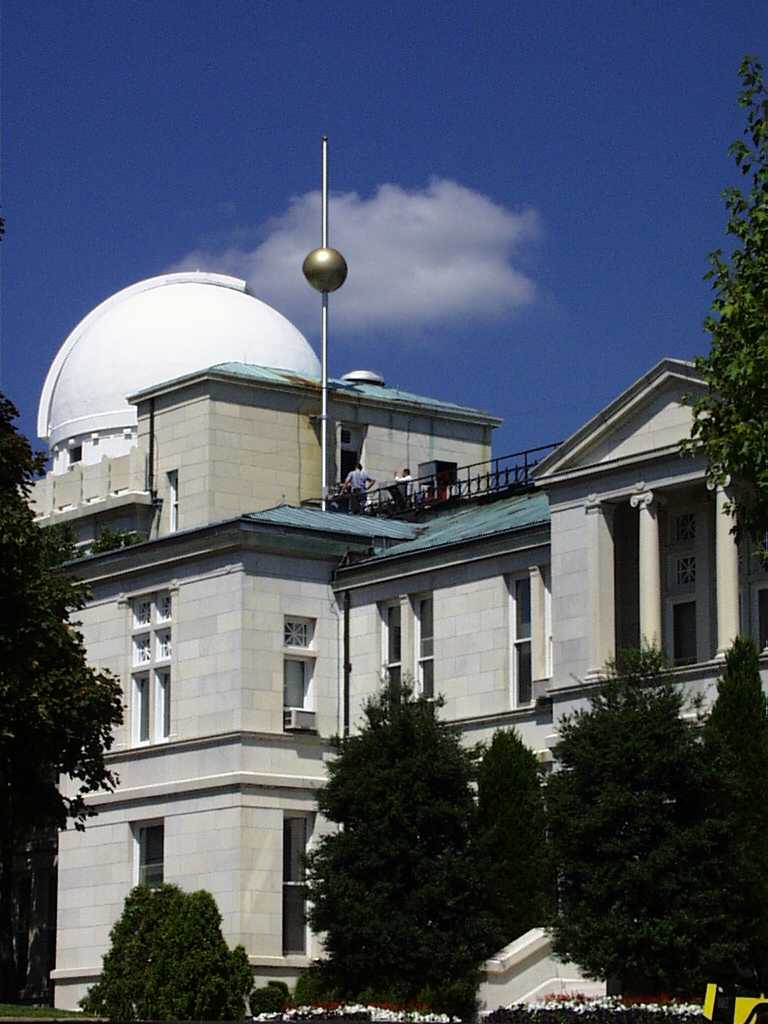
In the nineteenth century, dropping a time ball from a prominent location was a practical way of communicating the time to the surrounding country side and ships at sea. Initiating a fledgling time service for the United States, the U.S. Naval Observatory dropped a time ball at precisely noon every day begining in 1845. At the end of the twentieth century, in commemoration of this traditional method of disseminating time, the U.S. Naval Observatory has installed this ceremonial time ball atop its main building in Washington D.C. Dropping this time ball - at midnight Eastern Standard Time on New Year's Eve - will be the local culmination of a "round-the-world time ball drop" marking the beginning of the year 2000 and the beginning of the Third Millennium in 2001. Meanwhile, don't forget ... this year, in most of the U.S. Daylight Time ends at 2:00 am on Sunday, October 31.
En el siglo XIX, dejar caer una bola de tiempo desde un lugar prominente era una forma práctica de comunicar la hora a las poblaciones cercanas y a los barcos en el mar. Como inicio de un incipiente servicio horario para los Estados Unidos, el Observatorio Naval de los EE. UU. dejaba caer una bola de tiempo exactamente al mediodía cada día, comenzando en 1845. A finales del siglo XX, en conmemoración de este método tradicional de difusión de la hora, el Observatorio Naval de los EE. UU. instaló esta ceremonial bola de tiempo en lo alto de su edificio principal en Washington D.C. La caída de esta bola de tiempo —a la medianoche, hora estándar del Este, en la víspera de Año Nuevo— será la culminación local de un «descenso mundial de bolas de tiempo» que marca el inicio del año 2000 y el comienzo del Tercer Milenio en 2001. Mientras tanto, no olvide... este año, en la mayor parte de los EE. UU., el horario de verano termina a las 2:00 a.m. del domingo 31 de octubre.