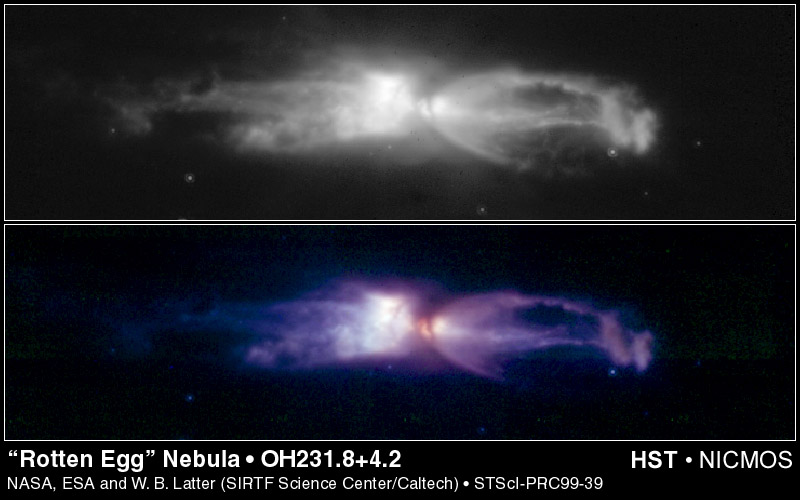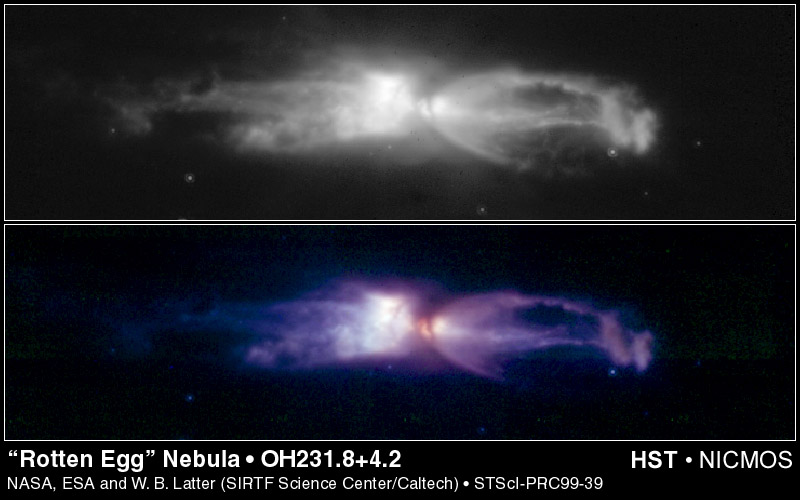
Not all evolving stars eject gas clouds that look like people. OH231.8+4.2 was a star much like our Sun that ran out of nuclear fuel to fuse in its core. It has therefore entered the planetary nebula phase, where it throws off its outer atmosphere into space leaving a core that will become a white dwarf star. Every Sun-like star creates a different planetary nebula though, and OH231.8+4.2's looks eerily like a person! Spectacular jets of streaming gas can be seen in this recently released photograph by the Hubble Space Telescope. The gas cloud has been dubbed the Rotten Egg Planetary Nebula because it contains unusually high amounts of sulfur, an element that, when combined with other elements, can smell like a rotten egg. This young planetary nebula will likely change its appearance over the next few thousand years and eventually disperse.
No todas las estrellas en evolución expulsan nubes de gas que parecen figuras humanas. OH231.8+4.2 fue una estrella muy similar a nuestro Sol que agotó el combustible nuclear disponible para la fusión en su núcleo. Por ello, ha entrado en la fase de nebulosa planetaria, en la que desprende su atmósfera exterior hacia el espacio, dejando un núcleo que se convertirá en una enana blanca. Sin embargo, cada estrella similar al Sol crea una nebulosa planetaria distinta, y la de OH231.8+4.2 presenta un aspecto que recuerda inquietantemente a una figura humana. En esta fotografía recientemente publicada por el Telescopio Espacial Hubble pueden observarse espectaculares chorros de gas en movimiento. La nube de gas ha sido denominada Nebulosa Planetaria del Huevo Podrido debido a que contiene cantidades inusualmente elevadas de azufre, un elemento que, al combinarse con otros elementos, puede desprender un olor similar al de un huevo podrido. Esta joven nebulosa planetaria probablemente modificará su apariencia durante los próximos miles de años y, con el tiempo, se dispersará.