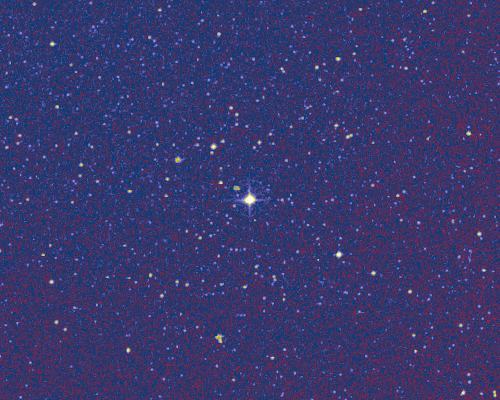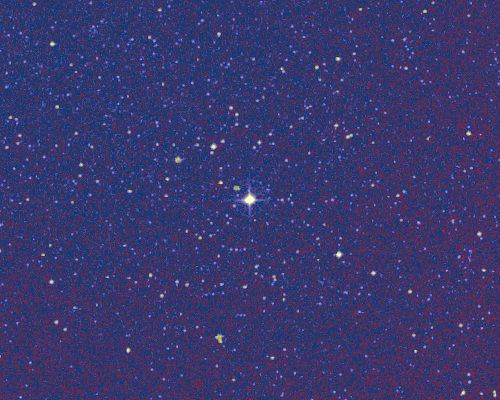
The unassuming star centered in this sky view will one day be our next door stellar neighbor. The faint 9th magnitude red dwarf, currently 63 light-years away in the constellation Ophiucus, was recently discovered to be approaching our Solar System. Known in catalogs of nearby stars as Gliese 710 it is predicted to come within 1 light-year of the Sun ... a million years from now. At that distance this star, presently much too faint to be seen by the naked eye, will blaze at 0.6 magnitude - rivaling the apparent brightness of the mighty red giant Antares. Ultimately Gliese 710 poses no direct collision danger itself although its gravitational influence will likely scatter comets out of the Solar System's reservoir, the Oort cloud, sending some inbound. This future stellar encounter was discovered by researchers Joan Garcia-Sanchez and Robert Preston (JPL), and collaborators while studying stars in the solar neighborhood using data from the Hipparcos Astrometry Satellite. The star field shown is based on the Palomar Digitized Sky Survey and is 1/4 degree wide (about half the diameter of the full moon).
La discreta estrella centrada en esta imagen del cielo será algún día nuestra próxima vecina estelar. Esta tenue enana roja de magnitud 9, actualmente a 63 años-luz de distancia en la constelación de Ofiuco, fue descubierta recientemente como una estrella que se aproxima a nuestro Sistema Solar. Conocida en los catálogos de estrellas cercanas como Gliese 710, se predice que pasará a menos de 1 año-luz del Sol... dentro de un millón de años. A esa distancia, esta estrella, actualmente demasiado tenue para ser visible a simple vista, brillará con una magnitud de 0,6, rivalizando con el brillo aparente del poderoso gigante rojo Antares. En última instancia, Gliese 710 no representa ningún peligro de colisión directa, aunque su influencia gravitacional probablemente dispersará cometas fuera del reservorio del Sistema Solar, la nube de Oort, enviando algunos hacia el interior. Este futuro encuentro estelar fue descubierto por las investigadoras Joan Garcia-Sanchez y Robert Preston (JPL), y sus colaboradores, mientras estudiaban estrellas en la vecindad solar utilizando datos del Satélite de Astrometría Hipparcos. El campo estelar mostrado está basado en el Palomar Digitized Sky Survey y tiene 1/4 de grado de ancho (aproximadamente la mitad del diámetro de la Luna llena).