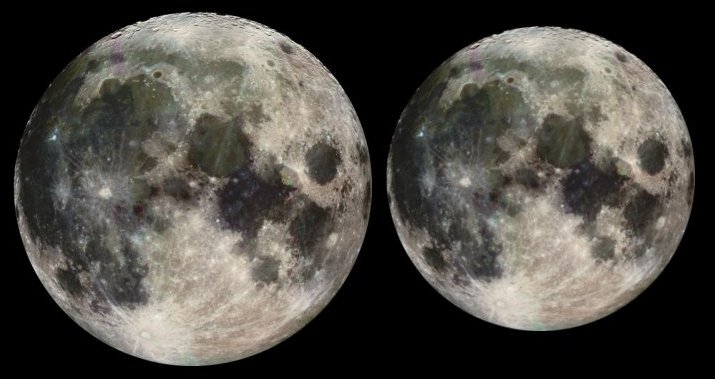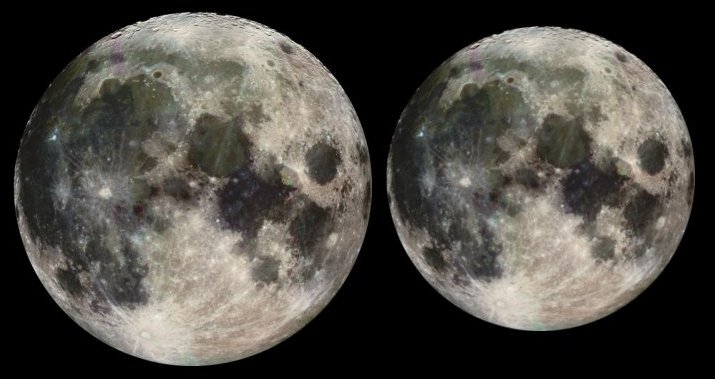
Tonight, those blessed with clear skies can enjoy a glorious full moon, the last full moon of the "Y1.9K"s. In fact, tonight's moon will be a full-perigee-solstice moon, reaching its full phase and perigee (the closest point in its orbit) on the solstice, the first day of northern hemisphere winter. Anticipation of this celestial event has generated a flood of e-mail chasing the rumor that the full-perigee-solstice moon will be intensely bright. However, calculations show it will only be a little brighter than usual, and certainly not dramatically so. Why would it be brighter? Mostly because the moon appears bigger and brighter at perigee. The above illustration, based on Galileo spacecraft images, shows the approximate difference in apparent size between a full moon at perigee (left) and a full moon at apogee, the farthest point in the lunar orbit. The Earth and moon are also a few percent closer to the sun during northern winter, but the combined effects will cause tonight's full moon to appear only about 20% brighter than an average full moon. That difference is not even likely to be noticeable to the human eye.
Esta noche, quienes cuenten con cielos despejados podrán disfrutar de una gloriosa luna llena, la última luna llena de los "años 1900". De hecho, la luna de esta noche será una luna llena en perigeo y solsticio, alcanzando su fase llena y su perigeo (el punto más cercano en su órbita) precisamente en el solsticio, el primer día del invierno en el hemisferio norte. La anticipación de este evento celestial ha generado una avalancha de correos electrónicos propagando el rumor de que la luna llena en perigeo y solsticio será intensamente brillante. Sin embargo, los cálculos demuestran que solo será un poco más brillante de lo habitual, y ciertamente no de forma dramática. ¿Por qué sería más brillante? Principalmente porque la Luna aparece más grande y brillante en el perigeo. La ilustración anterior, basada en imágenes de la sonda espacial Galileo, muestra la diferencia aproximada en tamaño aparente entre una luna llena en perigeo (izquierda) y una luna llena en apogeo, el punto más lejano de la órbita lunar. La Tierra y la Luna también se encuentran unos pocos por ciento más cerca del Sol durante el invierno boreal, pero los efectos combinados harán que la luna llena de esta noche aparezca solo aproximadamente un 20% más brillante que una luna llena promedio. Es probable que esa diferencia ni siquiera sea perceptible para el ojo humano.