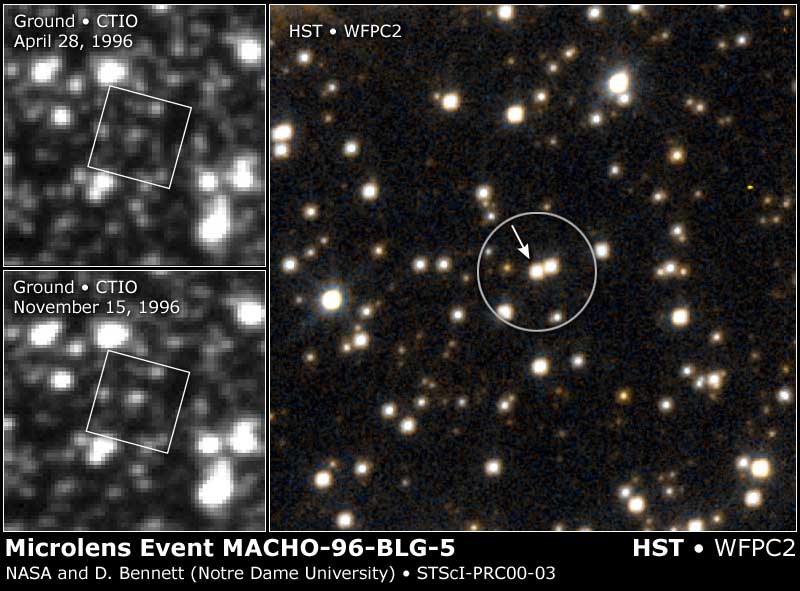
A black hole glides silently through space. Is there any way to know it's there? Until last week, all objects that might be black holes in our Galaxy were part of binary star systems. There, gas from the companion star was hypothesized to swirl around the black hole, heat up, and emit X-rays before falling in. Last week, however, analysis was released of a mysteriously dark object that floated in front of a distant background star, dramatically increasing this star's light by the lens effect of its gravity, as pictured above. The high mass and low light of this strange lens have astronomers guessing they might just have detected a lone black hole, weighing in at six times the mass of our Sun. The existence of isolated black holes is not in itself surprising, as they should be the end result of the cores of massive stars.
Un agujero negro se desliza silenciosamente por el espacio. ¿Existe alguna manera de saber que está ahí? Hasta la semana pasada, todos los objetos que podrían ser agujeros negros en nuestra Galaxia formaban parte de sistemas binarios de estrellas. En ellos, se postulaba que el gas de la estrella compañera se arremolinaba alrededor del agujero negro, se calentaba y emitía rayos X antes de caer en su interior. Sin embargo, la semana pasada se publicó el análisis de un misterioso objeto oscuro que pasó frente a una estrella de fondo lejana, incrementando espectacularmente la luminosidad de dicha estrella mediante el efecto de lente gravitacional, tal como se ilustra en la imagen. La elevada masa y la escasa luminosidad de esta extraña lente llevan a los astrónomos a especular con la posibilidad de haber detectado un agujero negro solitario, con una masa equivalente a seis veces la del Sol. La existencia de agujeros negros aislados no resulta en sí misma sorprendente, ya que deberían ser el resultado final de los núcleos de estrellas masivas.