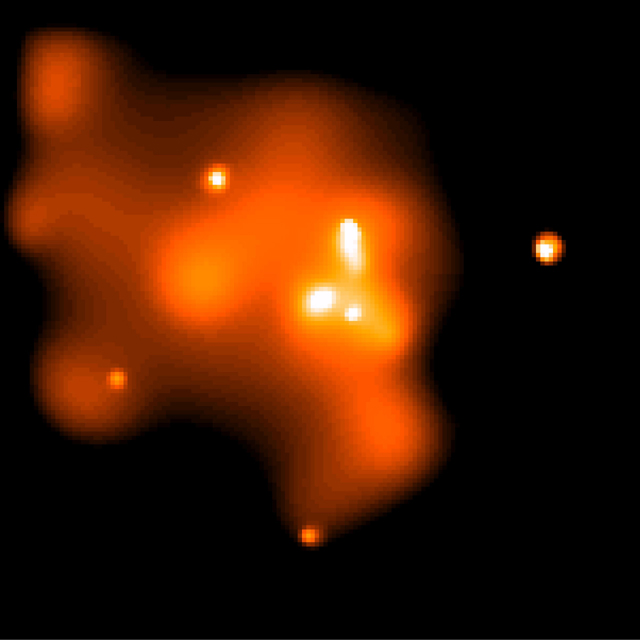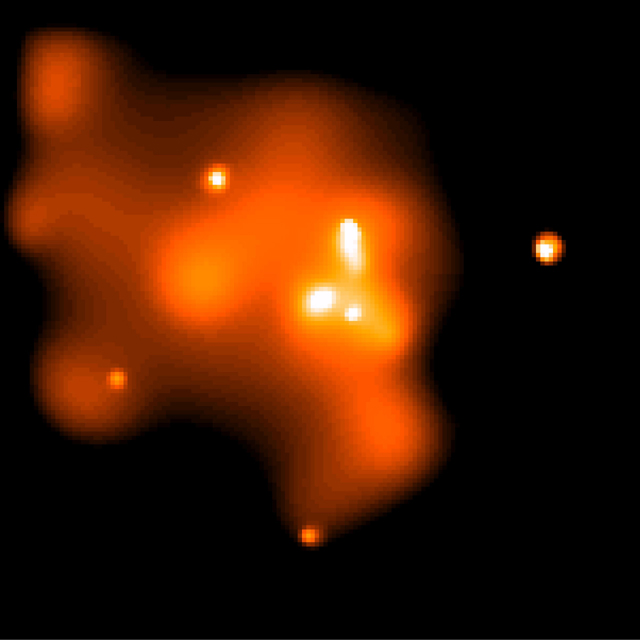
ring quasars and active galaxies in the distant universe, astronomers have come to believe that most galaxies have massive black holes at their centers. Swirling stars and a strong, variable radio source offer convincing evidence that even our own Milky Way galaxy's center harbors such a bizarre object, a mere 30,000 light-years away. Still, it has long been realized that if a massive black hole lurks there it should produce X-rays - which have not previously been identified. Now, though relatively faint, the missing X-ray source may have been found. Taking advantage of the sensitive Chandra Observatory astronomers have recorded this false-color X-ray image of the Galactic Center. Embedded in a diffuse cloud of X-ray hot gas, the white dot at the center corresponds to an X-ray source at exactly the position of the strong radio source and suspected black hole. Other individual X-ray sources are also present in the picture which spans about 10 light-years at the distance of the galactic center. With radio and X-ray emission generated by infalling material, the Milky Way's central black hole is thought to have a mass of over 2 million suns. News: Lunar Eclipse Tonight!
Al observar cuásares con anillos y galaxias activas en el universo distante, los astrónomos han llegado a creer que la mayoría de las galaxias poseen agujeros negros masivos en sus centros. Las estrellas que giran vertiginosamente y una fuente de radio intensa y variable ofrecen evidencia convincente de que incluso el centro de nuestra propia galaxia, la Vía Láctea, alberga un objeto tan extraordinario, a tan solo 30.000 años-luz de distancia. Sin embargo, hace tiempo se reconoció que si un agujero negro masivo se encuentra allí, debería producir rayos X, los cuales no habían sido identificados previamente. Ahora, aunque relativamente débil, la fuente de rayos X que faltaba podría haber sido encontrada. Aprovechando la sensibilidad del Observatorio Chandra, los astrónomos han registrado esta imagen de rayos X en falso color del Centro Galáctico. Inmerso en una nube difusa de gas caliente en rayos X, el punto blanco en el centro corresponde a una fuente de rayos X ubicada exactamente en la posición de la fuerte fuente de radio y el sospechoso agujero negro. Otras fuentes individuales de rayos X también están presentes en la imagen, que abarca aproximadamente 10 años-luz a la distancia del centro galáctico. Con emisión de radio y rayos X generada por material en caída, se estima que el agujero negro central de la Vía Láctea tiene una masa superior a 2 millones de soles. Noticias: ¡Eclipse lunar esta noche!