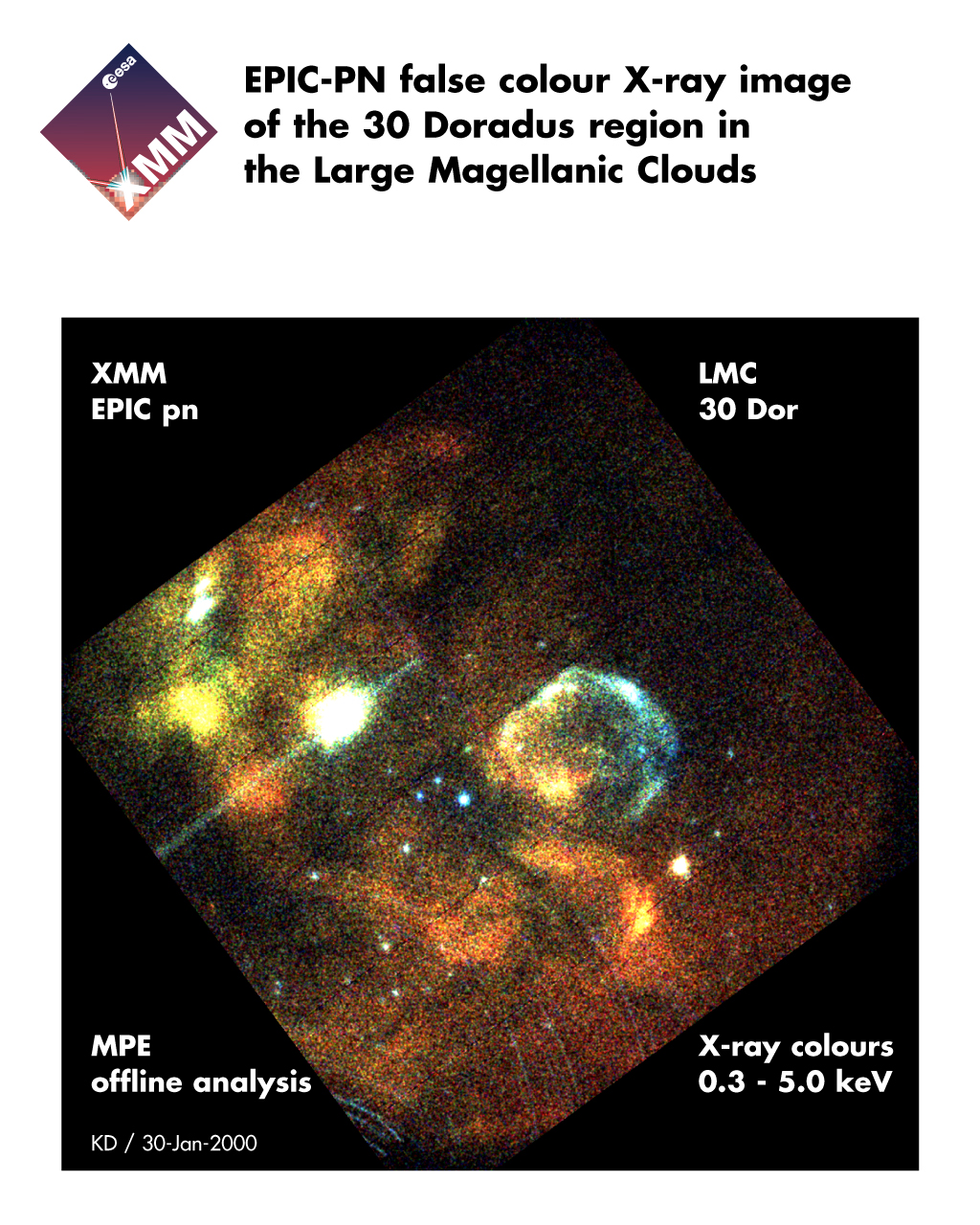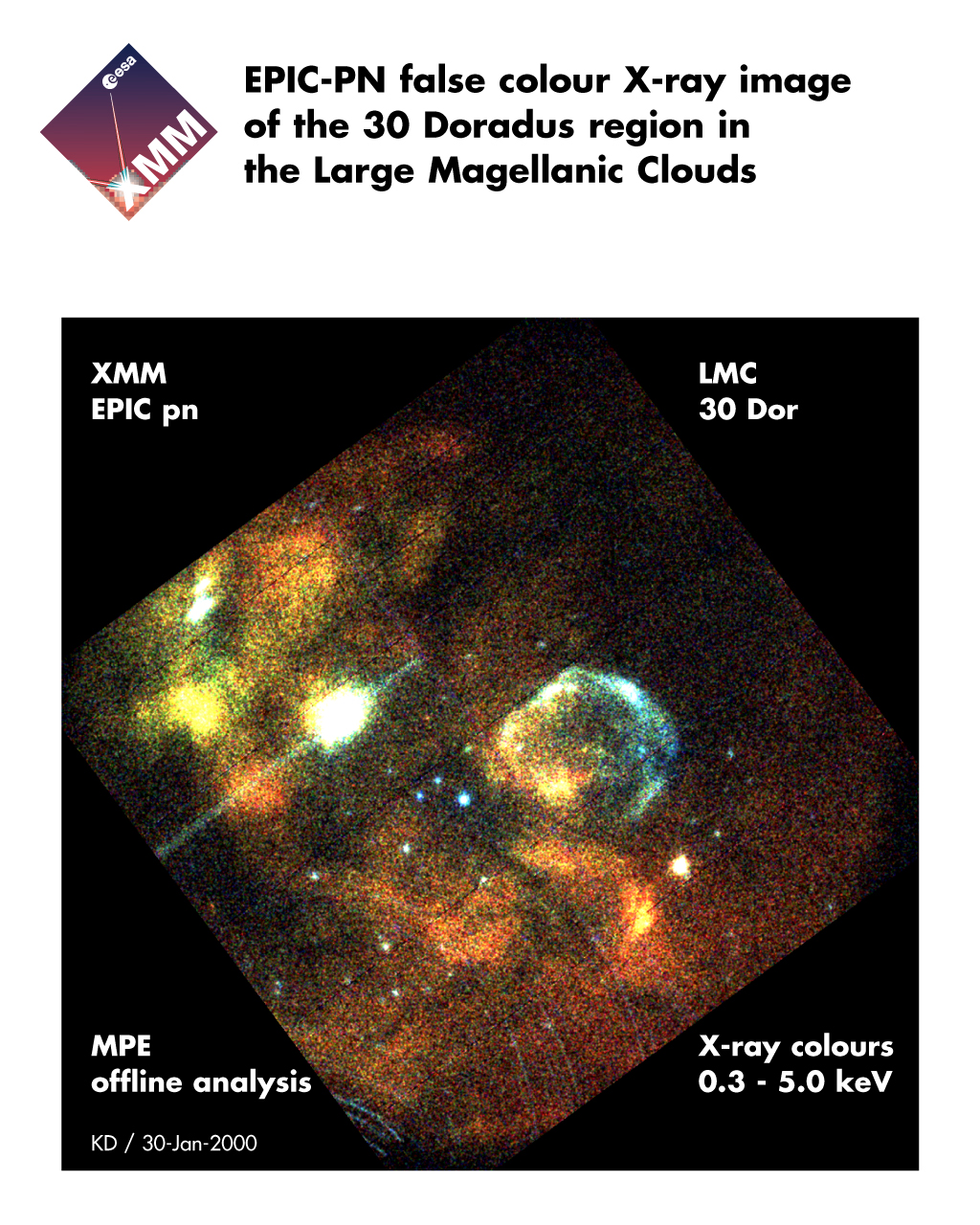
Recently the European Space Agency released this and other spectacular "first light" pictures from its new orbiting x-ray observatory, christened XMM-Newton. A churning region of star birth and death in our small neighboring galaxy, the Large Magellanic Cloud (LMC), this field was one of several chosen to test out XMM-Newton's x-ray imaging capabilities. The picture is a false-colour one in which low energy x-rays are translated to red, medium energy to green, and high energy to blue. Image colours therefore represent the relative million degree temperatures of the x-ray emitting regions, red being the coolest and blue the hottest. Remains of the star that exploded as Supernova 1987a appear here as the white x-ray source at the lower right, while another supernova remnant, cataloged as N157D is the brightest source at the upper left. The bluish arc (near center) also appears to be a supernova remnant whose expanding debris cloud is interacting with the LMC's local interstellar gas.
Recientemente, la Agencia Espacial Europea publicó esta y otras espectaculares imágenes de «primera luz» de su nuevo observatorio orbital de rayos X, bautizado XMM-Newton. Una región en ebullición de nacimiento y muerte estelar en nuestra pequeña galaxia vecina, la Gran Nube de Magallanes (GNM), fue uno de los varios campos elegidos para poner a prueba las capacidades de imagen en rayos X de XMM-Newton. La imagen es de falso color, en la que los rayos X de baja energía se representan en rojo, los de energía media en verde y los de alta energía en azul. Los colores de la imagen representan por tanto las temperaturas relativas de millones de grados de las regiones emisoras de rayos X, siendo el rojo el más frío y el azul el más caliente. Los restos de la estrella que explotó como Supernova 1987a aparecen aquí como la fuente blanca de rayos X en la parte inferior derecha, mientras que otro remanente de supernova, catalogado como N157D, es la fuente más brillante en la parte superior izquierda. El arco azulado (cerca del centro) también parece ser un remanente de supernova cuya nube de escombros en expansión interactúa con el gas interestelar local de la Gran Nube de Magallanes.