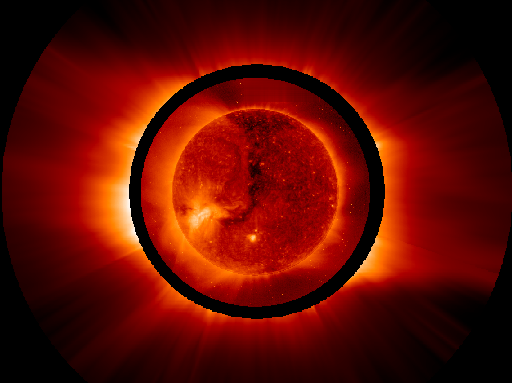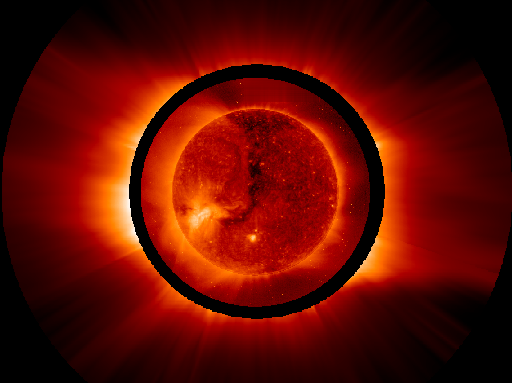
A wind from the Sun blows through our Solar System. The behaviour of comet tails as they flapped and waved in this interplanetary breeze gave astronomers the first hint of its existence. Streaming outward at 250-400 miles/second, electrons and ions boiling off the Sun's incredibly hot but tenuous corona account for the Solar Wind - now known to affect the Earth and other planets along with voyaging spacecraft. Rooted in the Solar Magnetic Field, the structure of the corona is visible extending a million miles above the Sun's surface in this composite image from the EIT and UVCS instruments onboard the SOHO spacecraft. The dark areas, known as coronal holes, represent the regions where the highest speed Solar Wind originates.
Un viento proveniente del Sol sopla a través de nuestro Sistema Solar. El comportamiento de las colas de los cometas, que ondeaban y se agitaban en esta brisa interplanetaria, dio a los astrónomos la primera pista de su existencia. Fluyendo hacia el exterior a velocidades de 250 a 400 millas por segundo, los electrones e iones que se desprenden de la corona solar —increíblemente caliente pero tenue— son los responsables del Viento Solar, conocido hoy en día por afectar a la Tierra y otros planetas, así como a las naves espaciales que viajan por el espacio. Enraizada en el Campo Magnético Solar, la estructura de la corona es visible extendiéndose más de un millón de millas sobre la superficie del Sol en esta imagen compuesta obtenida por los instrumentos EIT y UVCS a bordo de la nave espacial SOHO. Las áreas oscuras, conocidas como hoyos coronales, representan las regiones donde se origina el Viento Solar de mayor velocidad.