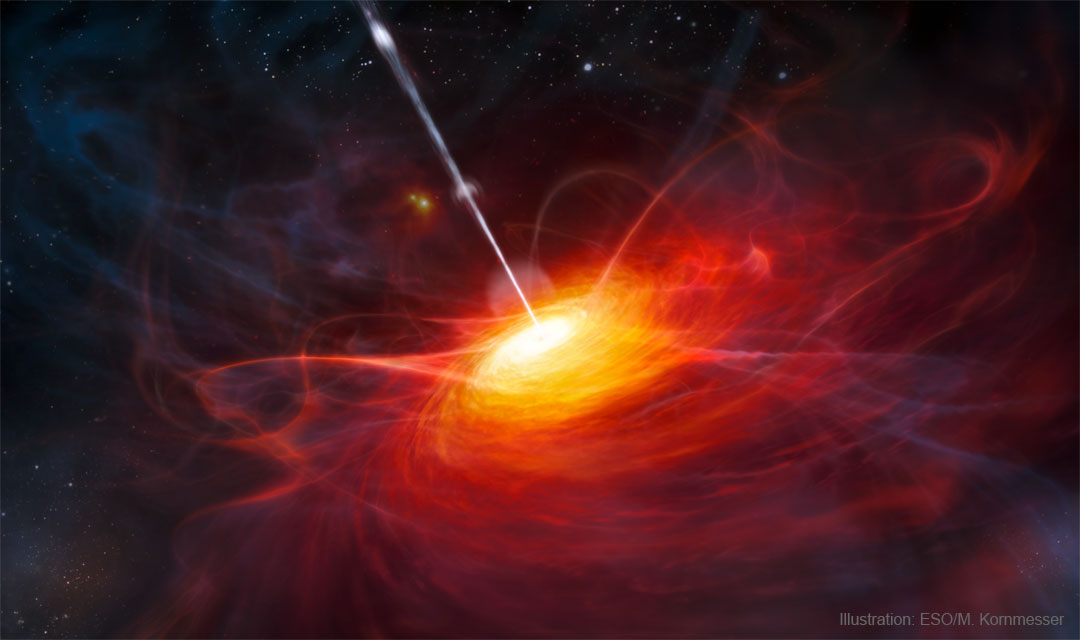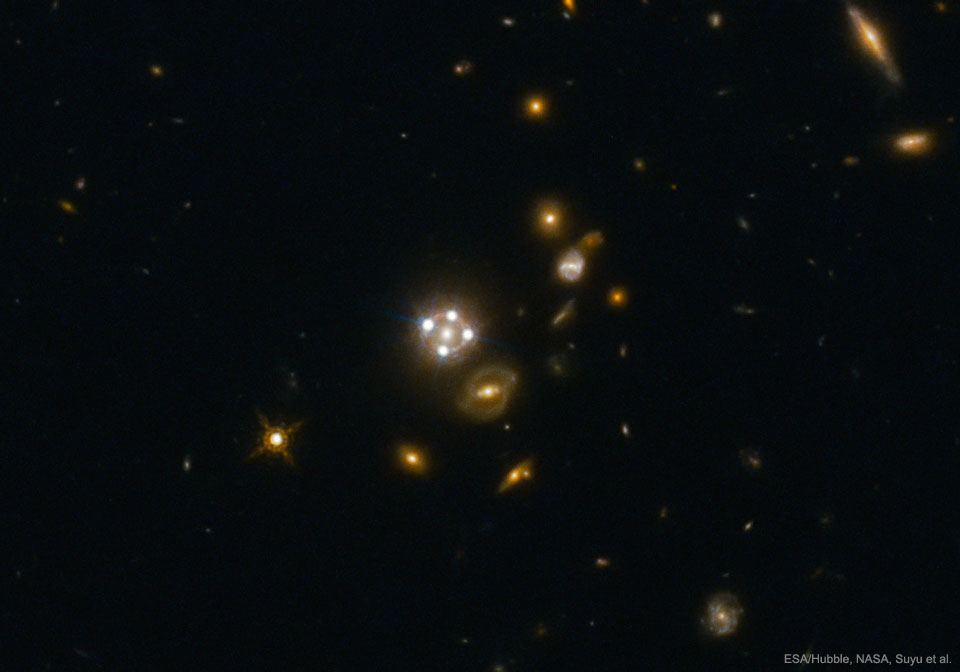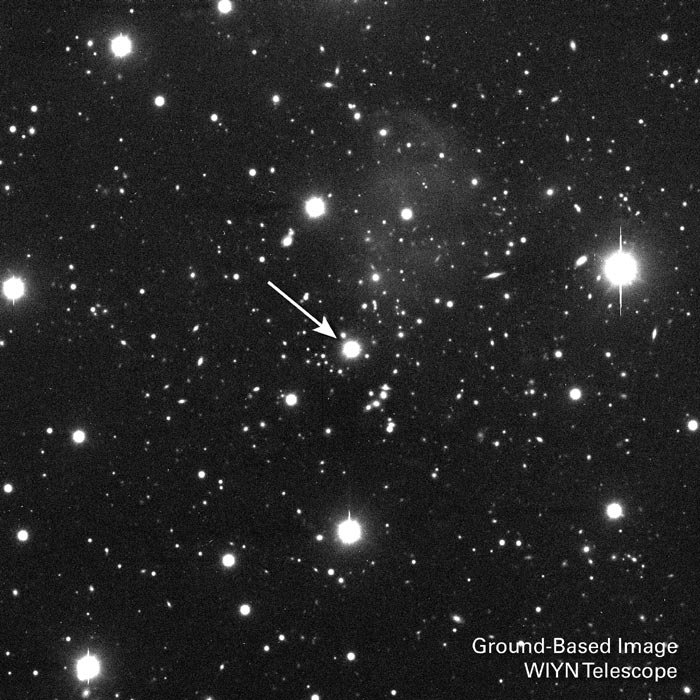
A quasar slightly depleted of a specific color of light may indicate that our universe is filled with massive amounts of ionized hydrogen. Light from QSO H1821+643, pictured above, comes to us from about a quarter of the way across the visible universe. Detailed analysis now indicates that a tiny amount of this quasar's light was absorbed by intervening ionized oxygen. Astronomers intuit that this oxygen is surely accompanied by much more abundant ionized hydrogen, which would otherwise be invisible. The oxygen is thus thought to be the tip of a tremendous iceberg, indicating a universe filled with proton and electron clouds so vast they likely exceed the mass of all the stars combined. Still, this is only a small part of the long-sought dark matter astronomers have been searching for. Our universe is thought to be filled with much more abundant, much stranger forms of dark matter.
Un cuásar con una ligera deficiencia en un color específico de luz podría indicar que nuestro universo está lleno de enormes cantidades de hidrógeno ionizado. La luz de QSO H1821+643, mostrada en la imagen, nos llega desde aproximadamente un cuarto del camino a través del universo visible. Un análisis detallado indica ahora que una pequeña cantidad de la luz de este cuásar fue absorbida por oxígeno ionizado interpuesto. Los astrónomos intuyen que este oxígeno va acompañado sin duda de hidrógeno ionizado mucho más abundante, que de otro modo sería invisible. Se cree, por tanto, que el oxígeno es la punta de un enorme iceberg, lo que indica un universo lleno de nubes de protones y electrones tan vastas que probablemente superan la masa de todas las estrellas combinadas. Aun así, esto es solo una pequeña parte de la tan buscada materia oscura que los astrónomos han estado investigando. Se cree que nuestro universo está lleno de formas de materia oscura mucho más abundantes y mucho más extrañas.