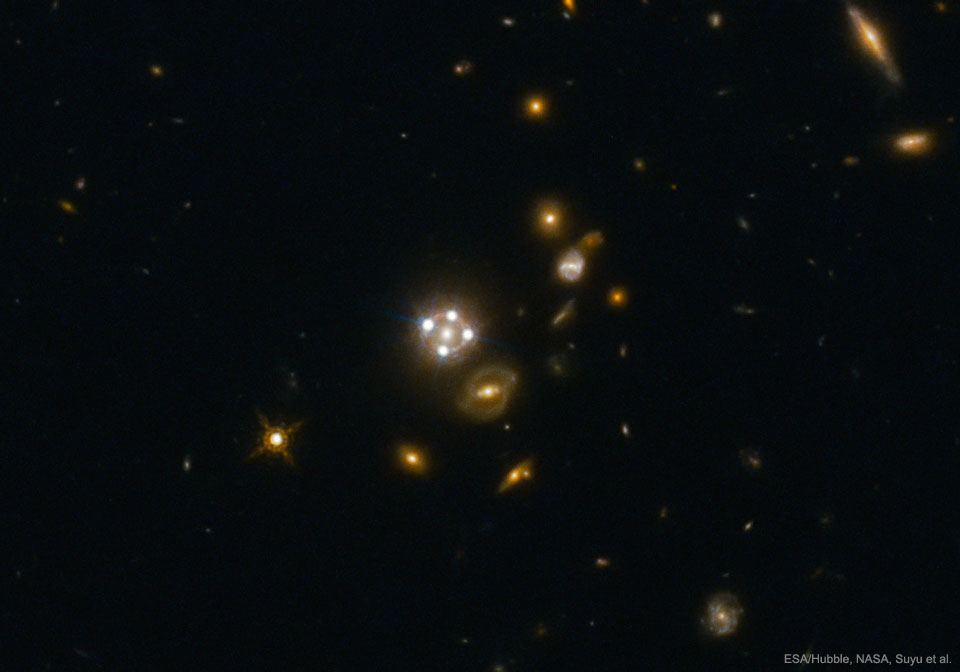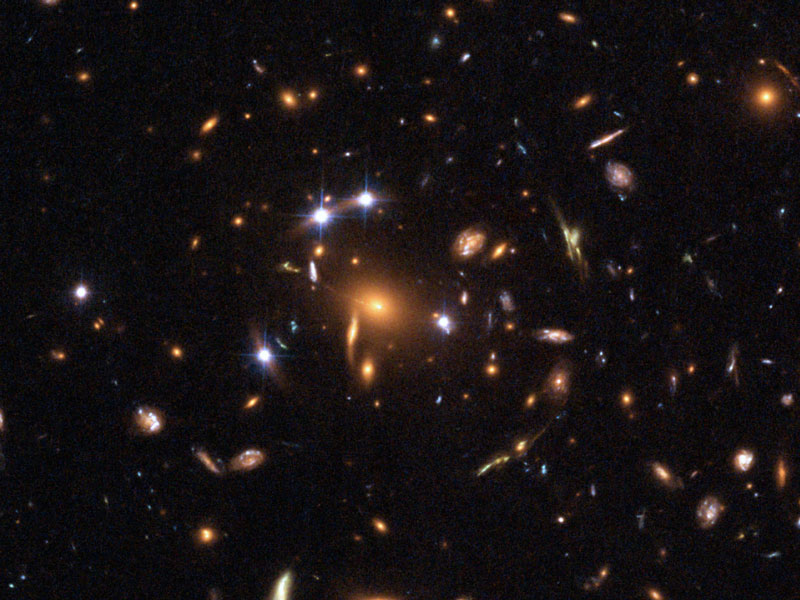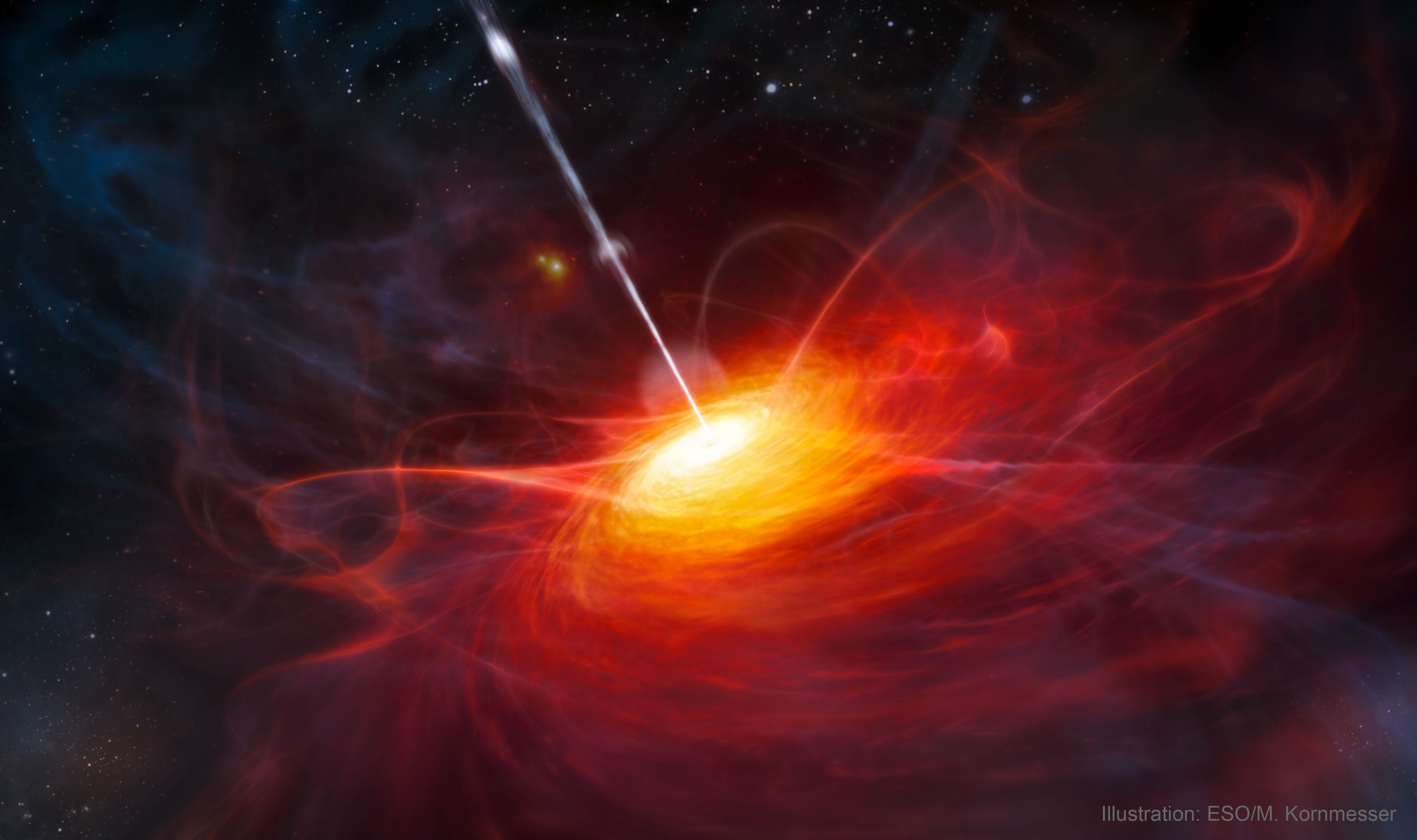
What did the first quasars look like? The nearest quasars are now known to involve supermassive black holes in the centers of active galaxies. Gas and dust that falls toward a quasar glows brightly, sometimes outglowing the entire home galaxy. The quasars that formed in the first billion years of the universe are more mysterious, though. Featured, recent data has enabled an artist's impression of an early-universe quasar as it might have been: centered on a massive black hole, surrounded by sheets of gas and an accretion disk, and expelling a powerful jet. Quasars are among the most distant objects we see and give humanity unique information about the early and intervening universe. The oldest quasars currently known are seen at just short of redshift 8 -- only 700 million years after the Big Bang -- when the universe was only a few percent of its current age.
¿Cómo lucían los primeros quásares? Los quásares más cercanos son ahora conocidos por involucrar agujeros negros supermasivos en los centros de galaxias activas. El gas y el polvo que cae hacia un quásar brillan intensamente, a veces superando el brillo de toda su galaxia anfitriona. Sin embargo, los quásares que se formaron en los primeros mil millones de años del universo son más misteriosos. En esta ilustración, datos recientes han permitido una representación artística de un quásar del universo primitivo tal como podría haber sido: centrado en un agujero negro masivo, rodeado por capas de gas y un disco de acreción, y expulsando un potente chorro. Los quásares son entre los objetos más distantes que observamos y proporcionan a la humanidad información única sobre el universo temprano y el que interviene entre nosotros y ellos. Los quásares más antiguos conocidos actualmente se observan a un desplazamiento al rojo cercano a 8 — solo 700 millones de años después del Big Bang — cuando el universo tenía apenas un par de por ciento de su edad actual.