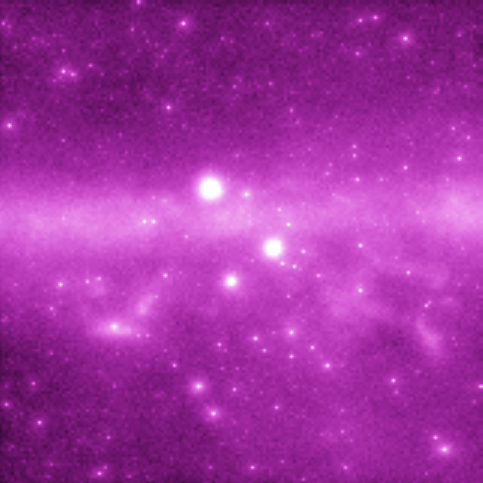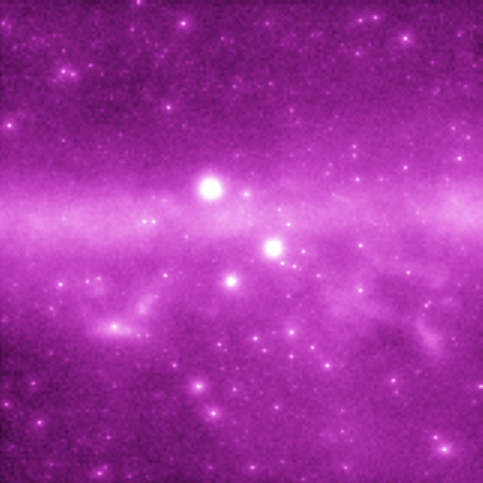
What shines in the gamma-ray sky? This simulated image models the intensities of gamma rays with over 40 million times the energy of visible light, and represents how the sky might appear to the Gamma-ray Large Area Space Telescope (GLAST) after its first year in orbit. Familiar steady stars are absent from the dramatic 80x80 degree field which looks directly away from the center of the Galaxy. Instead, the Geminga and Crab pulsars - bizarre, spinning stellar corpses known to be neutron stars - are the two brightest gamma-ray sources. These and other gamma-ray bright objects in the field, monstrous active galaxies and still unknown sources, have been detected by the Energetic Gamma-Ray Experiment Telescope (EGRET) on the orbiting Compton Gamma-Ray Observatory. However, most of the simulated sources are new - extrapolating current ideas and anticipating discoveries resulting from GLAST's improved gamma-ray vision. The central broad band of faint gamma-ray emission is due to high-energy cosmic rays colliding with interstellar gas in the outer spiral arms of the Milky Way, while below is a diffuse energetic glow from prominent molecular clouds in Monoceros, Orion, Auriga, and Taurus. Intended to explore extreme environments in the distant cosmos and planned for launch in 2005, GLAST is under development by NASA, U.S., and international partners.
¿Qué brilla en el cielo de rayos gamma? Esta imagen simulada modela las intensidades de los rayos gamma con más de 40 millones de veces la energía de la luz visible, y representa cómo podría aparecer el cielo ante el Telescopio Espacial de Gran Área para Rayos Gamma (GLAST, por sus siglas en inglés) después de su primer año en órbita. Las estrellas estables que nos resultan familiares están ausentes en este dramático campo de 80x80 grados que apunta directamente en dirección opuesta al centro de la Galaxia. En cambio, los púlsares Geminga y Cangrejo —cadáveres estelares giratorios y extraordinarios, conocidos por ser estrellas de neutrones— son las dos fuentes de rayos gamma más brillantes. Estos y otros objetos brillantes en rayos gamma presentes en el campo, galaxias activas de proporciones monstruosas y fuentes aún desconocidas, han sido detectados por el Telescopio de Experimentos de Rayos Gamma Energéticos (EGRET) a bordo del Observatorio de Rayos Gamma Compton en órbita. Sin embargo, la mayoría de las fuentes simuladas son nuevas, extrapolando las ideas actuales y anticipando descubrimientos que resultarán de la mejorada visión de rayos gamma del GLAST. La amplia banda central de débil emisión de rayos gamma se debe a rayos cósmicos de alta energía que colisionan con el gas interestelar en los brazos espirales exteriores de la Vía Láctea, mientras que en la parte inferior se observa un resplandor energético difuso proveniente de prominentes nubes moleculares en Monoceros, Orión, Auriga y Tauro. Diseñado para explorar entornos extremos en el cosmos distante y planeado para su lanzamiento en 2005, el GLAST está siendo desarrollado por la NASA, socios estadounidenses e internacionales.