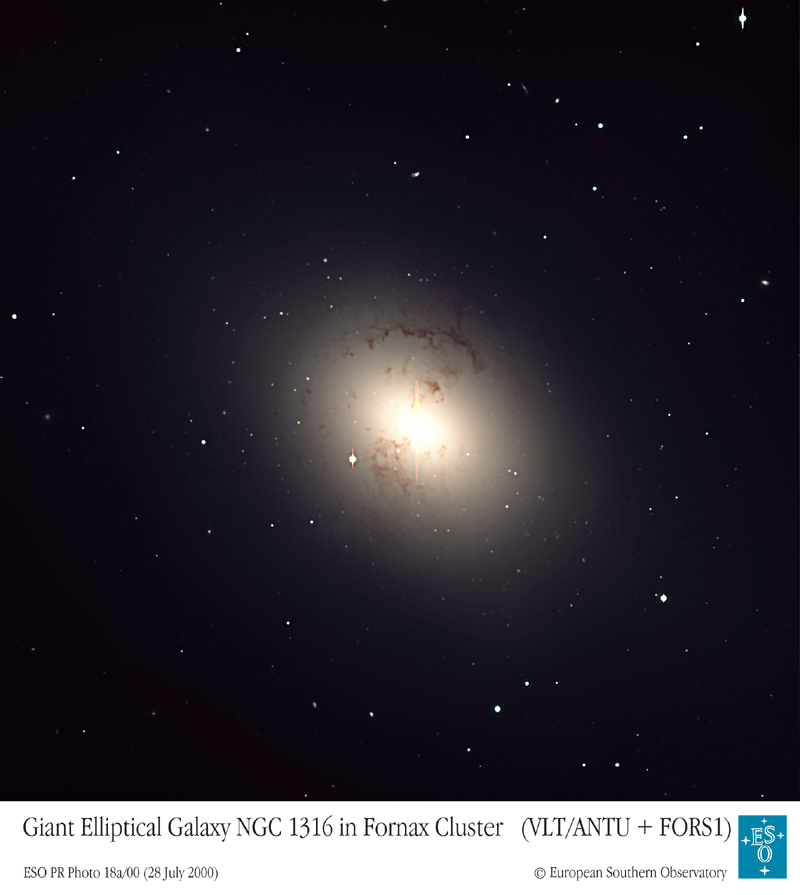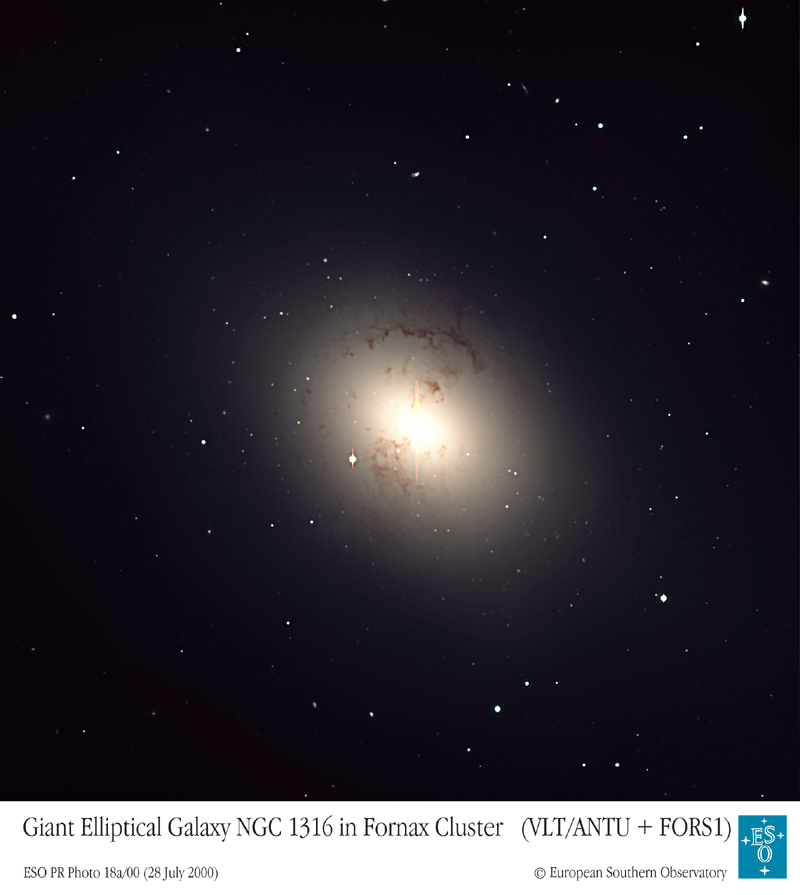
Can unusual giant galaxy NGC 1316 help calibrate the universe? Quite possibly -- if it turns out this atypical galaxy is composed of typical stars. NGC 1316, pictured above, is most obviously strange because it has a size and shape common for an elliptical galaxy but dust lanes and a disk more commonly found in a spiral galaxy. These attributes could be caused by interactions with another galaxy over the past billion years. Most recently, NGC 1316 has been monitored to find novae, explosions emanating from white dwarf stars that should have a standard brightness. Again, NGC 1316 was found atypical in that the nova rate was unexpectedly high. If, however, the stars and white dwarfs that compose NGC 1316 are typical, then the novae observed should be just as bright as novae in other galaxies so that astronomers can use them to compute an accurate distance. This distance can then be used to calibrate other distance indicators and result in a more accurate scale for distances throughout the universe.
¿Puede la inusual galaxia gigante NGC 1316 ayudar a calibrar el universo? Es bastante posible, si resulta que esta galaxia atípica está compuesta de estrellas típicas. NGC 1316, fotografiada arriba, es visiblemente peculiar porque posee un tamaño y una forma propios de una galaxia elíptica, pero con carriles de polvo y un disco que se encuentran más comúnmente en una galaxia espiral. Estos atributos podrían ser consecuencia de interacciones con otra galaxia durante el último mil millones de años. Más recientemente, NGC 1316 ha sido monitoreada para detectar novas: explosiones originadas en enanas blancas que deberían tener un brillo estándar. Una vez más, NGC 1316 resultó atípica, ya que la tasa de novas fue inesperadamente alta. Sin embargo, si las estrellas y enanas blancas que componen NGC 1316 son típicas, entonces las novas observadas deberían ser igual de brillantes que las novas en otras galaxias, lo que permitiría a los astrónomos calcular una distancia precisa. Esta distancia podría entonces utilizarse para calibrar otros indicadores de distancia y obtener una escala más exacta de las distancias a lo largo del universo.