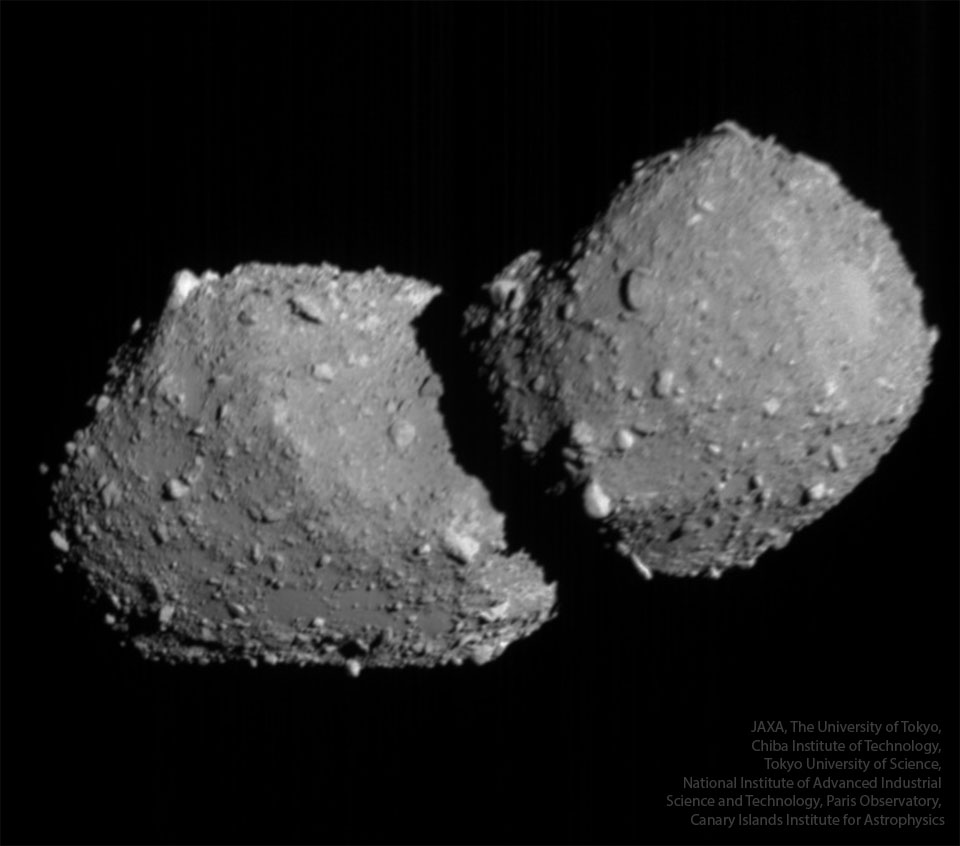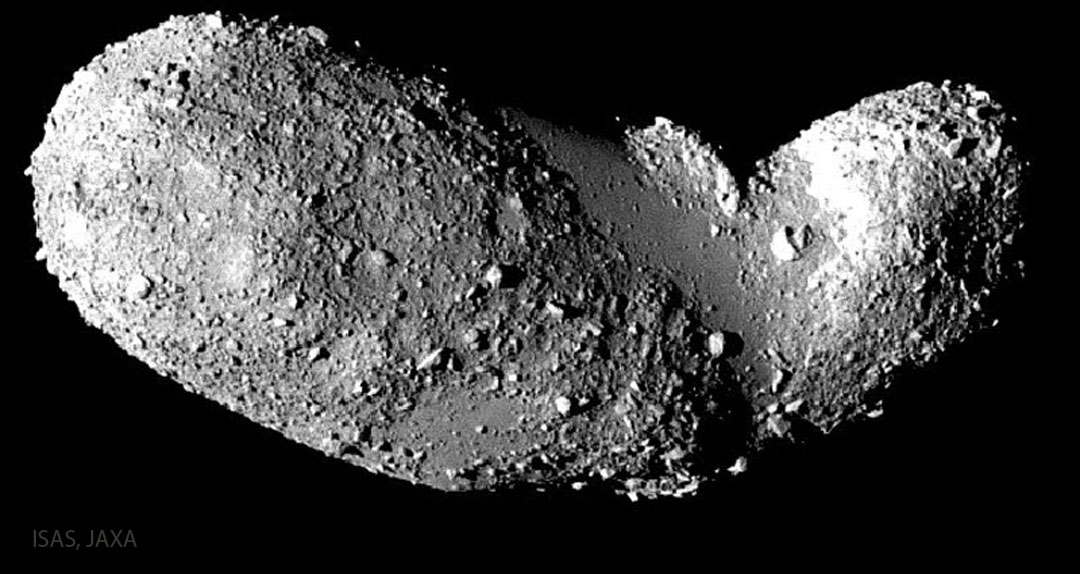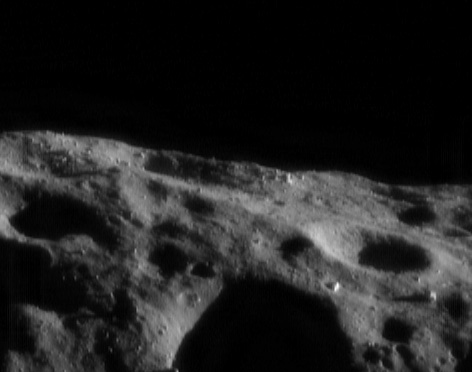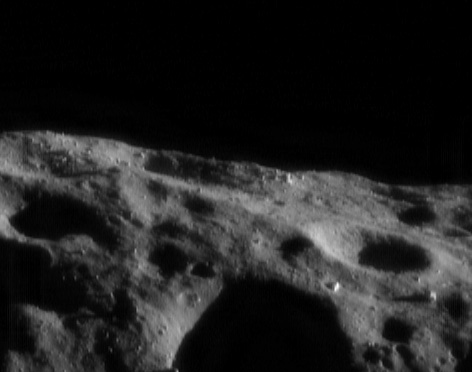
Gleaming in the rays of the setting sun, boulders litter the rugged surface of asteroid 433 Eros. The brightest boulder, at the edge of the large, shadowy crater near this picture's bottom center, is about 30 meters (100 feet) across. In orbit around Eros since February 2000, the NEAR Shoemaker spacecraft's camera recorded the dramatic view earlier this month from an altitude of about 50 kilometers. Eros itself orbits the Sun with a perihelion of 1.13 Astronomical Units (AU) and aphelion of 1.78 AU. Part of a class of near-Earth asteroids, it spends much of its time between the orbits of Mars (at 1.5 AU) and Earth (at 1 AU) ... but it wasn't always that way. Eros and other near-Earth asteroids originally orbited in the main asteroid belt, between Jupiter and Mars. Over time, the gravitational influence of Jupiter and other planets perturbed their orbits sending them on trajectories closer to Earth.
Brillando bajo los rayos del sol poniente, bloques rocosos cubren la accidentada superficie del asteroide 433 Eros. El bloque más brillante, situado en el borde del gran cráter sombreado cerca del centro inferior de esta imagen, mide aproximadamente 30 metros de diámetro. En órbita alrededor de Eros desde febrero de 2000, la cámara de la nave espacial NEAR Shoemaker registró esta dramática vista a principios de este mes desde una altitud de aproximadamente 50 kilómetros. El propio Eros orbita el Sol con un perihelio de 1,13 Unidades Astronómicas (UA) y un afelio de 1,78 UA. Como parte de la clase de asteroides cercanos a la Tierra, pasa gran parte de su tiempo entre las órbitas de Marte (a 1,5 UA) y la Tierra (a 1 UA)... aunque no siempre fue así. Eros y otros asteroides cercanos a la Tierra orbitaban originalmente en el cinturón principal de asteroides, entre Júpiter y Marte. Con el tiempo, la influencia gravitacional de Júpiter y otros planetas perturbó sus órbitas, enviándolos a trayectorias más cercanas a la Tierra.