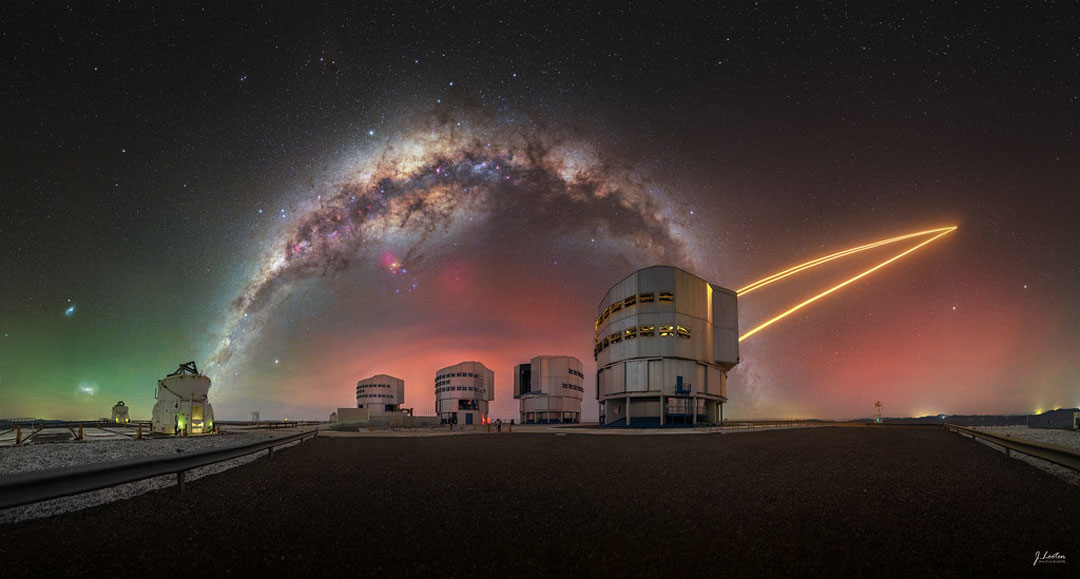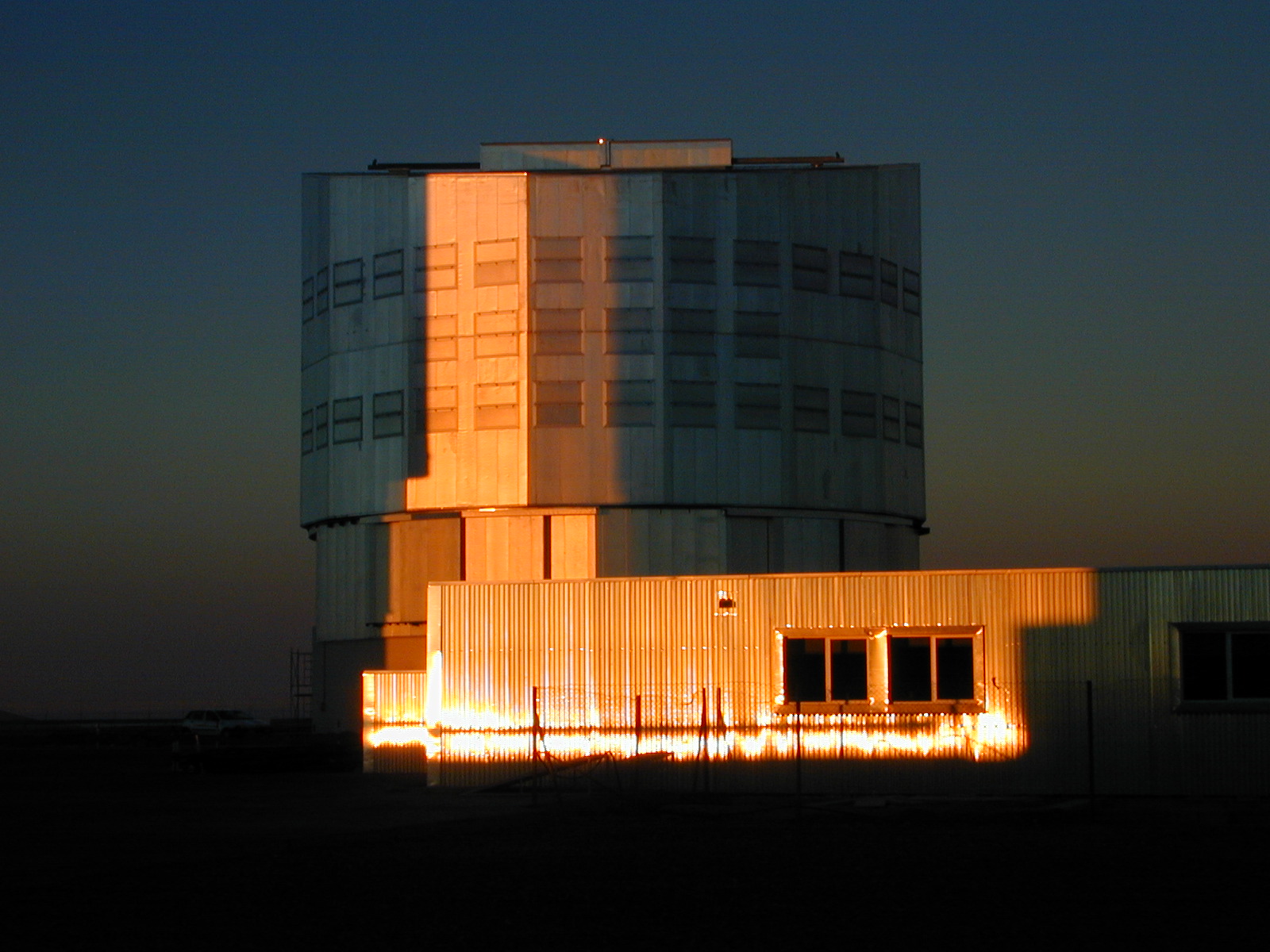
Pictured above on September 3rd, the enclosure for the 8.2 meter telescope christened Yepun glints dramatically in the light of the setting sun. Later that evening, under dark skies at Paranal Observatory, Chile, astronomers and engineers successfully captured Yepun's first light images, making Yepun the fourth and final unit of the European Southern Observatory's Very Large Telescope (VLT) array to reach this milestone. Ultimately, the light from the three other 8.2 meter unit telescopes (Antu, Kueyen, and Melipal) will be combined with Yepun's to achieve an effective aperture of 16.4 meters -- creating the world's largest optical telescope. But the next major step will be to combine beams from two of the telescopes creating an interferometer. The upper part of the mostly subterranean interferometer lab is the building in front of the telescope enclosure. The VLT unit telescope names have been taken from the Mapuche language. Originally thought to refer to the bright star Sirius, the word Yepun is now believed by linguists to mean Venus or evening star.
En la imagen del 3 de septiembre, la cúpula del telescopio de 8,2 metros bautizado Yepun destella de manera espectacular bajo la luz del sol poniente. Más tarde esa misma noche, bajo los cielos oscuros del Observatorio Paranal, en Chile, astrónomos e ingenieros capturaron con éxito las primeras imágenes de Yepun, convirtiendo a este instrumento en la cuarta y última unidad del conjunto Very Large Telescope (VLT) del Observatorio Europeo Austral (ESO) en alcanzar este hito. En última instancia, la luz de los otros tres telescopios unitarios de 8,2 metros (Antu, Kueyen y Melipal) se combinará con la de Yepun para lograr una apertura efectiva de 16,4 metros, creando así el telescopio óptico más grande del mundo. El siguiente gran paso consistirá en combinar los haces de luz de dos de los telescopios para crear un interferómetro. La parte superior del laboratorio interferométrico, que es en su mayor parte subterráneo, corresponde al edificio situado frente a la cúpula del telescopio. Los nombres de los telescopios unitarios del VLT han sido tomados del idioma mapuche. Originalmente se pensaba que la palabra Yepun hacía referencia a la brillante estrella Sirio, pero los lingüistas creen actualmente que significa Venus o estrella vespertina.