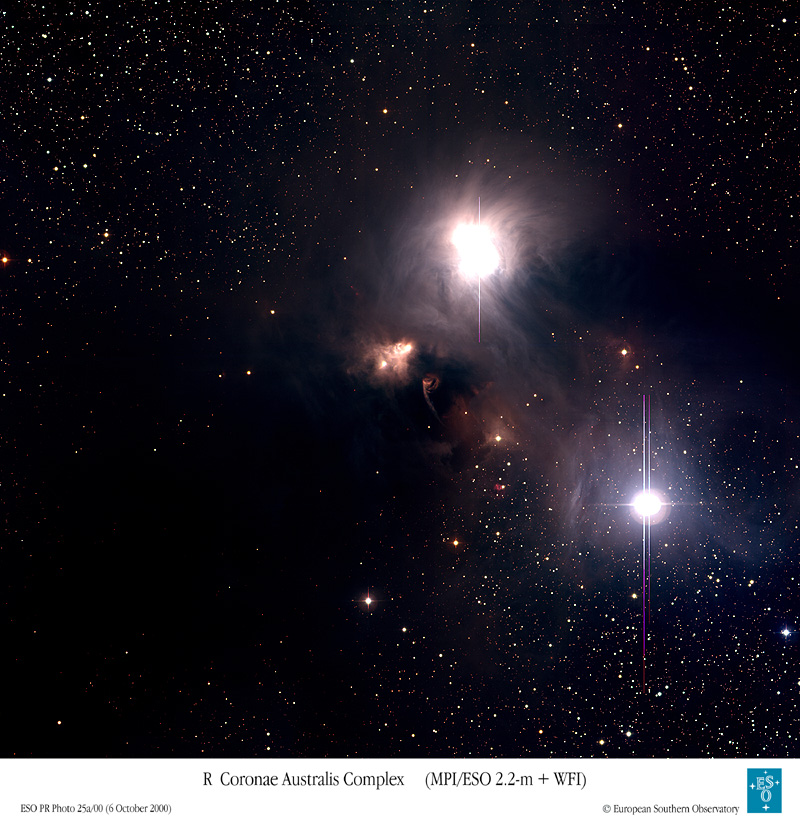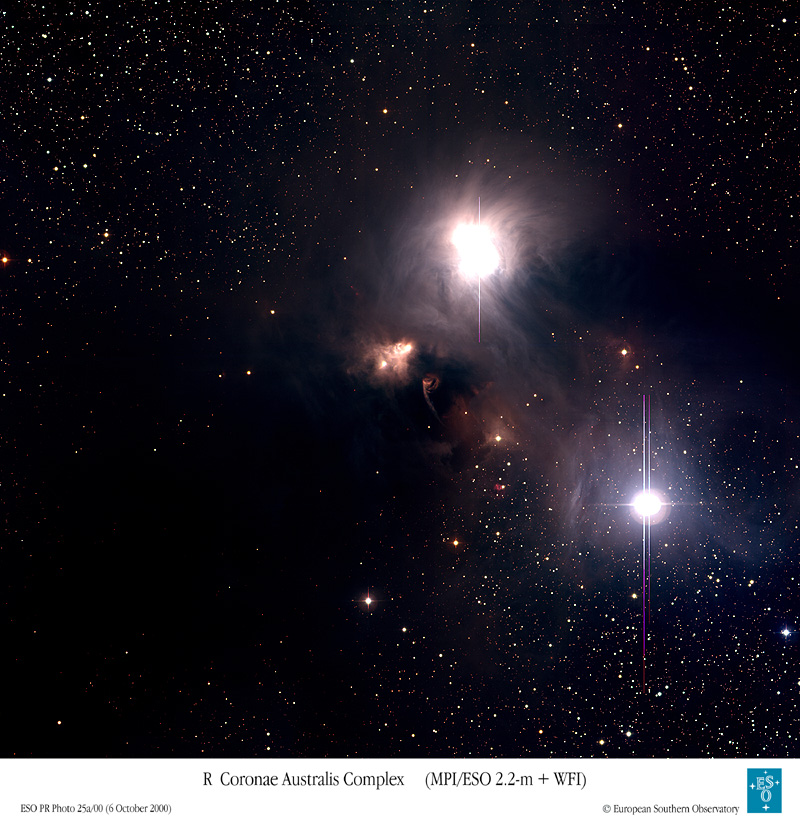
Young star R Coronae Australis has a dusty home. The dust is so thick on the upper left of the above photograph that little light from background stars comes through. Thinner dust near the stars reflects light from R Coronae Australis (upper right) and neighbor TY Coronae Australis, giving their surroundings a flowing appearance. Were these stars more massive they would emit light energetic enough to ionize much of the nearly invisible surrounding hydrogen gas, causing it to appear bright red. The unusual structure above the center is a Herbig-Haro object, a knot of gas ejected from the star that has impacted surrounding gas. R Coronae Australis is about 500 light-years away, while the region shown is about four light years across.
La joven estrella R Coronae Australis tiene un hogar polvoriento. El polvo es tan denso en la parte superior izquierda de la fotografía que apenas llega luz de las estrellas de fondo. El polvo más tenue cercano a las estrellas refleja la luz proveniente de R Coronae Australis (arriba a la derecha) y de su vecina TY Coronae Australis, otorgando a sus alrededores una apariencia fluida y ondulante. Si estas estrellas fueran más masivas, emitirían luz con suficiente energía para ionizar gran parte del gas de hidrógeno circundante, casi invisible, haciendo que apareciera de color rojo brillante. La estructura inusual que se observa sobre el centro es un objeto Herbig-Haro, un nudo de gas eyectado desde la estrella que ha impactado el gas circundante. R Coronae Australis se encuentra a unos 500 años-luz de distancia, mientras que la región mostrada abarca aproximadamente cuatro años-luz de diámetro.