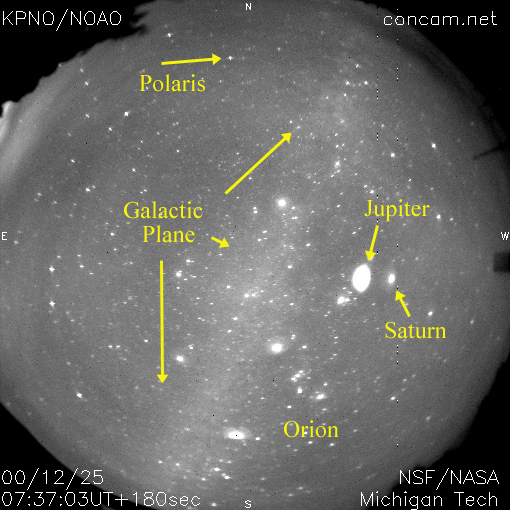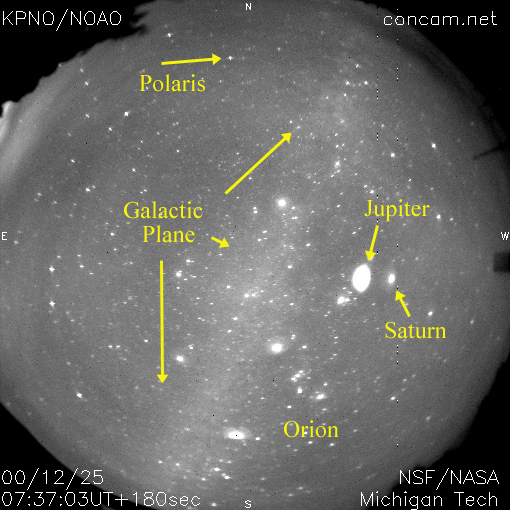
If you could watch the sky for an entire night, what would you see? The above time-lapse sequence from the CONtinuous CAMera (CONCAM) project shows the answer for the skies above Kitt Peak National Observatory on 2000 December 23. First and foremost stars appear to orbit about Polaris, a star near the top of the image. Actually, the Earth is spinning under the sky, and the camera is affixed to the Earth. The diffuse band of light that moves across the image is actually the central disk of our Milky Way Galaxy. Identifiable objects rotating across the frame include the constellation of Orion, stars such as Sirius and Betelgeuse, and planets such as Jupiter and Saturn. The CONCAM project is deploying astronomical quality web-cameras to major observatories with goals of starting a continuous record of the sky and helping astronomers using large telescopes monitor weather conditions remotely.
Si pudieras observar el cielo durante una noche completa, ¿qué verías? La secuencia de lapso de tiempo anterior del proyecto CONtinuous CAMera (CONCAM) muestra la respuesta para los cielos sobre el Observatorio Nacional de Kitt Peak el 23 de diciembre de 2000. Ante todo, las estrellas parecen orbitar alrededor de Polaris, una estrella cerca de la parte superior de la imagen. En realidad, la Tierra gira bajo el cielo, y la cámara está fija a la Tierra. La banda de luz difusa que se mueve a través de la imagen es en realidad el disco central de nuestra Galaxia Vía Láctea. Los objetos identificables que rotan a través del marco incluyen la constelación de Orión, estrellas como Sirio y Betelgeuse, y planetas como Júpiter y Saturno. El proyecto CONCAM está desplegando cámaras web de calidad astronómica en los principales observatorios con el objetivo de iniciar un registro continuo del cielo y ayudar a los astrónomos que utilizan grandes telescopios a monitorear las condiciones climáticas de forma remota.